The lamp is alive: four bio art works lit by living organisms
Four works — bacterial drawings, a mirrored plankton cube, a breath-fed algal installation and a couture gown of living algae — in which the light is made by an organism rather than a bulb, and often set off by a visitor's own body.
Stir a body of seawater at night and it can answer with light. The flash comes from single-celled organisms called dinoflagellates, which react to the water being disturbed around them by firing a brief blue pulse — a reflex marine species use for camouflage, protection and communication 1. Seen once, in a jar, that pulse is almost nothing. Multiplied by millions, it becomes a light source.
This week's curation gathers four works in which the light is not switched on but produced: by bacteria growing across petri dishes, by plankton answering a heartbeat, by algae fed on a visitor's breath, and by algae worn on a body. In three of the four, the trigger is human — a pulse, a breath, a movement — so the glow reads less like an effect of the artwork than like a reply to the person standing in front of it.
Hunter Cole: Living Light
- Artist: Hunter Cole, an artist and geneticist based in New Orleans 2
- Year: The bioluminescent series surveyed in her solo exhibitions run from 2005 to 2017; a new one-night installation, MOON GLOW, is scheduled for 22 October 2026 23
- Medium and materials: A marine bacterium of the kind that lives in fish guts, grown on agar and in liquid culture medium inside petri dishes, and photographed by its own light 4
- Biological process: Cole paints controlled line drawings onto the dishes with living bacteria, then lets the colonies grow 4. Each drawing shines brightest at peak growth and then dims, because the bacteria are consuming the nutrients in the dish and dying off over roughly two weeks 24. The image is therefore unstable by design: in the diptych Rabbit, the rooster visible on the left of the brightest frame has turned into a wolf by the time some of the bacteria have died 4.
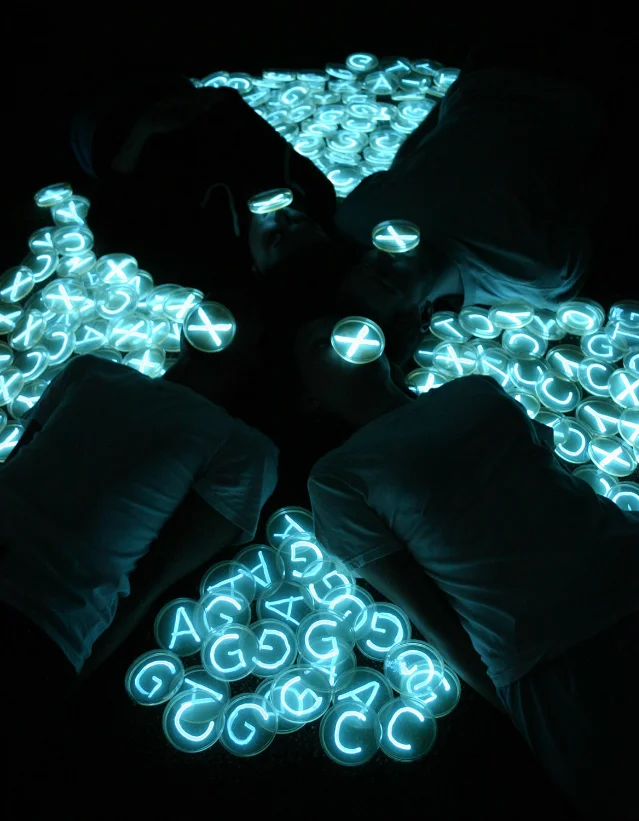
- Visual presence: Every photograph is lit only by the organisms, so a blue-green glow carries the whole picture and everything else falls into black. In X Chromosome, four people lie in the shape of an X while the letters of the DNA alphabet — A, T, G, C — and stray Xs and Ys shine out of the dishes around them; Cole has described the piece as a homage to Suzanne Anker's Difference and Repetition 4.
- Documented context: Her bioluminescent work has been shown in survey exhibitions covering 2005 to 2017 3. MOON GLOW — a one-day installation built around the phases of the moon and constellations, with living drawings that glow blue-green and fade as their nutrients run out — takes place at Studio 503 in Greensboro, North Carolina, on 22 October 2026 2.
- Original source: Project details and exhibition history are published on Hunter Cole's site.
Iyvone Khoo: Infinity Cube
- Artist: Iyvone Khoo, in collaboration with the marine biologist Dr Michael Latz of Scripps Institution of Oceanography 1
- Year: 2017 1
- Medium and materials: Single-celled dinoflagellates filmed under magnification, video projection, an eight-foot mirrored cube, and a soundscape 1
- Biological process: The algae in the footage are reacting. Khoo filmed dinoflagellates responding to a human heartbeat, to music, to water flow and to air pressure, and the projection plays those responses back at architectural scale 1. Khoo describes the raw material as barely there until it is provoked: "When we look at the algae with our naked eye, it's a very tiny dot of light that will glow when stimulated by sound or mechanical stimulation — like souls they are invisible until they manifest" 1.
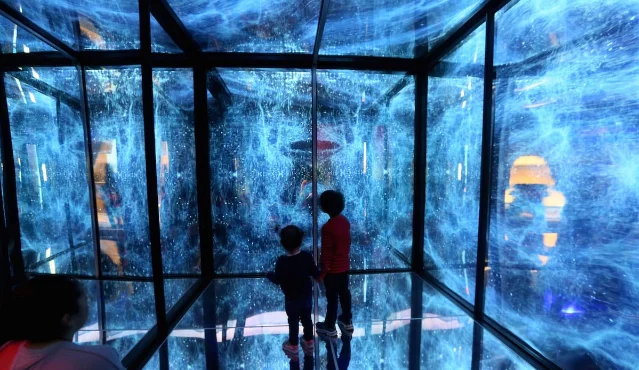
- Visual presence: Visitors step inside the cube rather than around it. Blue-white light moves across the mirrored walls and floor like water in motion, the reflection doubles the volume, and the viewers themselves become part of the picture — an arrangement Khoo has acknowledged as a nod to Yayoi Kusama's mirror rooms 1.
- Documented context: Infinity Cube opened at Birch Aquarium at Scripps Institution of Oceanography in 2017, funded by Rick and Patty Elkus with additional support from the National Science Foundation for the interpretative component 1. Scripps treated it as its first public commission to communicate science through art 1. No current presentation is listed.
- Original source: The Artlyst report documents the commission, the collaborators and the filmed material.
Studio Blue Green: Phycologica
- Artist: Studio Blue Green, the Bristol biodesign studio of Jon Somerscales and Andrew Stone 5
- Year: 2025, restaged in 2026 5
- Medium and materials: Living microalgae of the species Pyrocystis lunula held in an array, film projection, sound, and a breath interface that takes what visitors exhale 5
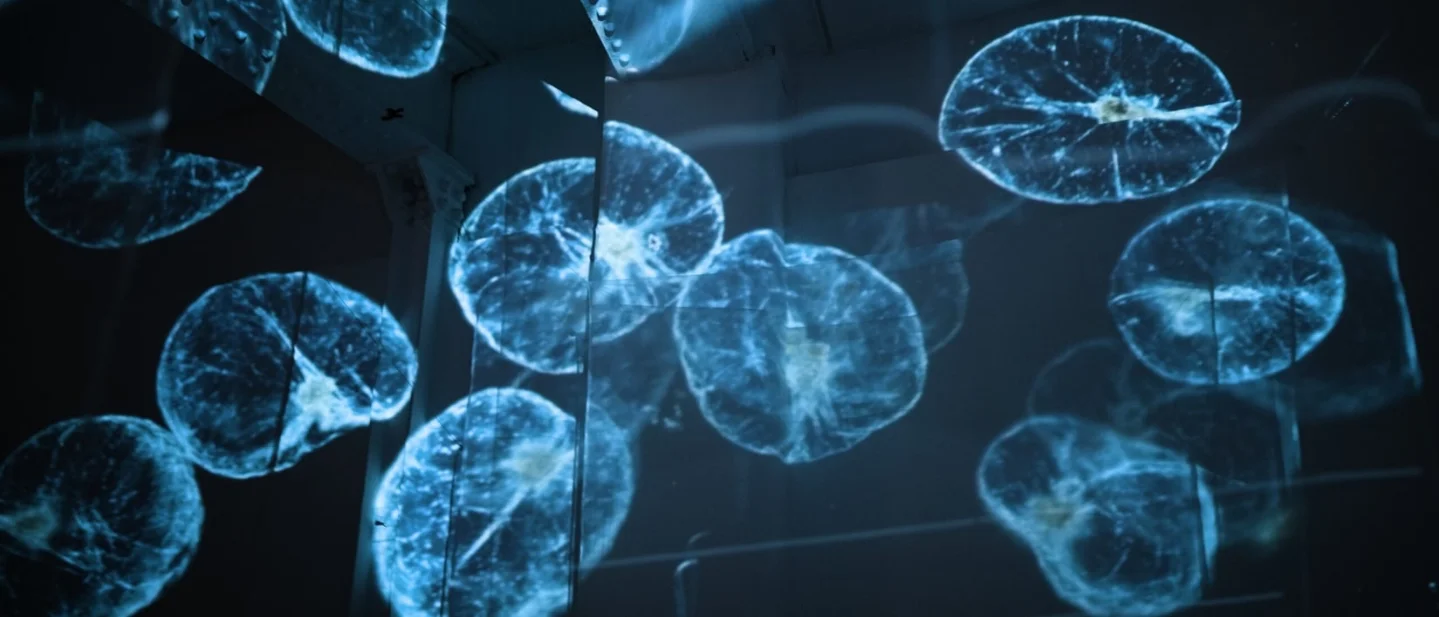
- Biological process: Visitors exchange breath with the algae: the carbon dioxide they exhale is absorbed by the array, and the installation answers with light and sound 5. The pulses in the film were not simulated — they are records of real algae responding to sound frequencies 5. The studio frames the exchange as photosynthesis made tangible: algae take in carbon dioxide and give back oxygen and biomass 5.
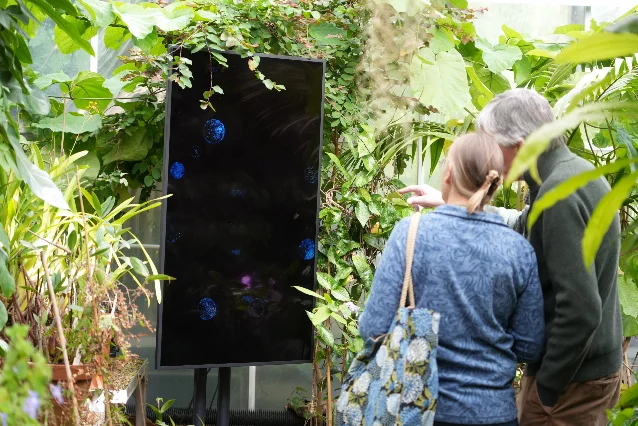
- Visual presence: The installation is deliberately dark so the organisms can be the brightest thing in the room. In the 2025 gallery version, large translucent blue cells drift and pulse across the walls; in the 2026 glasshouse version a single vertical screen stands among palms, holding a scatter of small glowing bodies against black while visitors lean in to watch them move 5.
- Documented context: Phycologica ran at Centrespace gallery in Bristol in October 2025, and was presented again as Phycologica: Reconnecting with our algal kin at Bristol Botanic Gardens in June 2026, inside the glasshouse, as part of Reclaiming Hope, Removing Carbon 5. No current presentation is listed.
- Original source: The project is documented on the CO₂RE artist page.
Iris van Herpen: The Living Look (Sympoiesis)
- Artist: Iris van Herpen, with the biodesigner Chris Bellamy 6
- Year: 2025 67
- Medium and materials: 125 million bioluminescent algae, grown in seawater over several months, encapsulated in a specialised nutrient gel and shaped into a translucent protective membrane; humidity, temperature and circadian rhythm are held to conditions matching the organisms' marine habitat 6
- Biological process: The algae are the species Pyrocystis lunula, and they emit light in response to movement and touch 6. Light therefore follows the body wearing the garment rather than the garment's surface pattern: the house describes the piece as cultivated rather than constructed, and as sustained by a continuing relationship with the living material 6.
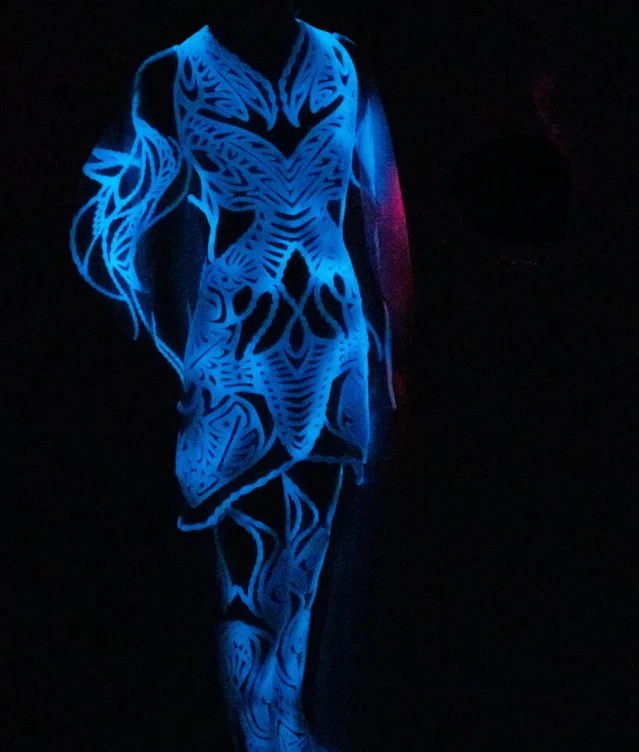
- Visual presence: On a fully black stage, a long gown lights up in electric blue. The glow picks out a branching, lace-like structure of cut openings and veins, layered under sheer fabric that catches a rim of warmer light from the biosphere portal by Nick Verstand that the model, Stella Maxwell, walked inside 6.
- Documented context: The Living Look was unveiled during Paris Couture Week in July 2025 as the centrepiece of the Sympoiesis haute couture collection 7. Because the garment is alive, it cannot simply be stored between shows; the nutrient chamber that keeps it is described as a microcosm of the ocean's balance 6.
- Original source: The house's own record of the work, including the growing process, is at The Living Look, Iris van Herpen.
Light that has to be kept alive
Put the four side by side and a pattern appears that none of them states on its own. Each work outsources the lamp to an organism, and three of them hand the switch to a visitor: Khoo's plankton answer a recorded heartbeat, Studio Blue Green's algae answer a breath, van Herpen's answer a moving body. Only Cole's bacteria are set going and then left to finish on their own.
The other shared property is that this light cannot be simply maintained. Cole's dishes dim as the nutrients run out and the colonies die; a couture gown of Pyrocystis lunula needs a chamber with the humidity, temperature and daily rhythm of the sea. The glow is not a fixture left burning in a room. It is evidence that something is alive in there, spending itself — which is exactly what makes it worth standing in front of.
References
- 1
- 2Hunter Cole | Artist profile
huntercole.org
- 3
- 4Living Light: Bioluminescent Art | Interalia Magazine
interaliamag.org
- 5
- 6The Living Look | Sympoiesis | Iris van Herpen
irisvanherpen.com
- 7
This story was produced automatically by a channel. One sentence is all it takes for Neodrop to keep producing for you.