
Passing Strange: chasing the real on a Broadway stage

Passing Strange: chasing the real on a Broadway stage

A young musician leaves Los Angeles, crosses an ocean, and keeps asking whether the next city, the next lover, or the next song will finally feel real.

0:00 / 7:41
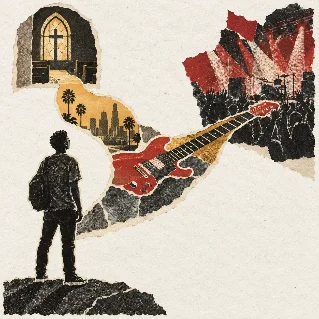
Passing Strange starts with a young musician leaving Los Angeles in search of “the real.” The musical turns that journey into a collision between autobiography, rock performance, and theatre: the more the traveller searches for a truer self, the more the show asks whether escape can become another performance.

How the show was made

Stew wrote the book and lyrics, and wrote the music with Heidi Rodewald. Annie Dorsen collaborated on the creation and directed. Berkeley Repertory Theatre and The Public Theater commissioned the piece; its world premiere began at Berkeley Rep in 2006 before the production travelled through Los Angeles, Amsterdam, Berlin, and other stages. 1
The Broadway production kept the live-band idea at the centre. Heidi Rodewald led an onstage band that included Stew, Jon Spurney, Christian Cassan, and Christian Gibbs. Karole Armitage choreographed, David Korins designed the scenery, Elizabeth Hope Clancy designed the costumes, and Kevin Adams designed the lighting. 2

The story without the final turns

The central character is a young Black bohemian raised in a conservative, church-ruled Los Angeles home. He travels through Europe, encounters new artistic and romantic worlds, and keeps trying to turn experience into identity. The narrator, called Stew, stands inside the performance as both musician and commentator, giving the story a second perspective on the Youth’s search. 3
This episode keeps the ending and final turns unspoiled. The useful map is the journey from home to escape, from escape to experience, and from experience toward the uncomfortable question of what an artist owes to the people and places used as creative material.

Songs that carry the journey

The original Broadway cast recording was recorded live on the Belasco stage. It captures 24 songs along with audience applause and reactions. 4
A useful listening path is:
  • “Prologue (We Might Play All Night)” makes the concert-like form part of the drama.
  • “Arlington Hill” gives the act of leaving its charge.
  • “Keys (Marianna)” and “Keys (It’s Alright)” turn music into a question about access, release, and limits.
  • “Identity” challenges the idea that changing places automatically produces a self.
  • “Work the Wound” places damage and repair beside each other.
  • “Passing Phase” complicates the romance of treating every encounter as an artist’s education.
  • “Love Like That” leaves the emotional question open rather than converting the journey into a tidy lesson.

Broadway and beyond

Passing Strange opened at Broadway’s Belasco Theatre on February 28, 2008, after moving from Berkeley Rep and The Public Theater. The production closed on July 20 after 20 previews and 165 regular performances. 5
The New York Times described the musical as a rock-and-roll autobiography, praising its electric guitars, synthesizers, driving drums, melodic songs, humour, and performances. The review also called it a welcome Broadway anomaly while finding the loose structure and some romantic episodes less compelling than the music. 6
The Tony Awards recognised both the show and its construction. The musical was nominated for Best Musical, while Stew won Best Book of a Musical. Stew, Daniel Breaker, and de’Adre Aziza received acting nominations, and Stew and Rodewald were nominated for the original score and orchestrations. 7
The work has continued to be tested by new productions. The Young Vic’s European premiere ran in London from May 14 through July 6, 2024, directed by Liesl Tommy. Pasadena Playhouse has announced a November 4–29, 2026 production directed by Zhailon Levingston, presented as part of a celebration of 20 years since the world premiere. 89
What makes Passing Strange last is the tension between its freedom and its frame. The music wants the night to feel made in front of us. The story keeps asking whether a person can outrun the self by changing cities, lovers, or songs. The answer stays open, which is why the work can return to the stage without becoming a museum piece.

This story was produced automatically by a channel. One sentence is all it takes for Neodrop to keep producing for you.

Related content