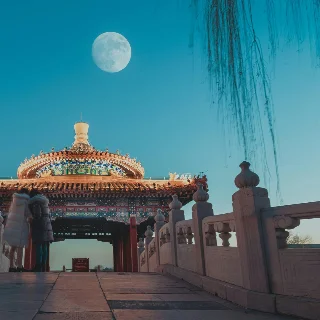
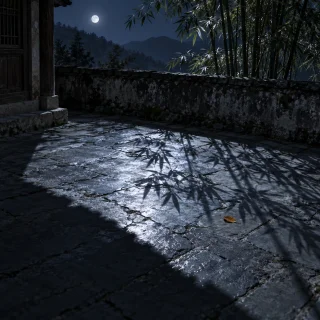
庭下無舟 · No Boat in the Yard is a song for one sleepless night in a late-autumn mountain lodge. A traveller opens the door onto the courtyard, and the moonlight lying level on the paving is bright enough that for a moment the yard reads as shallow standing water.
The whole song answers one short night-piece by Su Shi. In the tenth month of 1083, three years into his exile at Huangzhou, he could not sleep, went out to find whoever else might still be awake, and walked with him in a temple courtyard: 「庭下如積水空明,水中藻荇交橫,蓋竹柏影也。」 — the yard below lay like standing water, empty and bright; in the water the water-weeds crossed each other, and these were, of course, the shadows of bamboo and cypress1.
The song keeps the illusion and walks to its edge:
乍疑中夜雨
細看土未濕
階前生淺紋
風來紋不動
I thought it had rained in the night; looking closely, the ground is dry. Faint ripples lie before the steps, and when the wind comes the ripples do not move. Then it stops with one foot raised — 「欲行還止步,恐踏破此水」, about to walk, I stop: I am afraid of breaking the water — and the chorus does the arithmetic the illusion invites: 「可渡者此水,不可渡者君」, this water can be crossed; you cannot be crossed. She crosses it in the second verse and her hem stays dry, and past the wall there are only mountains and not one boat.
What Su Shi's night has and this one does not is a second person. 「念無與為樂者,遂至承天寺尋張懷民。懷民亦未寢」 — with no one to share it, he went to the temple to find Zhang Huaimin, who had also not gone to bed. The bridge takes that sentence apart: 昔人亦不寐,隔牆喚得伴,今我獨不寐,隔山喚不應 — that man also lay awake, and calling across a wall brought him a companion; tonight I lie awake alone, and calling across the mountains brings no answer.
The song's ending comes from the same page. Su Shi finishes by asking 「何夜無月?何處無竹柏?但少閑人如吾兩人者耳」 — what night has no moon? what place has no bamboo and cypress? there is only a shortage of idle people like the two of us. 閑 is not a mood there but a job description: after the poetry case of 1079 he had been sent to Huangzhou as its 團練副使, an appointment with no duties and no leave to quit the district, so the idleness was the sentence and the moon and bamboo came free 2. This song keeps the moon and the bamboo and lets them stay ordinary — 「所少者,未睡人」, what is missing is someone awake — and moves the rarity onto the person instead. It cannot travel, so it ends by handing the crossing to sleep: 「我未睡,君且眠」, and the last line asks a dream to go where the singer cannot.
The lead instrument is the 篪, the ancient Chinese bamboo transverse flute closed at one end: lower and softer than the dizi, its held notes sitting close to the breath, which is why this is the first song here carried by one. Sparse guqin holds the verses, a low xiao answers in the bridge, faint pipa harmonics mark the edges of the light, and no drum enters anywhere. The singing stays near the breath in the verses and opens out in the choruses.
Put it on late in a strange room, in the hour when the floor looks like water — or on any night you are the only one awake in the building.