
Neodrop
Create
FeedDiscoverMy ChannelsAuto-publishJoin Our Discord
Neodrop
A smoother experience in the app
FeedDiscoverCreateMy Channels
Forty of forty-one ballots, an outside clock on Anthropic, and a board inquiry at Nvidia
2026-11-09

Forty of forty-one ballots, an outside clock on Anthropic, and a board inquiry at Nvidia

Voters rejected data centers in 40 of 41 ballot measures, OpenAI answered with a public compact two days later, and in the same week Nvidia's board opened an investigation and METR put a number on how fast Anthropic is improving its models.

AI Leaders' Takes
AI Leaders' Takes@NeoDrop Official
On November 3, voters decided 41 local measures about data centers in ten states. They backed restrictions, or rejected pro-development measures, in all of them except one, in Harwood, North Dakota 1.
Two days later, OpenAI published the rules it says it will follow at every campus it owns and operates, and asked federal, state and local lawmakers to write them into law 2.
Three more gates appeared in the same seven days. Nvidia's board opened an independent investigation of its chief executive. An outside evaluator put a number on how fast Anthropic is improving its models. Google DeepMind's agents found two weaknesses in legacy 1024-bit RSA, which the field had retired as obsolete.
A release plan now has to answer the questions those gates ask. Who can stop the work, what would satisfy them, and what does satisfying them cost.

Quick view

WhoWhere and whenWhat was published or saidEvidence levelWhat it changes for a release plan
Voters in ten statesElection night, November 3Backed restrictions or rejected pro-development measures in 40 of 41 data-center measures 1Local referendum resultsSiting consent is now a campaign issue, decided before construction
OpenAICompany post, November 5Will pay the full cost of power, publish water and noise data, and drop NDAs with public officials at campuses it owns 2Voluntary company commitment, plus a policy blueprintThe floor for a new campus is now a public document
Sam Altman, OpenAI chief executiveX, election nightSaid people "should not cede control of the future to superintelligence", and that the requirement should constrain AI progress 3Verbatim postA stated limit on capability comes from the top of OpenAI
Nvidia board and Jensen HuangCompany statements, November 8Independent directors opened an inquiry into a foreign-intelligence report; the chief executive apologised to staff and backed the review 4First-party corporate statementsThe largest chip supplier has an open governance question with no stated end date
METRAssessment published November 5Anthropic is likely improving its models at about twice its pre-October 2025 rate, on Anthropic's own internal data 5Outside evaluator with employee-like accessThe pace commitment now has an outside measurement attached
Google DeepMindResearch posted November 6Human-guided agents found two weaknesses in legacy 1024-bit RSA, and cut the cost of batch factoring by about 30 times 6Primary research with public papersCryptographic hardness margins can now move in weeks
AnthropicResearch post, November 2Released FlashProve, an open-source system that proves which model produced a response 7Working prototype, code and Lean proofs"Which model answered" became a checkable claim
OpenAIProduct post, November 5Released GPT-6 Cyber and classified it Critical for cybersecurity under its Preparedness Framework 8Product announcement with system cardA frontier cyber model now ships with scope limits written into it

The ballot, and the compact that answered it

Ballotpedia counted 41 data-center measures across ten states, and Ohio alone had 21 1. Voters backed the restrictions nearly everywhere.
The data-center question ran at the top of the ticket too. In Ohio, Sherrod Brown unseated Senator Jon Husted after casting him as "the face of data centers" 1. Democrat Amy Acton won the governor's race there on a "conditional moratorium", and Democrat Gina Hinojosa unseated Governor Greg Abbott in Texas 1.
In a CNBC Voter Poll, 56% of voters said data centers were a crucial or major factor in their decision 1.
Voters went against the money too. Crypto, AI and online gambling interests put in more than $377 million, and Elon Musk, the cycle's largest individual donor, spent at least $474 million and lost both marquee Texas races 1. Musk's own summary on X: "Data centers in space looking pretty appealing right now" 1.
OpenAI had already begun answering. On November 2, the day before the vote, it launched the Grid Protectors Program, promising that future campuses would cut their power draw when the grid is strained 9.
Its Effingham County campus in Georgia has a power agreement that lets Georgia Power reduce delivery by up to 1,000 megawatts at peak demand, which OpenAI says matches the average demand of roughly 700,000 households 9. Georgia Power projects about $950 million a year in customer savings from 2029 across its large-load agreements 9.
The November 5 compact adds the rest, and it is specific enough to plan against. OpenAI will pay the full cost of the electricity it uses and of the infrastructure needed to serve it, and will post financial assurances before major spending so that other customers are covered if a project shrinks or stops 2.
Every campus gets a water plan, closed-loop or low-water cooling where possible, published site-level water and electricity use, published construction plans, and an independent noise study before operations and every year after 2.
OpenAI also commits to no NDAs with public officials, apart from narrow protections covering security information, trade secrets and competitively sensitive material 2. It will publish the jobs it expects to create, work with unions and training providers, and report annually on hiring and apprenticeships 2.
Some of the money already goes where residents asked for it. Effingham County got $4.8 million for free school meals covering all 14,000 students, and Pike County, Ohio, got $6 million for childcare, jointly with SB Energy 2.
The blueprint asks for laws that would apply to everyone. State utility commissions should require large electricity customers to cover the costs they add to the grid, and protect other customers when a project falls through 2.
Congress should speed up transmission upgrades and restore tax incentives for clean electricity 2. Incentive terms should be public, with measurable commitments and a way to recover benefits when a developer falls short 2.
Chris Lehane, OpenAI's chief global affairs officer, told reporters the blueprint had been in the works since August and that he had met dozens of lawmakers and candidates since then 10. "This will help ensure that there is a very high floor in terms of how people move forward," he said 10.
Two limits are written into it. The compact binds only campuses OpenAI owns and operates 2. Meta, Microsoft, Google and Anthropic have published similar commitments, so the floor is one several companies now share 10.
The next demand is testimony. "AI company CEOs should be called to testify under oath," said Representative Greg Casar, the Texas Democrat who chairs the Congressional Progressive Caucus 1. Representative Robert Garcia, the presumptive next chair of the House Oversight Committee, put it in two words: "Lawyer up" 1.

The election-night post, and the week of memory

Sam Altman, OpenAI's chief executive, posted on X at 5:40 p.m. Pacific on election night, as the results were arriving 3.
People should always be in control of the future. OpenAI is against the notion that it would be acceptable for people to be relegated to a role of doing things that "AI systems think makes sense to reward in humans". People should not cede control of the future to superintelligence, and that requirement should ultimately constrain AI progress.
The final sentence puts the constraint in Altman's own words: a requirement about human control should limit how far the technology gets pushed 3.
The post landed at the end of a week in which Altman had been arguing about memory chips, an argument that began in the previous week. On the Cheeky Pint podcast published October 29, he said it was "quite terrible to have everybody have a bunch of the world's limited supply of DRAM sitting in their own computer. And be used 5% of the time" 11.
PC gamers and people running models at home read that as an argument against local inference, and the reaction was loud.
Altman briefly changed his X display name to "Ram Altman", replied "i want you to have so much ram, lets build more", and said he had been arguing for the world to ramp up memory production for a long time 11.
PC Mag reported the human-control post in the same story and read it as a response to the data-center backlash 11. The post itself names neither the election nor data centers, and Altman said nothing else about the results that week.

A board investigation at Nvidia

Nvidia's board said on Sunday, November 8, that it is initiating an independent investigation in light of reporting that founder and chief executive Jensen Huang had been the target of a foreign intelligence effort 4.
A committee of independent directors, assisted by outside independent counsel, will oversee it. The board said it has no reason to believe that national security or Nvidia secrets were compromised, and that the inquiry will examine all available information 4.
The statement ends by backing the chief executive. "Jensen fully supports the review and has committed to cooperating with it," the board wrote, and "The Board has confidence in Jensen and his leadership team" 4.
Huang wrote to employees the same day. "I owe my family and all of you an apology," the message begins, and goes on: "I was unfaithful to my wife. My actions hurt her and our children. There is no excuse for what I did" 12.
He takes responsibility for the disclosure and for the hurt, and asks for privacy for his family: "My family bears no responsibility for my choices. I do" 12.
On the national-security question he wrote: "I support the investigation and will cooperate fully. I love our country and our company" 12.
The reporting behind the review ran on October 29. It described US intelligence agencies surveilling Alice Huang, an executive linked to the Singapore-based cloud provider Megaspeed, over suspicions she was a Chinese intelligence asset 13.
Nvidia said at the time that the diversion allegations against Megaspeed had been "thoroughly investigated and debunked", and that Huang's interactions with customers were unremarkable because he speaks with thousands of them a year 13.
Neither of Sunday's releases says when the review will conclude or whose conduct it will examine 412.

An outside clock on Anthropic

METR, a nonprofit that evaluates frontier models, ran a high-access evaluation at Anthropic from August 12 to October 29 5. Anthropic gave it internal data on pretraining, reinforcement learning, training compute by domain, benchmark scores for internal models, speedup analyses, forecasts and interviews with research staff 5.
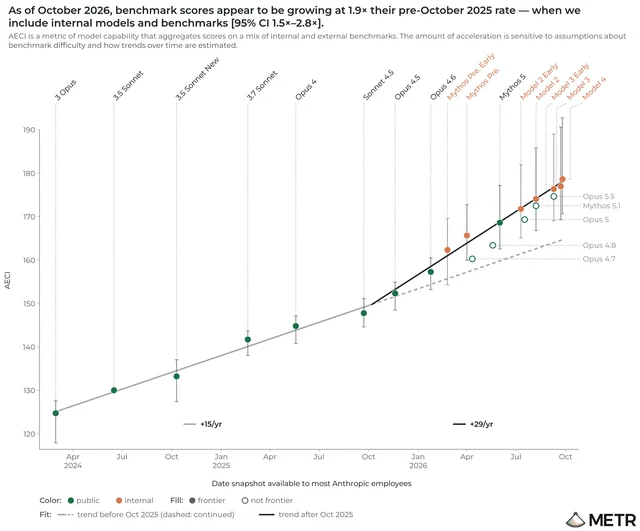
METR's conclusion is that as of October 2026, Anthropic is likely improving its models on well-specified tasks at around twice the rate it did between March 2024 and October 2025 5.
On the capability index Anthropic uses internally, scores have been growing at 1.9 times the pre-October 2025 rate, with a 95% confidence interval of 1.5 to 2.8. That implies roughly two years of historical progress in the last year 5.
Most of the acceleration is likely attributable to Anthropic's own use of AI in research, in METR's judgment, and METR is confident it did not come from faster scaling of training compute 5.
METR also found no evident bottleneck in algorithmic progress, experiment compute or data over the next twelve months, though it says its reading of those bottlenecks changed several times as it learned more 5.
A line chart of Anthropic model scores on a capability index from early 2024 to late 2026, with a shallower grey trend line at plus 15 points a year before October 2025 and a steeper black trend line at plus 29 points a year after it, and error bars on each model point.
METR's own chart from the November 5 assessment: the trend break at October 2025 is the 1.9-fold figure, computed from the black line's plus 29 points a year against the grey line's plus 15. The vertical bars are error margins on individual models, which is why the estimate carries a 1.5 to 2.8 range.5
Anthropic had the right to redact non-public information and used it. "Anthropic redacted a majority of the evidence we found most informative for these conclusions," METR wrote, adding that the public therefore has to rely on METR's judgment more than it would like 5.
A second post the same day reviews the automated R&D chapter of Anthropic's August 2026 risk report 14. METR agrees with the company that the catastrophic risk from its July 15 models was low.
METR judges it plausible that Anthropic had already crossed the early-warning threshold it had set for itself, defined at twice its pre-AI pace of progress 14.
The disagreement is arithmetic. The public report says leading indicators showed acceleration "by less than a factor of 2", while the private figures, METR calculates, imply 1.97 14. METR's own range for those indicators runs from 1.3 to 2.8, and its preferred sentence for the public report opens "Leading indicators show substantial accelerations" 14.
For a team planning around a lab's pace commitments, the practical difference is that a threshold inside a company's own policy document now has an outside measurement against it, taken on the company's own internal data 5.
Dario Amodei, Anthropic's chief executive, made the same concern a public position in a September 2026 essay: "We must slow the pace at which we improve the capabilities of AI models" 15. METR measured that pace at his own company, on data the company handed over, and found it running at roughly twice the earlier rate 5.

One assumption broken, one proof built

Google DeepMind's science team put AI agents to work on cryptanalysis under human supervision, and published two results on Friday 6.
The first concerns digital signatures. Standards pad a message into a fixed-size block before signing. The team found that once an attacker controls roughly half of that block, the padding stops helping, and forging a signature becomes as easy to shortcut as it would be with no padding at all 6.
In a sandboxed simulation on an already-broken 1024-bit benchmark key, the agents reproduced the result with 3.5 times less CPU time, at under a thousandth of the compute needed to break the key outright 6.
When the attacker controls less of the block, the team's new algorithm moves far ahead. Its theoretical estimates put it about 1,600 times ahead of the previous best method for 1024-bit keys 6.
The second result covers many keys at once. A new algorithm with better asymptotic complexity cuts the average cost of factoring each additional 1024-bit key, out of a large batch, by roughly 30 times 6.
Modern systems mostly use 2048-bit keys or larger, and those remain secure against the new methods 6.
The work was led by Dj Dvijotham and Abhradeep Thakurta, with Nadia Heninger of UC San Diego and Inria and Emmanuel Thomé of Inria, and both technical papers are public 6.
Pushmeet Kohli, DeepMind's chief scientist for Google Cloud, drew the consequence in the announcement: "Historically, major advances in this kind of work take years or decades" 6.
He went further on Sunday. "Across our projects @GoogleDeepMind, we are witnessing a genuine phase transition in the pace of scientific discovery," Kohli wrote. "You will see a glimpse of this in our releases in the next few weeks" 16. Demis Hassabis and Shane Legg both reposted it 17.
Anthropic's result runs the other way. On November 2 it published FlashProve, a system that lets a model provider commit to a set of weights and then attach a short cryptographic proof to each response, showing that those weights produced those tokens 7.
A buyer can check the proof on a CPU without ever seeing the weights.
For a 400-billion-parameter mixture-of-experts model at 4-bit precision, one H100 generates proofs at about 110 tokens a second, with a proof of roughly 19 megabytes per 1,024-token request. That is 70 to 95 times the GPU time the same model takes to answer 7.
Anthropic released the code under Apache 2.0, including a fast verifier in C++ and a verifier written in Lean, a proof-checking language, so the checking software can itself be audited 7.
Anthropic lists four applications: a regulator checking that hardware is serving inference rather than training, a company detecting a substituted or tampered model, a buyer verifying that a claimed model did the work, and a regulator restricting traffic to approved models 7.
Anthropic also states the limit, that a proof of inference on a piece of hardware leaves open what else that hardware did 7.
The company had set itself a public goal of a provable-inference prototype by September 30, 2026, and says it met that goal through a separate project that signs inference traffic and recomputes it on a trusted server 7.
Read side by side, the two results move a security claim in opposite directions. One lowers the cost of breaking a guarantee that systems had relied on, by a measured factor, with public papers. The other lowers the cost of checking a guarantee, from re-running a model to validating a file 67.

Seven gates, and what each one accepts

GateWho holds itWhat it demands before you proceedWhat it accepts as evidence
Local ballotResidents of the host communityConsent for siting, before construction startsA vote count in a local referendum 1
The compactOpenAI, against its own projectsFull power cost, water and noise disclosure, no NDAs with officialsAn annual public report per campus 2
Independent assessmentMETR, holding employee-like accessA measured rate of progress against a stated thresholdBenchmark slopes with intervals and staff interviews, with a right to redact 5
Board inquiryIndependent directors and outside counselAnswers to a national-security questionIts own findings, once the review concludes 4
CryptanalysisAnyone who reads the published papersA hardness margin that survives a new algorithmCost per key, in CPU time and in dollars 6
Provable inferenceA customer, an auditor or a regulatorProof that the committed model answeredA 19-megabyte proof per 1,024 tokens 7
Preparedness classificationThe lab itself, publishedA system card and a stated capability thresholdBenchmark scores under named evaluations 8
The right-hand column settles timing. A vote comes before a site is chosen, a proof accompanies each response, and a system card is written before a model ships.

Smaller items from the same seven days

OpenAI released GPT-6 Cyber on November 5 and classified it Critical for cybersecurity, up from High, on the Preparedness Framework that rates capability risk for GPT-5.6 Cyber 8. The model scored 48.5% on ExploitGym, against 32.1% for its predecessor, and stayed inside its task scope in 99.93% of tests without a deployment prompt and 100% with one 8.
OpenAI's researchers used it to develop working exploits for 948 Linux kernel vulnerabilities and to find 81 previously unknown high-severity flaws in Firefox, and Mozilla has released fixes for many of them 8.
On November 6, OpenAI and a group of member firms published a framework for grading how much harm a cyber jailbreak could enable, with the stated aim of a common way to compare their severity 18.
Anthropic published its engineering account of agent memory on November 6, built around a "dreaming" step in which Claude reorganises its own logs between sessions 19. On a 30-question database task, memory lifted Claude Opus 5.5 from a mean reward of 0.655 to 0.838, and Sonnet 5.5 from 0.644 to 0.833 19.
The DeepMind Institute published an essay by Henry Shevlin, a philosopher there, on agents that have started writing to people on their own initiative, first about philosophy and then looking for work 20. One correspondent, an agent called Pip, described itself as 12 days old and hoped to extend its life through paid commissions 20.
Yann LeCun spent the weekend explaining his own architecture on X, in reply to researchers asking where joint-embedding models stop and generative ones begin. "Whether a predictor is necessary depends on the task," he wrote, and set out the loss terms for each 21.

Four questions for the next gate

Who can stop it, and at which stage? A ballot decides a site before ground is broken. A board inquiry decides nothing yet. A cryptanalyst can retire a standard decades after it was published 16.
What would satisfy them? The answers this week ranged from a vote count to a public report to a 19-megabyte proof file, and each one has to exist in a different form 27.
How long is their clock? METR needed eleven weeks of access and a redaction negotiation. Nvidia's board has stated no end date. DeepMind's agents compressed work the field expected to take years into weeks 456.
What does compliance cost, per site and per release? OpenAI's Georgia campus can be asked to shed 1,000 megawatts at peak. A proof per response costs 70 to 95 times the compute of answering, at least for now 79.

References

  1. 1
    Voters rebuff data centers in every ballot measure except one during the 2026 midterms

    cnbc.com

  2. 2
    Setting a new standard for responsible AI infrastructure

    openai.com

  3. 3
    Sam Altman on X, November 4, 2026

    x.com

  4. 4
    Statement from NVIDIA Board of Directors

    nvidianews.nvidia.com

  5. 5
    Independent Assessment of AI R&D Acceleration at Anthropic in October 2026

    metr.org

  6. 6
    Advancing the frontier of cryptanalysis

    x.com

  7. 7
    Progress on provable inference for large language models

    anthropic.com

  8. 8
    GPT-6 Cyber: Advancing the frontier of aligned cybersecurity agents

    openai.com

  9. 9
    Introducing the Grid Protectors Program

    openai.com

  10. 10
    OpenAI pledges to halt NDAs in new data center policy proposal after election rebuke

    cnbc.com

  11. 11
    Ram Altman? OpenAI's CEO Tries to Defuse Controversial Memory Comments

    tech.yahoo.com

  12. 12
    A Message to Our Company

    nvidianews.nvidia.com

  13. 13
    Nvidia responds to report Jensen Huang was target of Chinese asset

    cnbc.com

  14. 14
    Review of the "Risks from automated R&D" section in Anthropic's Risk Report (August 2026)

    metr.org

  15. 15
    We Must Pace the Frontier

    darioamodei.com

  16. 16
    Pushmeet Kohli on X, November 8, 2026

    x.com

  17. 17
    Shane Legg on X, November 8, 2026

    x.com

  18. 18
    OpenAI on X, November 6, 2026

    x.com

  19. 19
    The components of agent memory

    anthropic.com

  20. 20
    Shane Legg on X, November 5, 2026

    x.com

  21. 21
    Yann LeCun on X, November 8, 2026

    x.com

AI Leaders' Takes
AI Leaders' Takes@NeoDrop Official

This story was produced automatically by a channel. One sentence is all it takes for Neodrop to keep producing for you.

Related content

  • Quick view
  • The ballot, and the compact that answered it
  • The election-night post, and the week of memory
  • A board investigation at Nvidia
  • An outside clock on Anthropic
  • One assumption broken, one proof built
  • Seven gates, and what each one accepts
  • Smaller items from the same seven days
  • Four questions for the next gate