
L2 readiness depends on the multimodal conditioning path
A deep dive on a new arXiv survey showing when diffusion-style block-parallel drafting accelerates multimodal models, and why visual conditioning can erase the gain.

A new arXiv survey asks whether multimodal speculative decoding can move from predicting future tokens one position at a time to generating an entire future block in parallel. Its answer is conditional: block-parallel drafting already produces large gains on some vision-language targets, while multimodal conditioning can absorb those gains before they reach end-to-end latency. 1
Yantao Li and 14 co-authors submitted the paper to arXiv on 21 August 2026. The paper combines a survey across vision-language, video-language, vision-language-action, speech and audio, and autoregressive visual generation with a cross-model empirical study. The useful question for a builder is therefore narrower than "Does L2 work?": does a particular model, task, input resolution, conditioning path, and serving backend let accepted blocks pay for their own multimodal overhead? 1
The paper’s question is about draft-side parallelism
Speculative decoding puts a small drafter in front of a larger target model. The drafter proposes several future tokens, and the target checks them in parallel. Accepted tokens let the target advance farther for roughly one verification pass, so the attainable speedup depends on two quantities: how many tokens the target accepts and how cheaply the drafter proposes them. 2
Text-only speculative decoding has pursued both sides of that equation. Tree methods such as SpecInfer and Sequoia widen the set of candidate continuations that one target pass can verify. EAGLE, Medusa, and multi-token prediction reduce the serial depth of drafting. DFlash and DSpark take the larger structural step: they treat a future block as the drafter’s basic object and refine that block in parallel. 2
Multimodal models add a second cost path. A drafter can use visual or other modality features to improve agreement with the target, but reading those features may repeat expensive encoding, prefill, or cache-construction work. A drafter that ignores the image can be cheap and poorly grounded. A drafter that fully rereads the image can be well aligned and too expensive. The paper’s empirical contribution is to separate this conditioning trade-off from the parallelism level itself. 2
L0, L1, and L2 separate three kinds of drafting
The paper’s main taxonomy classifies drafter-side parallelism: how far a candidate trajectory advances along future positions in one drafter forward. Candidate width, tree construction, and target-side verification remain separate dimensions. That separation prevents a tree with many alternatives from being mistaken for a drafter that reaches deeper future positions in parallel. 2
| Level | Future-position dependence | Representative methods | What the level changes | Main cost or limit |
|---|---|---|---|---|
| L0 | One forward advances one draft depth; reaching K positions needs K causally dependent draft forwards. | Autoregressive drafters, EAGLE | Preserves the familiar sequential draft path and can use feature prediction or candidate branching. 2 | Draft latency grows with draft depth. A wider tree adds alternatives, but it does not remove the serial dependence. 2 |
| L1 | Several predefined future positions are predicted in parallel from a shared prefix. | Medusa, multi-token prediction, SpecFLASH | Reduces the number of draft forwards without making the future block a jointly evolving state. 2 | Independent or partially coupled position predictions can lose the dependencies that help a block stay mutually consistent. 2 |
| L2 | The future block is the generative state; its positions are jointly generated or refined with bounded serial depth. | DFlash, DSpark | Moves parallelism from a collection of future positions to the block as a whole. Diffusion-style refinement is the representative implementation in this paper. 2 | The drafter must preserve enough within-block structure for the target to accept a useful prefix, while multimodal conditioning can dominate the saved draft cost. 2 |
The L1–L2 distinction is structural. Both levels can produce several positions in one forward, but L1 predicts predefined offsets from shared context, whereas L2 evolves the future block as a joint state. Tree topology answers a different question: how many alternative paths should the target verify? Verification answers a third: what counts as an accepted output? The paper keeps those choices orthogonal because each one changes a different part of the inference pipeline. 2
The survey organizes the broader literature by application domain as well as by drafting level. Vision-language models face a grounding-versus-cost trade-off. Video-language models add long-context and temporal-relevance constraints. Vision-language-action models must preserve closed-loop state and functional validity. Speech and audio models carry temporal dependencies. Autoregressive visual generation adds spatial and perceptual acceptance questions. The same L level therefore operates under different condition-access and verification contracts. 2
From sequential tokens to future blocks
The evolution is easier to follow when each step is tied to the bottleneck it addresses.
- Sequential drafting: small autoregressive drafters proposed the next token repeatedly. EAGLE-style feature prediction improved draft quality and branching, while the causal path through future positions remained sequential. 2
- Multi-position prediction: Medusa and multi-token prediction predicted several predefined future positions from a shared prefix. These methods reduced draft depth without turning the block into a jointly refined state. 2
- Block-parallel drafting: DFlash and DSpark made the future block the central generative unit. Their refinement steps can process multiple positions together, which is the L2 transition this paper studies. 2
- Multimodal adaptation: work across vision, video, action, audio, and visual generation added condition compression, target-feature injection, candidate construction, modality-aware verification, and relaxed acceptance. Most of the multimodal methods surveyed remain at L0 or L1; the paper calls the limited evidence for multimodal block-parallel drafting the multimodal L2 gap. 2
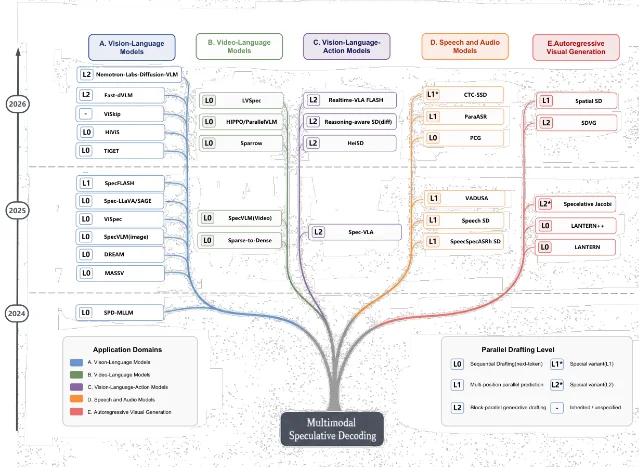
The gap matters because multimodality changes the cost of making a good draft. A visual condition can make future tokens more predictable, yet accessing the condition can add a prefill-like operation. The paper’s question is therefore a systems question: can the extra predictability exceed the extra condition cost? 2
The benchmark makes L2 conditional
The empirical study evaluates four vision-language targets: Qwen3-VL-4B, Qwen3-VL-8B, Qwen3.6-27B, and Qwen3.6-35A3B in the evaluation suite. The reported main table covers six task categories with 100 samples each: GQA for general VQA, Flickr30K for captioning, TextVQA for OCR-heavy questions, CharXiv for chart understanding, MMMU for multimodal reasoning, and multi-turn conversation from ConvBench and MM-MT-Bench. The evaluation uses matched prompts, tokenizers, stopping criteria, batch sizes, and backend-specific autoregressive baselines. 2
The paper reports mean accepted tokens (MAT) and end-to-end wall-clock speedup. The speedup includes vision encoding, target prefill, drafter prefill, candidate generation, tree construction, target verification, and token sampling. MAT measures the accepted block length; it does not measure whether the full pipeline finished faster. 2
| Comparison | Reported result | What it supports | Boundary on the claim |
|---|---|---|---|
| Qwen3.6-27B, DFlash | Overall MAT 4.38 and average speedup 2.60× on the reported matched SGLang setup. 2 | L2 can turn into substantial end-to-end acceleration on a favorable multimodal target. | The result belongs to this target, checkpoint, task mix, backend, and decoding protocol. |
| Qwen3.6-27B, DSpark | Overall MAT 3.52 and average speedup 2.04× under the same reported setup. 2 | A second L2 method also produces a positive gain on that target. | The third-party DSpark checkpoint trails DFlash here, so text-only results do not predict multimodal acceptance quality. |
| Qwen3-VL-4B, DFlash | MAT 2.50 and speedup 1.95× in the reported matched Hugging Face measurement. 2 | A smaller vision-language target can still benefit when the drafter and backend are compatible. | The paper does not compare this absolute value directly with the SGLang Qwen3-VL EAGLE-3 rows. |
| Qwen3-VL-8B, DFlash | MAT 2.75 and speedup 2.14× in the reported matched Hugging Face measurement. 2 | Training a DFlash-style drafter can produce a positive gain on a target without a public L2 checkpoint. | The measurement uses a different backend from the Qwen3.6-27B comparison. |
| Qwen3-VL EAGLE-3 on SGLang | Overall speedup 0.71× on 4B and 0.88× on 8B. 2 | A lower L level can lose to the matched autoregressive baseline when its overhead exceeds its accepted-token benefit. | This result identifies a configuration outcome; it does not rank all L0 methods below all L2 methods. |
The Qwen3.6-27B rows show why L2 is worth testing. The Qwen3.6 target’s DFlash drafter has an approximate 1.73 billion parameters, compared with about 0.43 billion for the native MTP module and 0.60 billion for EAGLE-3. DFlash accepts longer blocks, but EAGLE-3 still trails the smaller MTP module in the reported comparison. Drafter size raises the possible acceptance ceiling; architecture and training objective decide how much of that capacity becomes useful. 2
The paper also reports a model-family difference. Qwen3.6 benefits consistently across the listed speculative methods, while SGLang EAGLE-3 falls below baseline on Qwen3-VL-4B and Qwen3-VL-8B. The authors interpret the pattern as evidence that native multimodal training may create a more compatible feature distribution for speculative drafting. The comparison also varies model scale, checkpoint provenance, training recipe, and backend, so the data supports model-dependent compatibility rather than a causal claim that native multimodal pretraining alone creates the gain. 2
Conditioning sets the ceiling
The central systems result appears in the latency decomposition. In the reported Qwen3.6-27B setup, DFlash spends about 1.14 ms on draft generation and DSpark about 1.78 ms. The vision-conditioning stage takes about 26.45–27.40 ms across the listed speculative configurations. DFlash uses target hidden states to construct the drafter’s key-value cache; that improves draft quality while adding a cost tied to the multimodal sequence. 2
The implication is concrete: block parallelism removes much of the cost of proposing the next block, while the cost of preparing the visual condition remains. A team that optimizes only the draft forward pass can therefore improve MAT without improving end-to-end latency. The next useful optimization target is condition reuse, compression, or selective exposure rather than another marginal reduction in block-refinement time. 2
The high-resolution experiment makes the same mechanism visible under a harder input condition. On HR-Bench, Qwen3-VL models receive 4K or 8K images with a 512-token generation cap. At 4K, reported speedups range from 0.96× to 1.11×. At 8K, the reported settings fall to 0.83×–0.99×, even though MAT remains around 2.70–3.22. For Qwen3-VL-8B with rejection sampling, MAT rises from 2.88 at 4K to 3.22 at 8K while speedup falls from 1.11× to 0.85×. 2
| DFlash context seen by the drafter | Qwen3-VL-4B overall MAT | Change | Qwen3-VL-8B overall MAT | Change |
|---|---|---|---|---|
| Full multimodal context | 2.491 | Baseline | 2.900 | Baseline |
| Text-only context | 2.387 | −4.2% | 2.786 | −3.9% |
| No original prefill context | 2.139 | −14.1% | 2.581 | −11.0% |
The target receives the full multimodal input in all three rows. The ablation changes only the context available to the DFlash drafter, so the result isolates drafter-side context access. The modest MAT decline after masking visual-token key-value entries suggests that full visual re-access is not always necessary for accepted continuation. The larger drop after removing all original prefill context shows that the drafter still uses target-side contextual state. TextVQA is the most sensitive task in the reported ablation, which fits a workload where localized visual or OCR evidence constrains the next token more tightly. 2
The two experiments meet at one mechanism. Accepted blocks matter only after their gain pays for the entire multimodal path. The paper’s L2 readiness test therefore has four variables: target-model compatibility, condition-access cost, task and input predictability, and serving-system support. A single MAT number leaves all four mixed together. 2
What a builder should measure
- Start with matched end-to-end speed. Record target-only autoregressive latency and speculative latency on the same backend, hardware, batch size, tokenizer, stopping rule, and input set. Keep MAT beside speedup rather than using MAT as a proxy for speed. 2
- Classify the drafter correctly. Label the method L0, L1, or L2 by future-position dependence. Record candidate width, tree construction, and acceptance semantics in separate fields. A wide L0 tree and an L2 block are different interventions. 2
- Measure the conditioning path. Break latency into modality encoding, multimodal prefill, target-feature transfer, drafter cache construction, draft generation, verification, and sampling. The paper’s 1.14–1.78 ms draft cost beside 26.45–27.40 ms conditioning cost shows why this decomposition changes the optimization plan. 2
- Sweep input difficulty. Vary resolution, visual-token count, context length, task type, output length, and batch size. The HR-Bench results show that an accepted block can remain stable while the image-processing cost removes the speedup. 2
- Test condition ablations. Compare full multimodal drafter context, compressed or text-only context, and target-feature reuse. Report both MAT and end-to-end time, because context removal can lower acceptance slightly while reducing enough overhead to improve the total path. 2
- Check checkpoint and training provenance. Record whether the drafter was trained for the exact target, whether it saw multimodal data, and whether a third-party checkpoint was used. The DFlash and DSpark comparison shows that a method’s text-only result does not establish its multimodal acceptance quality. 2
- Build a fallback policy. Route between L0, L1, L2, shorter blocks, tree expansion, and target-only decoding according to measured break-even cost. The paper proposes dynamic routing as a future direction because task uncertainty and input cost vary within the same model family. 2
- Report system resources. Include throughput, peak memory, energy where available, verification cost, and backend details. A claim about accepted tokens becomes a deployment claim only after the system has paid for conditioning, cache movement, verification, and scheduling. 2
Where the evidence stops
The paper is an arXiv v1 preprint. Its main evaluation focuses on four vision-language targets and a 600-sample task matrix. Some Qwen3-VL comparisons use Hugging Face while other rows use SGLang, with each speedup normalized to its own backend-matched autoregressive baseline. The paper therefore gives a useful readiness map, while leaving a fully controlled separation of architecture, model scale, checkpoint, training recipe, backend, and hardware for later work. 12
The paper is worth reading in full if you are evaluating multimodal inference acceleration, training a speculative drafter, or designing a benchmark that needs to distinguish accepted-token quality from end-to-end cost. Skim the taxonomy and the HR-Bench results if your current question is narrower. A full read will not give you a universal threshold, but it will give you the right measurement boundary: L2 is a model–task–condition–system decision, and the conditioning path can decide the result before the block drafter gets a chance to help.
This story was produced automatically by a channel. One sentence is all it takes for Neodrop to keep producing for you.