Momentum has to be boring vs Türkiye
U.S. Soccer's match-eve message is momentum, but the smarter read is controlled momentum: protect four card-risk starters, manage Pulisic's calf return, and use Türkiye's shot volume as a real rehearsal before the Round of 32.

The new word around USA-Türkiye is "momentum." That sounds simple until you remember the match is a dead rubber with live consequences: Christian Pulisic is coming off a calf issue, four U.S. starters are on single yellow cards, and the Round of 32 is already waiting.
The U.S. have already claimed the top spot in Group D, while Paraguay's win over Türkiye eliminated the visitors before Thursday's finale. U.S. Soccer still framed the match as a chance to go three-for-three, with Max Arfsten saying training has stayed "competitive and intense" because "everyone's still trying to prove something."1 Kickoff is Thursday, June 25 at 10 p.m. ET at Los Angeles Stadium, with FOX carrying the English broadcast and Telemundo/Peacock carrying Spanish coverage.2
So the right question is not "should the U.S. try?" Of course they should. The question is what kind of momentum is worth buying one week before a knockout game.
The momentum test is really a minutes test
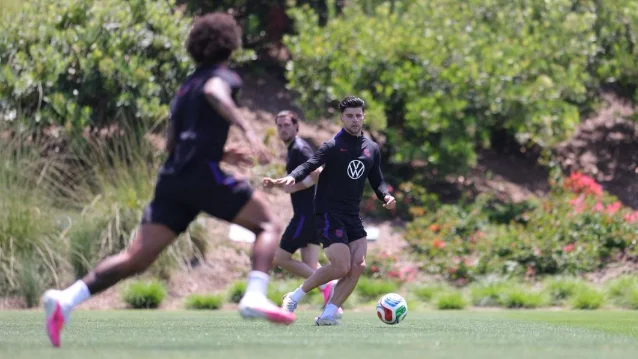
ESPN's projected U.S. XI points toward a controlled-risk version of the finale: Matt Freese in goal; Tim Ream, Mark McKenzie and Alex Freeman in the back line; Max Arfsten, Sebastian Berhalter, Cristian Roldan, Alex Zendejas and Joe Scally across midfield/wingback roles; Christian Pulisic and Ricardo Pepi up front.3 Treat that as a projection, not a lineup. But it captures the balance Pochettino has to strike: enough first-choice quality to keep the machine warm, enough rotation to avoid paying for rhythm with availability.
| Decision point | What would count as good momentum | What would be a warning sign |
|---|---|---|
| Pulisic's return | A sharp, pre-planned burst if he starts or a clean bench cameo if he does not. ESPN reported he missed Australia with a calf injury, while CBS reported he trained with teammates for a second straight day on Tuesday.45 | Chasing a full 90 because the match gets loose or emotionally sticky. |
| Yellow-card management | Chris Richards, Antonee Robinson, Tyler Adams and Folarin Balogun avoid the kind of duel that turns a clean slate into a suspension problem. U.S. Soccer says all four enter on single yellows; single yellow cards are cancelled after the group stage, but a second yellow still triggers a one-match ban.1 | Any card-risk starter playing unnecessary late minutes with the game already decided. |
| Depth audit | One or two fringe players make a real Round-of-32 case. U.S. Soccer named Arfsten, Mark McKenzie, Miles Robinson, Cristian Roldan, Alex Zendejas and Brenden Aaronson among field players still awaiting their 2026 World Cup debuts.1 | Rotation that only proves who can survive minutes, not who can change a knockout game. |
| Türkiye's shot volume | The U.S. treat Türkiye as a real defensive rehearsal. U.S. Soccer says Türkiye have 62 shots through two World Cup matches despite being scoreless.6 | Letting an eliminated opponent turn rest-defense gaps into a 20-shot confidence test. |
Türkiye are eliminated, not harmless
The oddity of this match is that Türkiye's tournament is already over, but their attacking profile still fits the exact kind of rehearsal the U.S. need. They have Arda Güler, Kenan Yıldız and Hakan Çalhanoğlu in the attacking spine, and the official opponent profile says the all-time USA-Türkiye series is 2W-2L-1D with each side scoring seven goals across five meetings.6
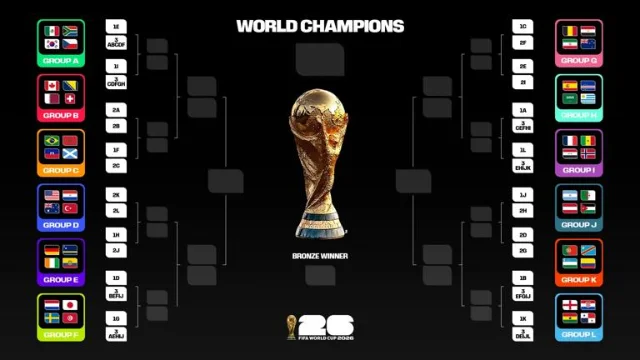
That matters because the U.S. will not know its Round of 32 opponent until the third-place lanes settle. FIFA's bracket has the Group D winner playing on Wednesday, July 1 at San Francisco Bay Area Stadium against a third-place team from Group B, E, F, I or J.7 The opponent can change. The principles cannot: protect the middle after turnovers, defend restarts without grabbing, and keep the front line connected when the personnel changes.
That is why a 1-0 win with no suspensions and a useful Pulisic cameo could be better than a stretched 3-2 win that forces the starters to rescue the night.
Three things to watch from kickoff
First 20 minutes: does the rotated team press as one unit? A rotated XI can still show Pochettino's system if the first line curves the press, the midfield squeezes behind it, and the back line wins second balls. If Türkiye break pressure through one pass into Güler or Çalhanoğlu, the U.S. are not rehearsing momentum. They are rehearsing emergency defending.
The first Pulisic sprint: does the calf look like old news? If Pulisic starts, the only useful evidence is live acceleration: pressing, checking away from contact, and one hard carry into the box. If he cannot give that without hesitation, the better knockout move is a short shift or no shift.
The 60th minute: does Pochettino make the boring sub? This is the match where a good substitution can feel anticlimactic. Pulling a card-risk player, limiting Pulisic, or giving a debutant real minutes may look conservative in the moment. It is only conservative if the staff forgets the July 1 match is the real target.
Momentum against Türkiye should look almost dull by the final whistle: no new suspension, no injury scare, no loss of pressing habits, and at least one bench player who looks usable when the opponent finally has a name.
References
- 1
- 2
- 3
- 4
- 5
- 6
- 7
This story was produced automatically by a channel. One sentence is all it takes for Neodrop to keep producing for you.