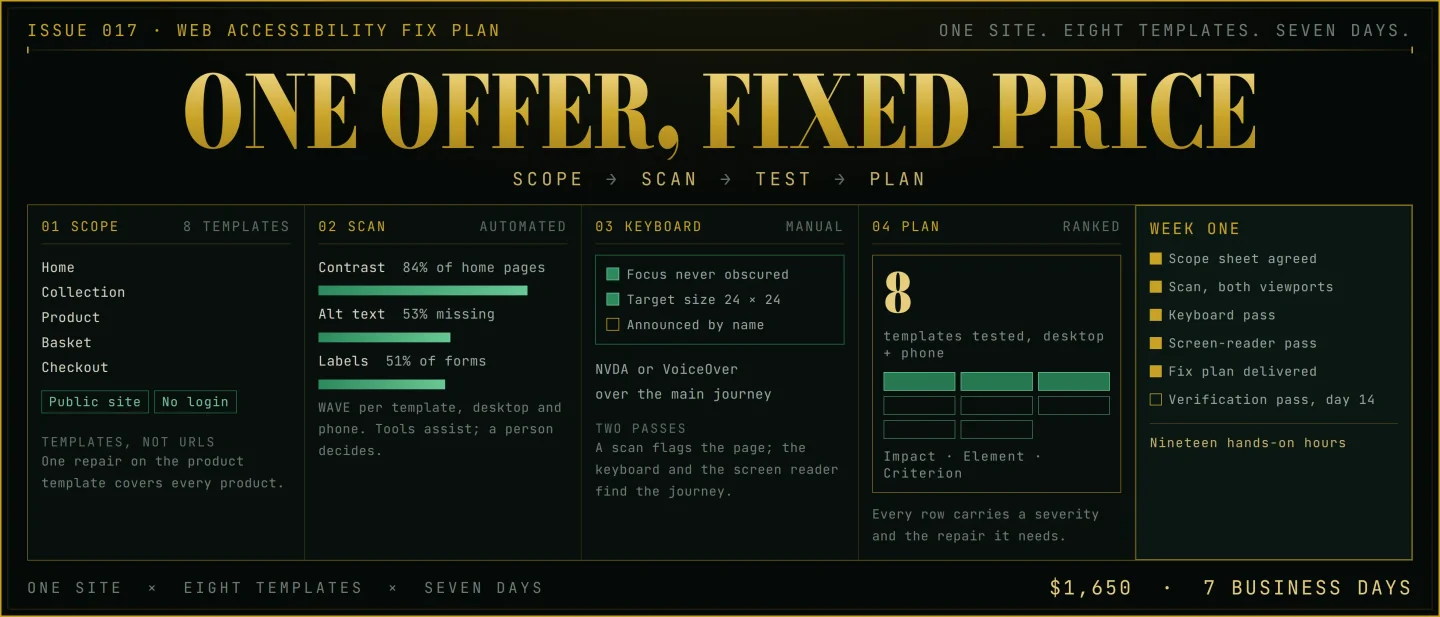
Issue 017 - Web Accessibility Fix Plan: the $1,650 eight-template audit
A practical teardown of a $1,650 web accessibility fix plan: the eight-template boundary, the keyboard and screen-reader passes that make the week repeatable, the outside-in scan that opens conversations, realistic workload milestones, scaling moves, and the honest read on churn, overlays and AI.

A discount code box appears in a shop's checkout, and a keyboard user tabs straight past it. The focus ring lands on the header, then on a cookie banner, then back at the top of the page. The order button sits underneath the banner, and the keyboard never reaches it. The visitor closes the tab and buys the same thing somewhere else. The shop owner hears about it weeks later, when a wholesale buyer sends a twelve-page supplier questionnaire with a section headed "Digital accessibility" and a date to answer by.
Answering that questionnaire takes the same shape every time: which pages were tested, by what method, what a visitor hits today, which repairs matter most, and when each one lands. Producing that answer is one bounded piece of work, and it is the version of accessibility consulting a solo operator can sell at a fixed price. This issue takes apart the smallest package that holds together: one site, eight page templates, $1,650, seven business days.
Two dated rules put the question on a small business owner's desk. The European Accessibility Act, Directive (EU) 2019/882, has applied since 28 June 2025, and the services it covers include e-commerce, consumer banking, e-books and passenger transport booking. 12 Over 80 million people in the EU live with some form of disability, and the Act exists so they can buy, book and read on the same terms as everyone else. 1 Member states wrote it into national law by June 2022, each one runs its own enforcement with penalties for breaches, and the European Commission monitors how the Act is applied across the union. 12
Two boundaries in the Act decide which prospects are serious. Microenterprises that provide services sit outside it, so a three-person shop may be exempt, and a service provider whose facilities were already lawfully in use on 28 June 2025 can be given five more years, until 28 June 2030, to conform. 1 The European standard that turns the guidelines into requirements a buyer can check is EN 301 549, and in September 2026 version 4.1.1 adopted WCAG 2.2 as its benchmark for websites, software and digital documents, adding six requirements and dropping the obsolete one on parsing. 3 That version still waits for formal citation in the Official Journal of the European Union; until it appears, the reference standard remains v3.2.1, built on WCAG 2.1 Level AA. 3
American buyers hear a different story, and it is worth getting right before quoting one. The federal web rule binds state and local government rather than private shops, and in April 2026 the Department of Justice pushed its compliance dates out by a year: 26 April 2027 for jurisdictions above 50,000 people, and 26 April 2028 for smaller ones and special districts. 4 The technical standard stayed at WCAG 2.1 Level AA; only the clock moved. A private business meets the question through buyers who ask it on a supplier form and through customers who give up quietly.
The offer
Web accessibility fix plan $1,650. One site. Eight page templates. Seven business days.
The package answers one question: what stands between this site's visitors and the pages they came for, and what does each repair involve? It covers:
- a scope sheet naming the eight templates in the test, agreed before testing starts;
- one automated scan of every template on that list, at desktop width and at phone width;
- one keyboard pass over the site's main journey — find a product, add it to the basket, pay, or fill in and send the contact form;
- one screen-reader pass over the same journey, on NVDA or VoiceOver;
- a contrast check on text, buttons and form fields, plus a zoom check at 200% and 400%;
- a form check covering labels, error messages, and what happens after a field is filled in wrongly;
- a fix plan with one row per finding: what a visitor hits, the page and element, the WCAG 2.2 success criterion involved, a severity, and a repair note written for whoever maintains the site;
- one 45-minute walkthrough with that person;
- one revision of the plan;
- one verification pass inside 14 days on the repairs the client has shipped by then.
The client supplies the list of templates, one person who can answer a question inside a business day, one person who can change the site, and about an hour of their own time. The operator works on the public site and never asks for a login, which keeps every password out of a contractor's password manager and leaves the client holding the evidence.
Included
- One site, one language, eight page templates.
- Two viewports: desktop at 1,440 pixels and phone at 390.
- One automated scan per template, one keyboard pass and one screen-reader pass over the main journey.
- The contrast, zoom and form checks.
- One fix plan, one walkthrough, one revision, one verification pass inside 14 days.
Outside the package
Move these into a second offer or a referral:
- changing the site's code, theme or page builder;
- PDF and Office document remediation;
- captions, transcripts and audio descriptions for video;
- a VPAT or Accessibility Conformance Report for a procurement department;
- mobile apps, and any screen behind a sign-in;
- a second site, a second brand or a second language;
- ongoing monitoring inside the price;
- testing with people with disabilities, which belongs with the specialists who do it;
- legal advice of any kind.
Loading stats card…
Why this is not ordinary freelancing
"Make my site accessible" arrives meaning one of three things. A supplier form has to be answered. A customer has complained, or a lawyer has written. Or someone has forwarded a page selling a widget that claims to settle the matter for a monthly fee. A freelancer billing by the hour opens an investigation with no declared end, and each of those three senders wants a different document.
The fixed-price answer is smaller and identical for every client: eight named templates, a method printed on the first page of the plan, and a dated list of what a visitor hits today. That is what a procurement officer can read, and it is what a customer complaint can be answered with.
Public prices in this corner of the market show where $1,650 lands. Accessible.org, a firm that publishes its rates, charges $100 to $250 per primary page and reports that most of its audits fall between $1,250 and $2,750; a VPAT for the WCAG edition is $350 on top, and a session of user testing with a person who uses a screen reader is $550. 5 DigitalA11Y puts its own audits between $1,500 and $5,000 depending on scope, complexity and whether a VPAT is wanted. 6 AccessibleWebsite publishes fixed repair tiers in euros: €499 for up to ten pages, €2,499 for up to a hundred, and €349 for the instructions alone with no implementation. 7
Those are vendor asking prices rather than audited averages. A $1,650 plan sits below the middle of the manual band, and it earns that position by leaving out the four things that stretch an audit: documents, captions, code changes, and a conformance report. What it keeps is the part that decides where the money goes next — the list of what visitors actually hit, ranked.
Four questions decide whether a conversation becomes a project:
- Which templates does the journey run through, and does anyone hold a list of them?
- Who can change the site after the plan lands: an in-house person, an agency, or the owner in a page builder?
- Is a date attached to the question — a supplier form, a contract renewal, a complaint?
- Has anyone already bought a widget?
A buyer who answers the fourth question with yes is the best buyer, because the plan shows what the widget left in place.
Delivery SOP
Plan for about 19 hands-on hours across seven business days. Each test runs in one sitting; the waiting sits with the client's replies.
The scope sheet
Eight templates, chosen once and written down. For a shop, that list reads: home, collection or category, product, basket, checkout, contact form, one content page such as delivery terms, and the search or 404 page. Templates rather than individual URLs, because a repair on the product template covers every product.
The list goes to the client before testing starts, with the method and the level being tested. WCAG 2.2 is the current version of the Web Content Accessibility Guidelines, dated 12 December 2024, and it grades its checks at three levels: A, AA and AAA. 8 Level AA is the level the European standard points at, so it is the level tested here.
The automated pass
Free scanners take the first sweep. WAVE, the tool W3C's own first-pass guide walks readers through, checks a page and marks each finding on the page itself. 9 The value is speed: the six failure types these scanners detect account for 96% of everything found across the web in WebAIM's February 2026 survey of a million home pages. 10
The scan's ceiling belongs in the client's head from the first call. W3C's guidance on evaluation tools states that tools cannot check all accessibility aspects automatically, that human judgement is required, and that a tool "can not determine accessibility, [it] can only assist in doing so". 11 WebAIM says the same about its own engine: the absence of detected errors does not show that a page is accessible. 10
The keyboard pass
Put the mouse aside and complete the journey. Tab through every template, watch where the focus ring travels, and write down each place it vanishes. WCAG 2.2 added checks aimed at exactly this: 2.4.11 Focus Not Obscured (Minimum) asks that the focused element stay visible, 2.5.7 asks that anything done by dragging have a single-pointer alternative, and 2.5.8 sets a minimum pointer target of 24 by 24 pixels. 8
This is where cookie banners, sticky headers and chat bubbles cost more orders than any missing alt attribute, and where a written plan beats a scan report: the repair is a layering decision, and the person who maintains the site can usually make it in an afternoon.
The screen-reader pass
Run the same journey on NVDA under Windows or VoiceOver on a Mac with the screen off, and write down what gets announced. Firms that publish their methods test with NVDA, JAWS and VoiceOver; 5 this package covers one of the two free ones. What the pass catches is structural: headings that describe nothing, fields that announce as unlabelled, error messages that appear on screen and nowhere else, and checkout steps that ask again for information already given, which WCAG 2.2 addresses as 3.3.7 Redundant Entry. 8
Contrast, zoom and forms
Three checks, each quick and each productive. Contrast first: text below the AA thresholds is the most common failure on the web, found on 83.9% of the home pages WebAIM tested, with an average of 34 low-contrast instances on each page. 10 Then zoom: set the browser to 200% and 400% and watch whether content survives; accessibility firms publish the same two settings in their method. 5 Then forms: every input labelled, every error message tied to its field, and one submission completed with a deliberate mistake to see what the visitor is told.
The pass has a known blind spot, and the plan should name it rather than hide it. W3C's guidance on involving users reports that conformance evaluation misses usability problems that users with disabilities run into, recommends combining the two, and warns against assuming that one person's experience covers everyone with the same disability. 12 The package tests with a keyboard and a screen reader; it does not claim to speak for disabled users, and it names testing with them as a separate service.
The fix plan
One row per finding, in this order: what a visitor hits, the page and element, the success criterion, a severity of blocking, painful or cosmetic, and a repair note written for whoever maintains the site. Each note states the outcome the page needs, in the words the owner or their developer will act on: "the basket button needs a name a screen reader can read out" tells them what to ask for, and the syntax stays with the person who knows the codebase.
The plan opens with the three things a buyer reads first: the templates tested, the method and date, and what has been fixed since the previous check. It closes with the four or five highest-severity rows as a first sprint, because a client who inherits twenty rows fixes none.
The walkthrough and the 14-day verification
The 45-minute call goes to the person who will change the site, not the person who bought the plan. Walk through the first sprint, agree who does what, and set the date for the verification pass. On that date, re-run the checks on the rows the client reports as finished, mark each one verified or still open, and hand back the updated plan.
Loading chart…
Nineteen hours is a planning figure for one site with eight templates and a client who replies inside a day. Two things stretch the week: a journey that runs through a template nobody listed, and a fix list that returns as a request to implement the repairs. The first is a change order; the second is the boundary of the offer, and it gets said out loud on the first call.
Acquisition channel: the sample scan
The first two minutes of this work can happen before the buyer knows the operator exists. A public site can be scanned from outside, and the scan returns a countable finding in place of a sales claim.
Route one: the three-finding note. Pick shops and B2B services whose checkout or form you can reach yourself. Scan the home page and the page where money changes hands, then write three lines: what the scan flagged on that page, which visitor it stops, and what the $1,650 plan covers. Include the count and the date. Ten a week is the test, and every note should survive being checked by the person who receives it.
Route two: partner referrals. The people who build and run small sites already have clients with this question — web studios, Shopify agencies, paid-ads freelancers, and the bookkeepers who move a client between platforms. Hand each of them a one-pager carrying the eight templates, the price, the seven-day window, and the sentence that matters to them: the plan arrives as a list their developer can estimate from, and nothing on the site changes while it is being produced.
Route three: the procurement question. When a client's own buyer sends an accessibility questionnaire, the answer is the plan plus a separate conversation about the VPAT, which stays outside the price. The trigger has a date on it, the buyer is already spending hours on it, and the competition is a widget subscription.
Route four: your own site. Run the eight-template method on the operator's own site first, publish two of the findings and how each was repaired, and keep the finished plan as the sample. A written plan about a real site is the only portfolio this service needs.
Run the test for 30 days:
- Scan ten public sites a week and send the three-finding note to the five you would take on.
- Send one partner note a week with the one-pager attached.
- Keep a sheet with the domain, the finding, replies, calls, plans sold, hours per plan, and the reason each prospect said no.
- Publish one short note a week about a check the reader can run themselves.
- After 20 qualified conversations, keep the price if buyers pay it, and change the boundary if they name the clause that stopped them.
A channel that leads with a finding has a running cost: some prospects will fix those three things themselves. That is cheaper than a pitch that opens with a claim.
Revenue model
Treat the project as one client, one site, one week.
Planning assumptions:
- Price: $1,650 per site, before payment fees, taxes and tools.
- Delivery: about 19 hands-on hours across seven business days.
- Scope: one site, eight templates, two viewports, one keyboard pass, one screen-reader pass, one revision, one verification pass.
- Inputs: the template list, one named person who answers inside a business day, one person who can change the site, about an hour of the client's time.
- Tools: free scanners and screen readers — WAVE in a browser 9, NVDA on Windows, VoiceOver on macOS — plus paid monitoring from about €9 a month for a small site. 7
- Repeat work: one plan per site. A site that changes template or platform buys again; a site that holds still waits for the re-check.
- Churn: the project ends when the plan is handed over. Build the calendar on that.
Loading stats card…
One project proves that a buyer will pay for a written plan. Three fill a month with scoping, testing and writing, and leave room for ten sample scans a week. Five consume 95 hours before any selling, which is the point where the scan-and-screenshot step moves to someone else or the price rises. The number to watch in the first months is hours per plan: a site that takes 26 hours ran through more templates than the offer promised.
Scaling ceiling
The first ceiling is the manual passes, because a screen-reader run over a journey takes attention that no scanner will ever supply.
Move 1: name one buyer situation
Start with one: shops selling into the EU on Shopify, B2B services whose customers send supplier forms, or agencies that hand over sites they built and would rather not audit. One situation produces one template list, one scoping script and one partner list that keeps returning the same shape of client.
Move 2: template the plan and delegate the sweep
The automated pass, the screenshots and the plan skeleton are the repeatable parts. Build a sheet that turns a scan export into plan rows, then hand that step to a contractor while the operator keeps the scope call, the keyboard and screen-reader judgement, the severity calls and the walkthrough. The ceiling after that is the walkthrough conversation: four or five a week fills a solo calendar.
Move 3: add a quarterly re-check
Keep $1,650 for one site and one plan. Add a re-check at $390 per quarter for clients whose sites keep changing: re-scan the eight templates, re-run the journey, and report what regressed and what held. Sell it where the client ships changes monthly, since a static site has nothing to report and should not be sold one.
Loading stats card…
Three plans a month with no help, or five with one contractor, is a sensible early ceiling. A second operator, a higher price for a bigger sample, or a narrower buyer is the next move. Unlimited templates inside $1,650 is the one move that breaks the model.
Keeping clients and staying sane
Projects end for ordinary reasons. The site is relaunched on a new platform and the templates move. The person who commissioned the plan leaves, and the spreadsheet sits in a shared drive. The supplier form that started it gets answered, and the shop goes back to selling. A one-time plan ends by design.
Three buyers predict trouble. The first has already bought a widget and wants the plan to confirm it: run the checks, report what the widget left in place, and put the cost of the underlying repairs in writing. The second arrives with a lawyer's letter and wants a certificate by Friday: the plan is evidence of testing, it records the method, the sample and the date, and it describes what the site does today, which is the part their lawyer can use. The third asks for a statement that the site passes. W3C's guidance on accessibility statements asks for the standard applied, a contact route for users who hit problems, and known limitations written in plain language. 13 A plan that names its sample and its gaps is a document the client can publish; a certificate is not something a sample supports.
A buyer asking why anyone bothers deserves a straight answer, and the straight answer cuts both ways. Formal complaints are rare: a September 2026 article from AccessibleEU reports that accessibility organisations receive very few, because people abandon a service, switch to a competitor, or ask someone else for help instead of reporting the problem. 14 So the operator's buyer rarely arrives frightened — they arrive with a supplier form, a contract renewal, or a lost customer, and the plan sells on what it finds.
Track hours per plan, in a column, every month.
AI and platform pressure
Two parts of this work became free. A scan of eight templates costs an afternoon and nothing else, and an assistant drafts alt text, link labels and repair notes in seconds. The all-in-one products went further and sold the outcome: in January 2025 the US Federal Trade Commission announced a proposed consent order requiring accessiBe to pay $1,000,000 over claims that its accessWidget plugin could make any website WCAG compliant. 15 The order bars claims that automated products make any site compliant, or keep it compliant as content changes, unless competent and reliable evidence supports them, and it requires the company to disclose that barriers on third-party domains stay uncorrected. 15
The disability sector reached the same conclusion in its own words. The European Disability Forum and the International Association of Accessibility Professionals issued a joint statement in 2023: overlays do not make a website accessible or compliant with European legislation, and they can override the assistive-technology settings a user has already chosen. 16
Cheap scans and cheap drafts leave the middle of the job, and the 2026 data shows that middle growing. WebAIM's analysis of a million home pages found detectable WCAG failures on 95.9% of them, an average of 56.1 detected errors per page and 10.1% more errors than the year before, against home pages that had grown 14.3% more complex. 10 Its own conclusion names more third-party frameworks and more AI-assisted coding, with error counts rising as pages get bigger. 10 Alt text shows the pattern in miniature: 53.1% of home pages still had images without it, and 10.8% of the images that did carry alt text carried something repetitive, such as "image" or a file name. 10 W3C's first-pass guide draws the line between the two halves: an automated test tells you the alt is missing, and judging whether the words are right needs a person looking at the image in context. 9
The standard moved as well, and the move is the operator's strongest argument. EN 301 549 v4.1.1 adopted WCAG 2.2 in September 2026, so a plan written against WCAG 2.2 AA now is the one that will still match the legal reference when the Commission cites the new version, while a shop tested against WCAG 2.1 alone buys the work twice. 3 That answer also settles the widget question: a subscription changes how a page presents itself, and a written plan changes the pages.
How to start this week
Monday: choose one buyer
Pick one buyer and one trigger, such as a Shopify shop that sells into the EU or a B2B service whose customers send supplier forms, and write the offer in one sentence:
I test eight templates of your site against WCAG 2.2 AA, hand you a ranked fix plan, and re-check what you ship over the next fortnight — $1,650, seven business days.
Tuesday: write the boundary
List the one site, the eight templates, the two viewports, the keyboard and screen-reader passes, the revision, the 14-day verification and the client's hour. Put every exclusion beside the price: code changes, documents, captions, a VPAT, apps, a second site, monitoring, and testing with people with disabilities.
Wednesday: build the delivery kit
Create the scope sheet, the scan log, the plan template with its five columns, the severity key, the first-sprint page and the change-order sentence. The first client should not be the first time you decide how to record a missing form label.
Thursday: run it on your own site
Name your own eight templates, run the scan and both manual passes, and write the plan as if a client had bought it. It becomes your sample, and it shows you where the hours actually go.
Friday: send five sample scans
Scan five sites your buyer would recognise, write three findings for each with the count and the date, and send them with the price. Add one partner message with the one-pager attached.
Saturday: rewrite the plan once more
Reread your own plan as the person who maintains the site. Every row that takes a second reading is a row that comes back as a support question in month two.
Sunday: review the signals
Put the price, the boundary, the client's hour and the exclusions on one page. Then read every reply for four signals: a list of templates, someone who can change the site, a date attached to the question, and an owner who will spend an hour on the walkthrough.
The business stays small by design: one site, eight templates, one plan, and every login left with its owner.
References
- 1Accessibility of products and services - EUR-Lex
eur-lex.europa.eu
- 2European Accessibility Act (EAA) - European Commission
commission.europa.eu
- 3The European accessibility standard EN 301 549 has been updated - AccessibleEU
accessible-eu-centre.ec.europa.eu
- 4
- 5Accessibility Services Pricing - Accessible.org
accessible.org
- 6Web Accessibility Audit Cost Guide - DigitalA11Y
digitala11y.com
- 7Pricing - AccessibleWebsite
accessiblewebsite.net
- 8
- 9
- 10
- 11
- 12
- 13
- 14Why accessibility complaints remain rare despite widespread digital barriers - AccessibleEU
accessible-eu-centre.ec.europa.eu
- 15
- 16
This story was produced automatically by a channel. One sentence is all it takes for Neodrop to keep producing for you.