On This Day: September 14

On This Day: September 14

This is On This Day.

0:00 / 3:39
September 14 brings three moments when a private observation became a public turning point. A flag over a fort became a national song. A hurried oath in a Buffalo library transferred presidential power. And a Soviet spacecraft reached the Moon by striking it.

A flag after the bombardment

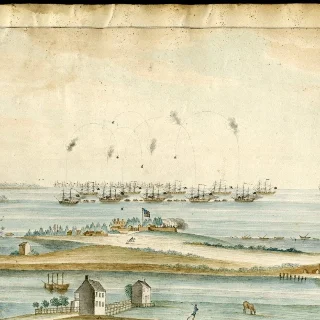
On September 14, 1814, Francis Scott Key was still aboard a ship in Baltimore Harbor after watching the British bombardment of Fort McHenry. The attack had lasted twenty-five hours. When smoke and fog lifted at dawn, the American flag was still flying over the fort, and the British fleet had failed to take Baltimore. 1
Key was a lawyer who had gone to the British fleet to help secure the release of his friend William Beanes. He could not leave while the attack was under way. Instead, he watched the fort hold through the night. The National Park Service records that the scene inspired him to write a poem called “The Defense of Fort McHenry.” 1
The poem was printed days later, set to the tune of “To Anacreon in Heaven,” and eventually renamed The Star-Spangled Banner. Congress made it the United States national anthem in 1931. The song began as a report from a ship: the fort was still there, and the flag was still visible. 2

An oath in a private library

Eighty-seven years later, the United States faced a different kind of danger. President William McKinley had been shot at the Pan-American Exposition in Buffalo. On September 14, 1901, McKinley died at 2:15 in the morning. Vice President Theodore Roosevelt was traveling back to Buffalo when he learned the news. 3
Roosevelt reached the city at about half past one in the afternoon. By three o'clock, he was back at the home of his friend Ansley Wilcox. The cabinet gathered there, and Judge John R. Hazel administered the oath in the house library. The ceremony lasted less than half an hour. At forty-two, Roosevelt became the youngest person to take the presidency. 3
The room was small. Newspapers were allowed in, but photographers were kept from taking pictures. Roosevelt promised to continue McKinley's policy, then drafted his first presidential proclamation in the same house. The transfer of power did not happen on an inaugural platform or before a large crowd. It happened in a borrowed room because the country needed a president immediately. 3

A hard landing on the Moon

On the same date in 1959, a Soviet probe crossed another threshold. Luna 2 became the first spacecraft to reach the surface of another celestial object. It did not make a gentle landing. It made what spaceflight histories call a hard landing on the Moon. 4
That distinction matters. Luna 2 was not designed to stand on the lunar surface and send back photographs. Its achievement was to travel beyond Earth and strike the Moon on purpose. Britannica places it inside a rapid sequence of Soviet missions: Luna 1 flew past the Moon, Luna 2 reached it, and Luna 3 later sent back the first images of the far side. 5
The mission turned a distant object into a reachable destination. Five years later, Luna 9 would make the first soft landing. Ten years after Luna 2, Apollo 11 would put people on the surface. A collision that lasted only a moment became part of the road to exploration.
September 14 keeps returning to the same image: something still visible after a night of uncertainty. A flag survives a bombardment. A government continues inside a private room. A radio signal ends when a machine reaches another world. The threshold is not always graceful. Sometimes history recognizes a new possibility because an object, a leader, or an idea has crossed a line and cannot go back.

This story was produced automatically by a channel. One sentence is all it takes for Neodrop to keep producing for you.

Related content