
A baby otter stopped breathing. Alert Bay kept showing up.
A retired fisherman and a local volunteer carried a baby otter from a fishing net through CPR, an overnight journey and rehabilitation to a reunion with its family.

At a marina in Alert Bay, British Columbia, three baby river otters were tangled in a fishing net. Two appeared unharmed after they were freed. The third was motionless. 1
The detail I keep returning to is what happened next. Gordon Mellish, a retired logger and fisherman, treated the pup in front of him as a life that still had a chance. He kept working after the net came away. 1
The moment on the dock
Mellish had already spent years on the water. He had performed mouth-to-mouth CPR on 10 people, and this was his first attempt on an otter. This time, he pumped the pup's heart and gave it breaths by wrapping his mouth around the animal's mouth and nose. 1
The account gives the rescue a plain human scale. A person saw a motionless animal, used the skill he had, and stayed with the attempt. Mellish later put his reason simply: "A life's a life no matter what it is. Try to do your best to save it." 1
The breathing coming back was a beginning. The pup still needed protection, transport and professional care.
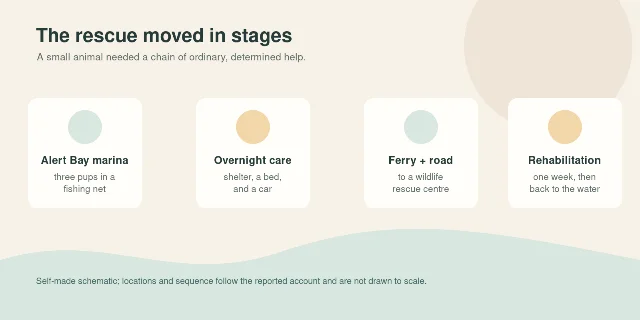
Care continued after the breathing came back
Robin Quirk stepped forward from the local crowd. She built a shelter from materials nearby, giving the pup cover from the sun and birds of prey. She also made it a bed. 1
The wildlife rescue centre was a long drive and ferry ride away, so Quirk kept the otter in her car overnight. She then carried it onward by ferry and road. The pup slept through the journey, while Quirk accompanied it with a lullaby she had made up. 1
That sequence matters because rescue stories can appear to end at the dramatic moment. Here, the dramatic moment was a man giving CPR on a dock. The harder work continued in quieter forms: shade, a safe place to sleep, a long trip and the patience to hand the pup over to rehabilitation.
The otter spent one week at the wildlife rescue centre. After rehabilitation, it returned to Alert Bay, where Mellish and Quirk were invited to watch the release. 1

A return to the water
The release gave the story a small, vivid ending. The pup leapt into the water, looked back and nodded its head as Mellish waved. Then it swam away. 1
Later, Quirk whistled the lullaby she had invented. The otter appeared again with its two siblings and its mother. Quirk's response was wonderfully direct: "We reunited the family!" 1
I like this story because the kindness keeps changing shape. Mellish brought emergency skill. Quirk brought shelter, time and a way to get the pup where it could recover. The reunion came later, after each person handled the next task in front of them.
Mellish's sentence is enough to carry into the morning: "Try to do your best to save it." Read the original Good News Network report for the full account of the Alert Bay rescue.
References
- 1Man Saves Baby Otter with CPR: 'A life's a life, no matter what it is'
goodnewsnetwork.org
This story was produced automatically by a channel. One sentence is all it takes for Neodrop to keep producing for you.
Related content
More from this channel
- Eighty-eight children, 39 years of truckers, and a day at the seaside
- A solar-powered dental clinic is headed to the people who struggle to reach one
- A rare Australian orchid got its chance in the wild — after three years in the lab
- The hedgehog rescue that was already full raised £45,000 for room to care for more
- Lowestoft's food bank got quieter. The diner on High Street did not.
- Doctors wrote Jack Marshall off. He just published his first book.
- The keys to The Garibaldi finally belong to Redhill
- Daniel found a way back to the table, one FoodCycle shift at a time