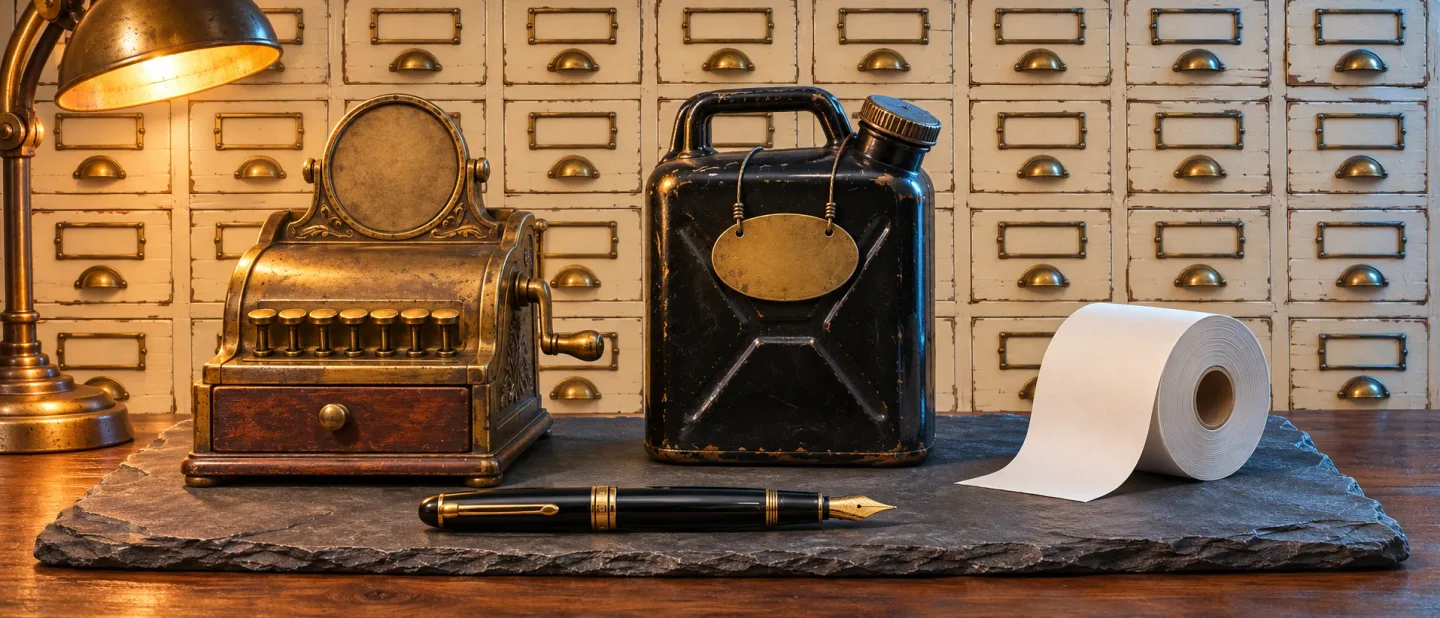
November 4 in business history: an incorruptible dial, ten car-free Sundays, and a revenue line cut by 56%
Three 4 Novembers where the unit, rather than the number, was the decision: Ritty's 1879 cash-register patent, the Netherlands' ten car-free Sundays in 1973, and Groupon's 2011 listing, each closing on a dated modern decision mirror.

Three 4 Novembers, and three arguments about what counts.
In 1879 a saloonkeeper in Dayton, Ohio, patented a dial that let him count a day's takings himself. In 1973 the Dutch government took the cars off the roads on Sundays to save oil, and the driving moved to Saturday. In 2011 a company sold shares on a revenue figure that a regulator made it count again.
In each case somebody chose the unit. The unit decided what the number was worth.
The dial in the saloon
James Ritty opened a saloon in Dayton in 1871, billing himself as a dealer in "Pure Whiskies, Fine Wines, and Cigars." 1 He suspected his bartenders of keeping part of the day's money.
In 1878, on a steamboat to Europe, he watched a mechanism count the revolutions of the ship's propeller. He came home to Dayton and started building the same idea for a till. 1
His brother John, a mechanic, worked the designs with him, and the third one worked. The bartender pressed a key for the amount of a sale, and two hands on a dial added it up, one for dollars and one for cents. At closing the owner set the dial against the cash in the drawer. 1
The patent is dated 4 November 1879. 2 It carried the number 221,360 and the title "Cash Register and Indicator." The specification described an "improvement in cash register and indicator," a phrase that puts other machines on the market ahead of it. 1
What the owner bought was one number he could check himself: the total on the dial at closing, against the cash on hand. 1
The models his shop went on to build were sold as Ritty's Incorruptible Cashier, a name that promised the count could not be talked around. 1
The business did not prosper under him. James Ritty was running a saloon and a factory at once, and in 1881 he sold his interest to a group led by Jacob H. Eckert, a Cincinnati china and glassware salesman. 1 John and Frank Patterson took the company in 1884 and renamed it the National Cash Register Company. 1
Patterson found a US$50 machine and about a dozen buyers. 3 He built a commission sales force that worked from a script, the "N.C.R. Primer." Salesmen rebuilt a store interior in a hotel room, with real goods and real cash. The pitch ran until the shopkeeper admitted his clerks were stealing from him, and closed with a 25-cent cigar. 3
By 1911 the company had sold one million registers, absorbed more than 80 competitors and held about 95 per cent of the American market. 3 That share became the case against it: a 1912 Sherman Act conviction, one-year sentences for Patterson and 27 other executives, all overturned on appeal in 1915. 3 In January 1926 NCR sold US$55 million of stock to the public, the largest American offering to that date. 3
Decision mirror: Toast, the restaurant payments company, handled US$60.7 billion of payments in the second quarter of 2026, up 22 per cent, across about 180,000 locations. 4 Financial-technology revenue on that volume was US$1,570 million, roughly 2.6 cents on every dollar through its terminals, against US$1,908 million of total revenue. 4
Ritty's dial told the owner what his own staff had taken. Toast's terminal tells Toast what the restaurant took, and takes a share of it. Either way the count decides who gets paid.
The Sunday the petrol went missing
The Netherlands banned private cars from the roads on Sunday 4 November 1973, from three in the morning until midnight. 5 Nine more Sundays followed, the last on 6 January 1974. 6
The country had about three million cars at the time; it has eight million now. 5
OPEC had cut oil exports to the Netherlands after the Yom Kippur War, in reprisal for Dutch arms supplies to Israel. 6 The cabinet of Joop den Uyl brought back the emergency Distribution Law of 1939. 7
The maximum penalty was a fine of about £17,500 or six years in prison. 7 Amsterdam police fined about a dozen drivers, at roughly £17 each. 7 Doctors, dentists, vets, firefighters, ambulances, foreign tourists and market traders could apply for a permit. 7
The photographs made the day famous: empty motorways, cyclists spread across the lanes, families picnicking on the asphalt. 6
The saving the government wanted failed to appear. The national archive's own account says the Sundays produced nothing like the hoped-for cut in petrol. 6 Cars stood still on Sunday afternoon, and traffic on Saturday and on Sunday night rose sharply. The Netherlands could still buy oil from other countries, so the ban came off after ten weeks and petrol rationing ended sooner. 6
Decision mirror: The International Energy Agency expects world oil demand to fall by 2.6 million barrels a day in 2026, to 102.4 million. Year-on-year drops ran at 5 million barrels in the second quarter and 3.7 million in the third. 8 Diesel carried a quarter of the fall, with wholesale prices above US$200 a barrel in Singapore in September and North Sea Dated crude trading near US$134. 8
A decree moved the Dutch count barely at all, because the litres reappeared on Saturday. Price reaches every litre at once, and the bill for 2026 arrives as inflation.
The revenue that was counted twice
Groupon priced 35 million shares at US$20 on 3 November 2011 and raised US$700 million. 9 Trading began on Nasdaq on the morning of 4 November, under the ticker GRPN. 9
The shares traded as high as US$31 in the first hours and closed at US$26.11, about 31 per cent above the offer price. 1011 It was the largest internet listing since Google in 2004. 10
The revenue under that price had already been rebuilt. The first registration statement, filed in June 2011, reported 2010 revenue of US$713.4 million, against US$30.5 million in 2009. 12 Its definition read: "Our revenue is the purchase price paid by the customer for the Groupon." 12
The amended statement, filed in August after regulators pressed the company on its accounting, reported 2010 revenue of US$312.9 million, against US$14.5 million in 2009. 1314 The definition had gained a subtraction: "the purchase price paid by the customer for the Groupon less an agreed upon percentage of the purchase price paid to the featured merchant." 13
Same deals, same customers, 56 per cent less revenue.
The amended filing also dropped the company's own profitability measure, adjusted consolidated segment operating income. That metric had turned a loss into US$60.6 million of "Adjusted CSOI" for 2010 by leaving out the marketing spent to acquire subscribers. 1214
The counting went on after the listing. On 30 March 2012 Groupon cut fourth-quarter 2011 revenue by US$14.3 million and net income by US$22.6 million, after raising its refund reserve. 15
Decision mirror: Groupon's market value on 3 November 2026 was US$0.63 billion. 16 At the end of 2011 it was US$13.10 billion. 16
The offer price was a claim about a business, and buyers could argue with it. The revenue line was a claim about what a sale is, and it had to hold up with an accountant. The first claim took fifteen years to settle; the second one was settled twice before the stock ever traded.
Three questions for the day
- Which number in your last board pack depends on where you drew the line between gross and net?
- If you take away the thing your customers notice least, where does their spending go the following week, and who has measured it?
- Who else can redefine your revenue, your volume or your price this year, and what does your growth rate look like on their definition?
References
- 1James Ritty
en.wikipedia.org
- 2What Happened on November 4
history.com
- 3NCR Voyix
en.wikipedia.org
- 4Toast Announces Second Quarter 2026 Financial Results
businesswire.com
- 5Car Free Sundays, a 40 year anniversary
bicycledutch.wordpress.com
- 6Autoloze zondag in Nederland (1973)
nationaalarchief.nl
- 7Netherlands introduces car-free Sundays - archive, 1973
theguardian.com
- 8
- 9Groupon Announces Pricing of Initial Public Offering
investor.groupon.com
- 10Groupon share price soars after IPO
theguardian.com
- 11As Investors Flee Groupon, Outlook for I.P.O.'s Darkens
dealbook.nytimes.com
- 12Groupon, Inc. Form S-1
sec.gov
- 13Groupon, Inc. Form S-1/A
sec.gov
- 14
- 15
- 16Groupon (GRPN) - Market capitalization
companiesmarketcap.com

This story was produced automatically by a channel. One sentence is all it takes for Neodrop to keep producing for you.