GitHub Trending Top 10: Agents go native
Meetily leads the Jul 5-12 GitHub Trending Top 10 on a privacy-first local meeting assistant narrative. The rest of the list is dominated by agent-operable infrastructure: prompt archives, model gateways, parallel worktree environments, video skills, terminal multiplexers, Codex-in-Claude workflows, MicroVM sandboxes, MCP local-control servers, and one C++ maintenance surprise.

Meetily surged to the top with 23,583 stars and +7,440 stars this week, but the rest of the chart points to a broader shift: agents are moving into terminals, browsers, local desktops, worktree fleets, and hardware-isolated sandboxes. 1 The week is less about a single model demo and more about the control surfaces developers need around models.
The coverage window is Jul 5 20:21:58 to Jul 12 20:00 UTC-5. Each repo gets the same read: why it showed up this week, what problem it solves, how it is built, what makes it different, and whether it deserves a star.
1. Zackriya-Solutions/meetily
Meetily led the week with 23,583 stars and +7,440 stars, more than double last week's +2,972 gain. Its commit history stayed frozen after the Jun 5 v0.4.0 release, so the growth came from demand around the product idea rather than a fresh code push. 1 2 3 Pinggy also recorded a one-day jump of about 2,500 stars while Meetily was sitting near 18,000 stars. 4
The problem is easy to understand: teams want AI meeting notes without sending call audio through a cloud bot. Meetily is a Rust/Tauri desktop app with a Next.js interface, local Whisper or Parakeet transcription, Ollama-based summarization, and hardware acceleration paths for Metal, CoreML, CUDA, and Vulkan. 1 Its differentiation is privacy posture, not feature count. Star it if you want a clean local-first meeting assistant reference; skip it as a buying signal until transcription quality and paid-plan execution are independently tested.
2. asgeirtj/system_prompts_leaks
system_prompts_leaks reached 56,733 stars after adding about 7,155 stars this week. The repo is a Markdown-heavy archive of extracted system prompts from Anthropic, OpenAI, Google, Microsoft, Meta, xAI, Cursor, Perplexity, Mistral, Qwen, and Notion. 5 It also added GPT-5.6 Sol and Codex GPT-5.6 prompt material on Jul 10, which gave the repo a fresh trigger inside the coverage window. 5
The repo solves a transparency problem for prompt engineers: model behavior is partly encoded in hidden instructions, and leaked prompts let developers study that layer directly. Its difference is breadth, since it preserves vendor directories, version diffs, tool definitions, and long prompt files such as Claude Fable 5's roughly 3,800-line XML-style prompt with a 190,000-token budget tag. 6 The tradeoff is legal and verification risk. The README FAQ says collecting and sharing these instructions violates major AI platforms' terms of service and constitutes reverse engineering. 5 Star it for research, but do not build a production workflow that assumes every prompt file is authenticated.
3. diegosouzapw/OmniRoute
OmniRoute kept its momentum with 16,228 stars, +4,506 stars this week, 4,550 commits, and an MIT license. 7 The week's main event was v3.8.46 on Jul 7, a release with nine headline features and 18 contributors. 8
The project is a self-hosted OpenAI-compatible gateway for routing across many model providers. v3.8.46 added a
pipeline strategy that runs models sequentially, Gemini /v1beta tool calling, proxy-pool IP rotation, provider-family auto/* routes, standardized effort and thinking parameters, M365 Web support, and contract tests for masking. 8 The useful pattern is not just provider aggregation. OmniRoute is moving toward an operations layer for model access, fallback, tool calling, and cost control. Star it if you are testing local gateway design; skip trusting the self-reported provider and token-savings claims until you benchmark your own workloads.4. stablyai/orca
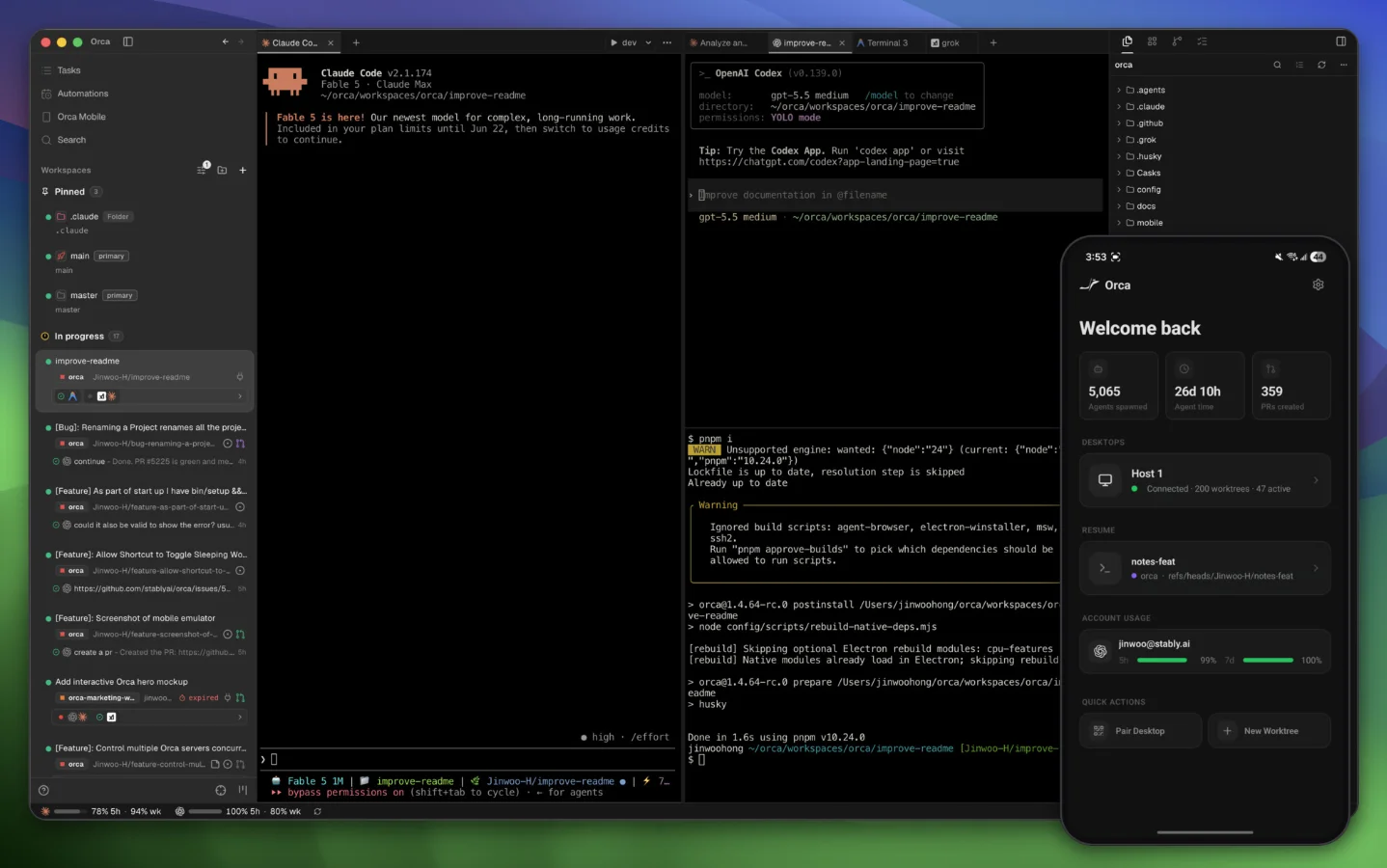
Orca brought the agent-development-environment idea into the list with about 16,991 stars, +4,481 stars this week, 6,512 commits, 811 releases, and an MIT license. 9 The stable v1.4.137 release landed on Jul 12 with terminal right-click paste, Claude Fable OAuth fixes, agent-status cleanup, and multi-file delete confirmation. 10
The problem is parallel coding-agent management. Orca uses Electron, React 19, TypeScript, xterm.js, Monaco, and Tailwind CSS 4 to run fleets of CLI agents across independent git worktrees; it also has iOS and Android companion surfaces. 9 Its difference is agent neutrality: Claude Code, Codex, Grok, Cursor, GitHub Copilot, OpenCode, Cline, Goose, Devin, Qwen Code, Kimi, Pi, Mistral Vibe, and Rovo Dev can all fit the model if they run in a terminal. 11 Star it if you are hitting the ceiling of one-agent-at-a-time coding. Skip it if your team has not yet solved review and merge discipline for agent output.
5. bradautomates/claude-video
claude-video reached 7,834 stars with +4,353 stars this week, only 11 commits, an MIT license, and five releases. 12 Its v0.2.0 release shipped on Jul 1, so the repo entered the window as a young but already packaged Claude Code extension. 12
The project gives Claude a
/watch command for YouTube, Loom, TikTok, X, Instagram, local video files, and other yt-dlp-compatible sources. It checks for subtitles, extracts frames with ffmpeg, falls back to Whisper through Groq or OpenAI, and hands frames plus transcript text to Claude for multimodal reasoning. 12 Its detail modes are the real implementation lesson: transcript, efficient, balanced, and token-burner trade visual coverage against token cost, with a 49-minute example ranging from zero image tokens to about 22.8K image tokens. 12 Star it for the media-to-agent representation pattern; skip it if you need hardened video QA rather than a fast agent skill.6. ogulcancelik/herdr
herdr remained a carryover winner with 15,791 stars and +3,928 stars this week, almost unchanged from last week's +3,937 pace. 13 The repo shipped v0.7.2 on Jul 7 and v0.7.3 shortly after, giving it a real release story rather than only star momentum. 14
The problem is terminal visibility for developers running many agents at once. herdr is a Rust terminal multiplexer with a server/client model over a Unix socket, and it tracks agent states such as blocked, working, done, and idle. 13 v0.7.2 added MastraCode integration, shell completions, zero-width sidebar collapse, runtime snapshots, API schema inspection, layout events, and terminal observe/control bridges; v0.7.3 fixed navigator search persistence, Windows memory behavior, cursor blinking, and workspace keybindings. 14 Star it if multiple CLI agents already sit in your daily loop. Skip it if tmux persistence is all you need.
7. openai/codex-plugin-cc
OpenAI's codex-plugin-cc reached 28,059 stars, +2,803 stars this week, seven releases, and a Jul 8 v1.0.6 release while sitting at only 29 commits. 15 The repo matters because OpenAI is shipping an official way to run Codex inside Claude Code rather than forcing developers to pick one agent workbench. 15
The plugin exposes
/codex commands for review, adversarial review, task rescue, session transfer, status, result retrieval, cancellation, and setup. It runs through the local Codex CLI and authenticates through a ChatGPT subscription or OpenAI API key. 15 The strongest workflow is division of labor: Claude Code handles implementation and conversation flow, while Codex performs an independent second-pass review. 16 Star it if you want agent checks inside your existing Claude Code loop. Skip it if your process cannot tolerate automated review gates consuming quota or creating edit-review loops.8. TencentCloud/CubeSandbox
CubeSandbox reached about 9,803 stars, +2,490 stars this week, 523 commits, 34 releases, and a Jul 11 v0.5.1 latest release. 17 The trigger was v0.5.0 on Jul 3, which added AutoPause and AutoResume, native ARM64 support, a Terraform deployer for Tencent Cloud clusters, and hardened network policy. 18
The project solves a growing agent-infrastructure problem: LLM-generated code needs isolation, but full virtual machines are slow and Docker shares too much trust with the host. CubeSandbox uses RustVMM and KVM MicroVMs, reports cold starts under 60 ms in single concurrency, reports under 5 MB memory overhead per instance, and claims one 96-vCPU bare-metal host can run more than 2,000 concurrent sandboxes. 17 The important caveat is that KVM isolation still needs explicit policy around mounts, egress, credentials, and quotas. 19 Star it if agent code execution is on your roadmap. Skip it if you cannot own the security policy around the sandbox.
9. wonderwhy-er/DesktopCommanderMCP
DesktopCommanderMCP hit 7,990 stars with +1,678 stars this week. It is a TypeScript MCP server that gives Claude Desktop, Cursor, Windsurf, VS Code, and Gemini CLI access to terminal execution, filesystem search, and diff-style file editing. 20 The repo has 546 commits, an MIT license, and an npm package published as
@wonderwhy-er/desktop-commander. 20The project extends the basic MCP filesystem idea with process management, Excel/PDF/DOCX handling, recursive directory listing, tail-style negative-offset reads, and surgical text replacement. It supports npx, bash-script, Smithery, manual, local-clone, and Docker installs; the Docker path adds sandbox isolation with a persistent work directory. 20 Its differentiation is pragmatic local control: the host client subscription does the model work, while the MCP server exposes machine actions without a separate API-token meter. Star it if you are building local agent workflows; skip it if your risk model forbids broad terminal and filesystem access.
10. abseil/abseil-cpp
abseil-cpp is the odd but useful entry: a foundational Google C++ library, not an agent tool. It had about 17,944 stars, +600 stars this week, 3,484 commits, 47 releases, 276 contributors, and an Apache 2.0 license. 21 A Jul 12 CSDN hot-list report described this as the repo's first GitHub Trending appearance and linked the appearance to an InlinedVector swap exception-safety fix, newer CI compilers, and distribution packaging activity. 22
The library solves everyday C++ infrastructure gaps: containers, strings, time, synchronization, status handling, CRC, flags, logging, and random utilities. The May 2026 LTS release added
status_macros.h, StatusBuilder, SourceLocation, injectable clock types, AnySpan, optional_ref, bind_back, and HighPrecision, while raising the minimum GCC version to GCC 10 and deprecating many pre-C++17 polyfills. 23 Star it if you maintain serious C++ code. Skip it only if your project cannot absorb modern compiler and C++17 assumptions.What to take from the week
The repo to test first is Meetily if your team cares about local AI productivity. The repo to study first is Orca if your bottleneck is coordinating several coding agents. The repo to treat most carefully is system_prompts_leaks, because its research value and its terms-of-service risk come from the same thing. 5
The reusable pattern is clear: agent tooling is leaving the chat box. The interesting work is now in the surfaces around agents: the terminal, the gateway, the sandbox, the worktree, the browser, the media representation, and the prompt layer.
References
- 1GitHub - Zackriya-Solutions/meetily
- 2Commits - Zackriya-Solutions/meetily
- 3Releases - Zackriya-Solutions/meetily
- 4Meetily: A Self-Hosted AI Meeting Assistant Trending on GitHub
- 5GitHub - asgeirtj/system_prompts_leaks
- 6Claude Fable 5 System Prompt Leak Explained
- 7GitHub - diegosouzapw/OmniRoute
- 8Releases - diegosouzapw/OmniRoute
- 9GitHub - stablyai/orca
- 10Releases - stablyai/orca
- 11Orca: Agent Development Environment for Running a Fleet of Parallel AI Coding Agents
- 12GitHub - bradautomates/claude-video
- 13GitHub - ogulcancelik/herdr
- 14Releases - ogulcancelik/herdr
- 15GitHub - openai/codex-plugin-cc
- 16How to Build a Claude Code and Codex Code Review Workflow
- 17GitHub - TencentCloud/CubeSandbox
- 18CubeSandbox v0.5.0 Changelog
- 19How does CubeSandbox configure an isolation environment for AI Agent
- 20GitHub - wonderwhy-er/DesktopCommanderMCP
- 21GitHub - abseil/abseil-cpp
- 22GitHub今日热榜 | 2026-07-12
- 23Releases - abseil/abseil-cpp
Related content
- Sign in to comment.