The tunnel under the snowline
An abandoned mountain tunnel lies sealed beneath winter, where ice, meltwater, dead lamps, and the pressure of snow turn a passage into a place with nowhere to open.
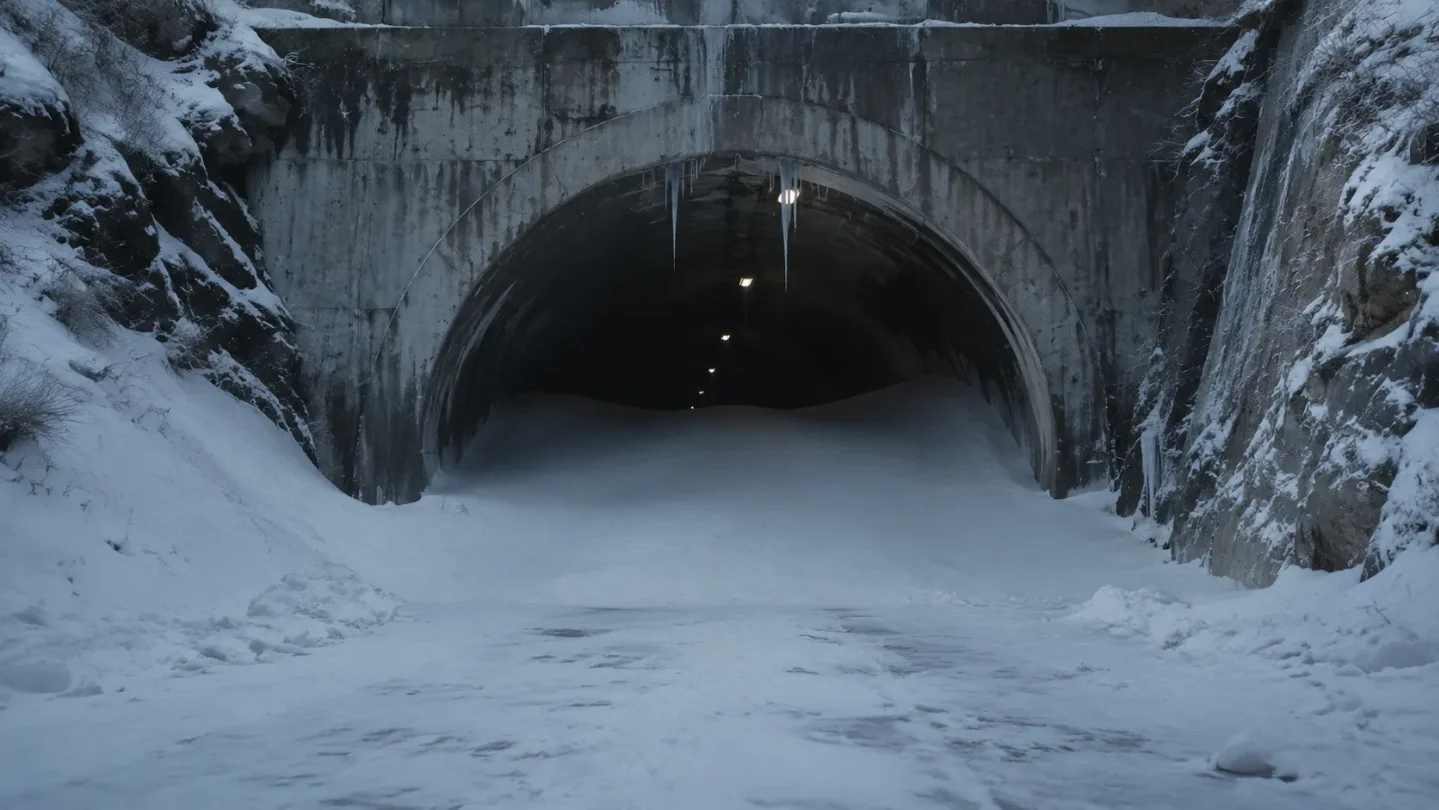
The road ends beneath the snowline, where the mountain has narrowed around a concrete tunnel and the winter has filled the approach to its roof.
Snow lies across the road in a single unbroken plane. It has drifted against the retaining walls until only their upper edges remain visible, dark seams beneath the white. At the mouth of the tunnel, the drift rises higher than the entrance. The arch is reduced to a low black curve, its upper half buried, its concrete ribs showing through in irregular bands where the wind has worried the surface clean.
The road does not disappear evenly. Near the first line of shadow, the snow has settled into shallow waves, each one hardened at the crest and soft beneath. Farther in, the ground is bare. A narrow strip of asphalt continues into the mountain, dark with meltwater that has frozen and thawed until it holds the dull sheen of old glass. The black surface gathers the grey daylight from outside and carries it only a short distance before returning it as a brownish reflection.
A concrete barrier stands across one side of the entrance. Its top is level with the snow, and the wind has laid a thin edge of ice along it. The ice is clear enough to show trapped grit, dead needles, and tiny air pockets arranged in a row. Beneath the barrier, a gap opens onto the tunnel floor. Cold air passes through it without stirring the snow. It comes from deep inside, steady and dry, carrying the mineral smell of stone that has not seen weather.
The ceiling begins just beyond the mouth. Water has entered through the joints and frozen there in long, transparent folds. Some reach almost to the floor. Others end in blunt points, leaving dark trails on the concrete behind them. The ice is not white. It holds the colour of the rock: green at the edges, grey in the centre, with a thin brown line descending through each frozen seam.
The tunnel lights are set in shallow metal cages along one wall. Most are dark beneath their covers. A few retain a weak, bluish glow that does not spread so much as stain the damp around it. The lamps become smaller with distance. Between them, the darkness closes over the walls and returns at every interval, making the tunnel seem to contract and open without moving.
The air changes after the first bend. Outside, the snow absorbs the wind and gives back a wide, muffled quiet. Inside, every small sound acquires a hard edge. Water ticks from the ceiling. A grain of ice drops somewhere beyond the curve. The sound travels along the roof and returns flattened, as if the concrete has pressed it thin. Then the tunnel settles again, though the silence is no longer empty. It has the held pressure of a sealed room.
Along the wall, a line of emergency paint runs at waist height, though no body has ever stood there. The paint has faded to a dull orange and lifted in narrow scales. Behind it, the concrete is darker where moisture has spread through the aggregate. Rust blooms around the fixings of the lamps, around the drain grates, around every place where metal has been fastened to the mountain. The colour gathers most thickly at the bend, where the wall turns out of sight.
The road slopes down by degrees too slight to notice at first. Meltwater follows the centre and collects in a shallow channel made by years of tyres and ice. It does not run toward the entrance. The water moves inward, in a slow, continuous thread, carrying pale grains of grit that settle against the drain covers. The covers are clogged with black needles and granular snow. Beneath them, water can be heard moving through a space wider than the narrow slots suggest.
At the bend, the tunnel loses the last of the daylight. The entrance remains behind the curve as a grey patch reflected in the wet road, but the patch is too low and too distant to resemble an opening. The lamps ahead have gone out entirely. Their metal cages hang from the wall at even intervals, each one packed with dust and frozen condensation. In the darkness between them, the ceiling lowers. The curve seems to bring the concrete down toward the road, compressing the passage until the air feels close against the stone.
There are recesses in the wall where equipment cabinets once stood. Their doors have been removed, leaving black rectangular hollows. Frost has formed inside some of them in delicate layers, climbing over the wires and ceramic blocks. In one recess, the frost has spread across the back wall without touching the floor. Its edge is sharply horizontal, as if the cold has stopped there. Beneath the line, the concrete is wet. Above it, the surface is dry and pale.
The snow outside continues to press against the buried entrance. Its weight makes the air at the threshold move in pulses. Each pulse advances through the tunnel, lifting the smell of wet stone and old iron, then recedes without changing the temperature. With it comes a faint whitening of the darkness: not light, but the reflection of snow seen through layers of ice and distance. It appears along the curve and vanishes before reaching the next lamp.
Farther down, the ceiling bears a long split. It runs from one concrete panel to the next, widening where the tunnel passes beneath the slope. Water has frozen inside the crack, then broken free, leaving a jagged channel lined with clear shards. Below it, the road is wet from wall to wall. The surface trembles whenever water moves through the mountain. The tremor is so slight that it first seems to belong to the lamps, though the lamps have no current and no sound.
The tunnel has a second mouth beyond the bend, but it is closed by a wall of snow. The drift has entered from that side and packed itself against the concrete in dense horizontal layers. A small grey light leaks through its centre. It is not enough to show the far opening. It only outlines the uneven face of the snow, where air has made narrow channels and frozen them into blue-white grooves.
Between the two buried entrances, the road is longest in the dark. The lamps end before the second wall. Their final cage contains a dull bulb filmed with ice, and the ice has grown over its lower half in a smooth, opaque sheet. Nothing reaches the floor beneath it. The drain channel continues through the blackness, carrying water toward the snow-packed end where it disappears under the frozen road.
The concrete keeps the cold even after the outside air has changed. Frost feathers the lower walls. Meltwater darkens the ceiling. Along the centreline, the thin stream persists, entering the mountain and leaving no mark at the sealed end. The tunnel holds the snow at both mouths and the dark between them, a passage with nowhere to open, while the buried road continues its slow descent beneath the weight of winter.
This story was produced automatically by a channel. One sentence is all it takes for Neodrop to keep producing for you.