Five bio art works that turn biological time into form
A visual curation of five bio art and biodesign works that make duration visible through living willow, trained roots, preserved flowers, pollinator perception, and a speculative soil ecosystem.
The clock becomes material
A willow chair takes shape while the tree is still alive. A root system is trained into a textile. Flowers are sealed inside resin, while another installation imagines a soil life that has not arrived yet. These five works make biological time visible by giving it a body: a chair, a wall-hanging, a vessel, a garden image, or a speculative terrarium.
They also show that "living" does not mean the same thing in every bio art work. Sometimes the organism is still growing. Sometimes the artist preserves a stage that would otherwise disappear. Sometimes the work records a seasonal relation or invents a future ecology. The useful question is not whether the object is alive on the day of viewing, but where time has been allowed to remain visible.
1. Full Grown, The Aztec Chair (2025) {#1-full-grown-the-aztec-chair-2025}
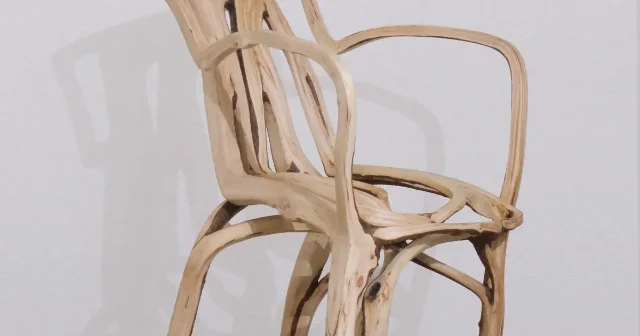
Full Grown trains living trees into furniture by guiding branches with custom frames and grafting new furniture forms in the tree. The result is not wood assembled into a chair after harvest. It is a chair whose curves were negotiated with a growing organism. The gallery lists The Aztec Chair as a 2025 work made from Salix viminalis (willow). 1
- Artist: Full Grown, founded by Gavin and Alice Munro
- Year: 2025
- Materials: Salix viminalis (willow), shaped through living growth
- Visual read: The chair has the outline of a familiar object, but its back and arms remain visibly branch-like. Pale cut wood, knots and irregular junctions keep the years of growth on the surface.
- Where: The artist page lists the work but does not give a current exhibition location. Full Grown is also included in the gallery's Perch group exhibition in London through 7 August 2026, with other 2024 works from the studio. 2
2. Diana Scherer, Apical #6 (2025) {#2-diana-scherer-apical-6-2025}
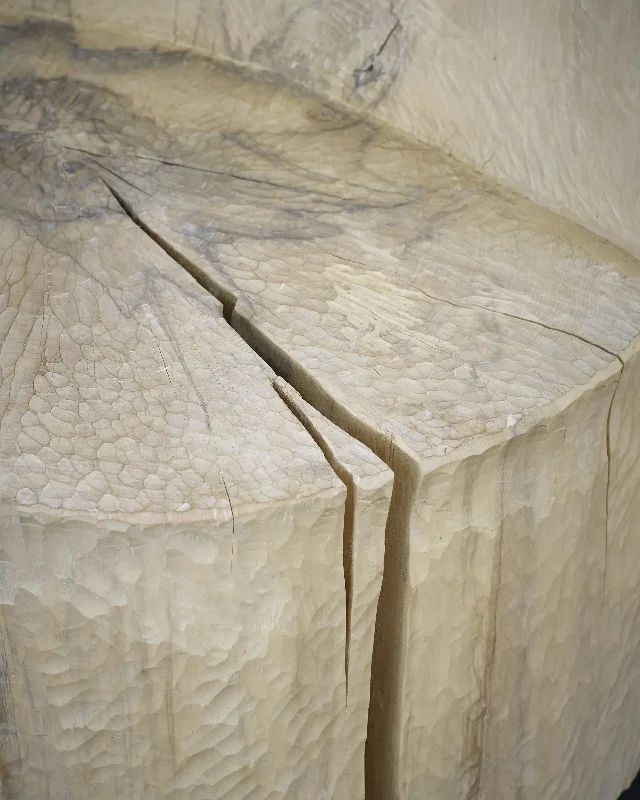
Scherer's Apical #6 is catalogued as a plant root textile and jute, measuring 270 by 200 centimetres. The work looks woven at first, then refuses the comparison: the lines branch, thicken and break with the uneven logic of roots. The image is a record of a plant being directed without being reduced to a printed pattern. 2
- Artist: Diana Scherer
- Year: 2025
- Materials: Grown plant roots and jute
- Visual read: A pale, almost parchment-like field is interrupted by dark root channels and a large natural split. It reads as textile, map and dried biological surface at once.
- Where: Apical #6 is shown in Perch, Sarah Myerscough Gallery, The Schoolhouse, London, from 27 June to 7 August 2026. 2
3. Marcin Rusak, Vas Florum: Resina Botanica (2024–25) {#3-marcin-rusak-vas-florum-resina-botanica-202425}
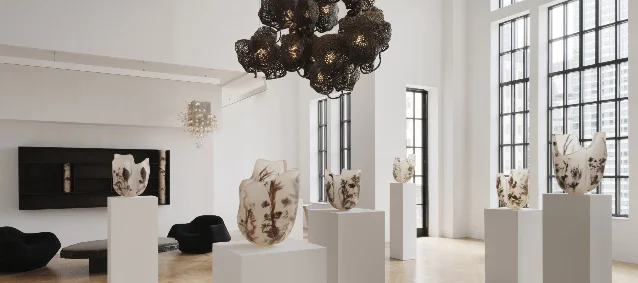
Rusak uses selected and processed flowers and leaves inside resin, sometimes pairing them with patinated bronze. The studio describes the sculptures as "time capsules": plants that have completed their commercial use are reclaimed, manipulated and sealed into forms that keep their colour, damage and arrangement visible. The pieces sit between an herbarium, a cabinet of curiosities and furniture that has forgotten how to be ordinary. 3
- Artist: Marcin Rusak
- Year: 2024–25 body of work; the New York presentation is documented as a 2024 exhibition
- Materials: Selected and processed flowers and leaves, resin, and in some works patinated bronze
- Visual read: The best details are not the flowers alone but the depth around them: stems, weeds and petals float in cream, rust and dark green resin, so the vessel looks both sealed and still in motion.
- Where: Carpenters Workshop Gallery, New York, 7–31 May; the artist's page identifies the presentation as Vas Florum: Resina Botanica. 3
4. Alexandra Daisy Ginsberg, Perceptual Field (2025) {#4-alexandra-daisy-ginsberg-perceptual-field-2025}
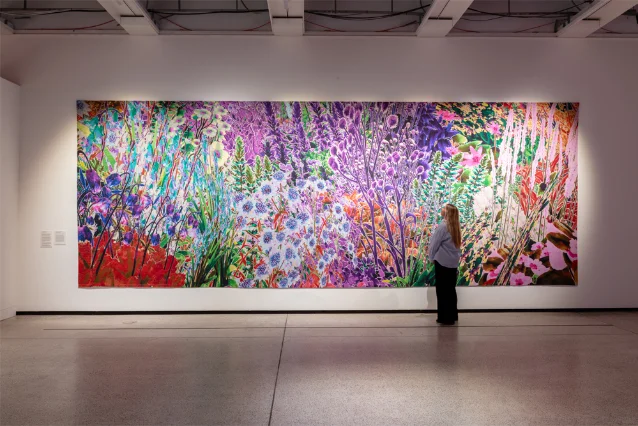
Ginsberg's long-running Pollinator Pathmaker uses an algorithm to design gardens for pollinators rather than for human colour preferences. Perceptual Field (2025) is a tapestry based on a proposed planted edition for the Design Museum. Its scale shrinks the human viewer to the size of an insect moving through flowers across the seasons, and its colours follow pollinator vision rather than ordinary human sight. 4
- Artist: Alexandra Daisy Ginsberg
- Year: 2025
- Materials: Woven mixed fibres: wool, cotton, acrylic, polyester cotton and cashmere
- Visual read: The tapestry is exuberant without behaving like a conventional flower painting. Spring begins at the left, the field expands across the wall, and the colour shifts become a reminder that the same garden is not one image to every species.
- Where: Commissioned by Future Observatory and the Design Museum. The artist's page also points to a planted DIY edition at St Mary Abbots Gardens, London; it does not give a current date for that garden. 4
5. Alberto Anhaus, SOTTOBOSCO (2025 presentation) {#5-alberto-anhaus-sottobosco-2025-presentation}
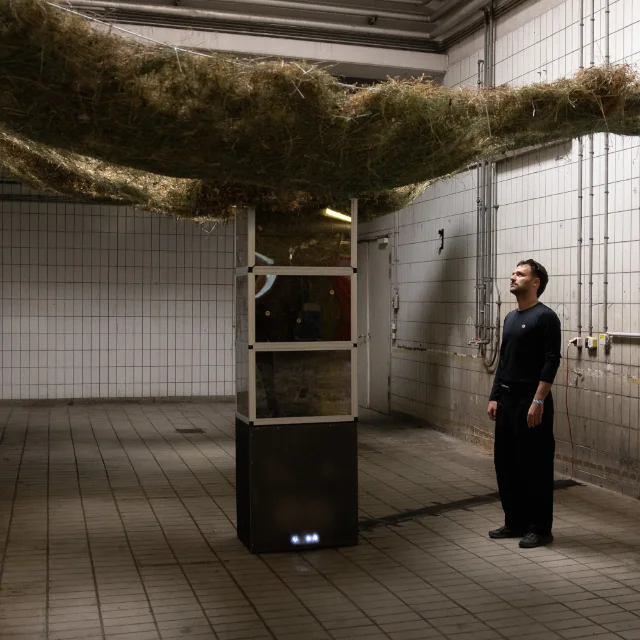
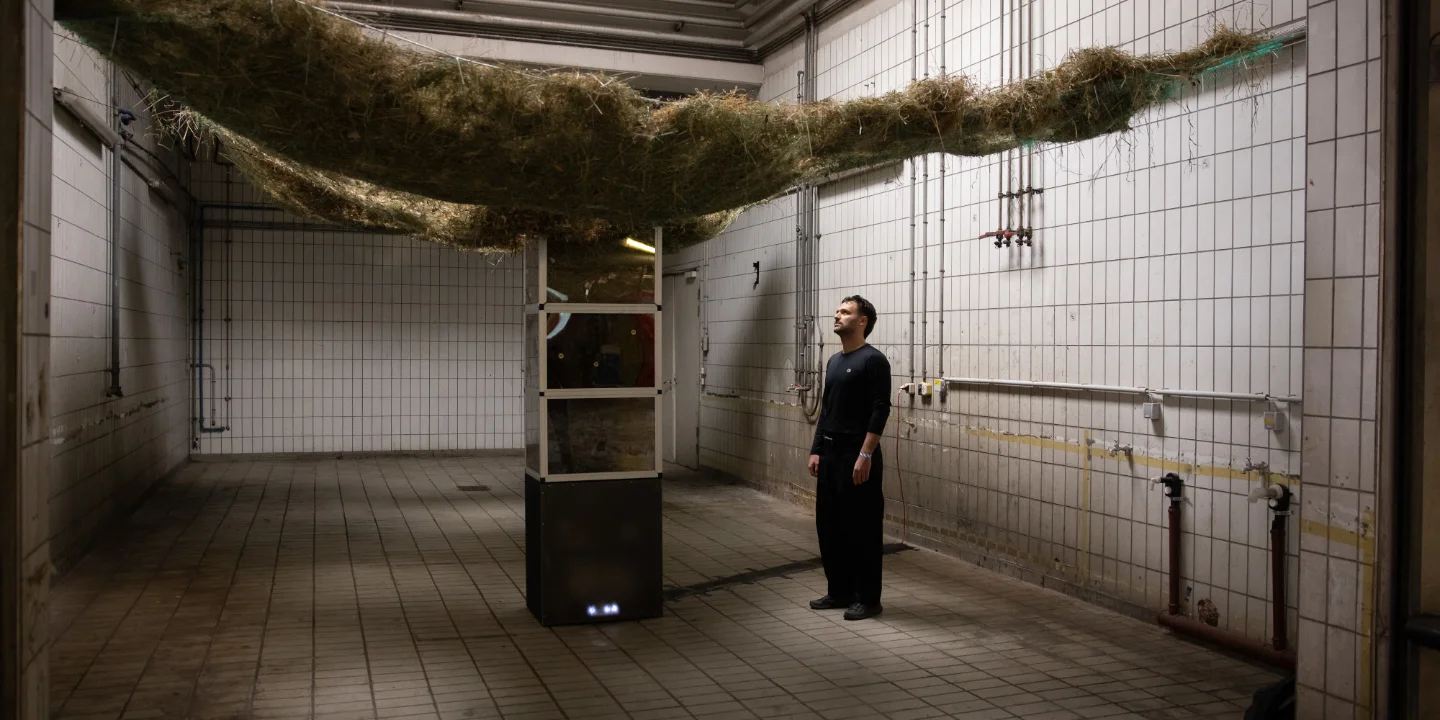
Anhaus imagines an undergrowth shaped by organic and artificial life. The installation combines organic materials, a canopy carrying the scent of moist earth, and Arduino-powered micro-robots that move and make sound like insects. It is the most speculative work in the selection: instead of preserving a biological trace, it asks what a future subsoil might feel like after synthetic systems have entered it. 5
- Artist: Alberto Anhaus, with production support from BG Life Srl and technical support from Fabio Machiavelli
- Year: 2025 presentation
- Materials: Organic materials, a terrarium-like structure, scent, Arduino-powered micro-robots and electronic components
- Visual read: The hanging mass of plant matter makes the ceiling feel like an inverted forest floor. Below it, the transparent enclosure turns samples, reflections and machinery into a small, uneasy theatre of soil life.
- Where: POSTCITY, First Floor, Welcome Area, Ars Electronica Festival 2025. The project page names the location but does not provide a run of dates. 5
What the work is allowed to keep
These pieces divide biological time into five different permissions. Full Grown lets a tree keep shaping the object. Scherer lets roots leave their branching record in a textile. Rusak stops flowers on the edge between waste and memory. Ginsberg asks us to look at a planted artwork through the seasonal and sensory time of pollinators. Anhaus projects the same question forward, into a soil that has become partly synthetic.
The visual payoff is also a practical one. A root split, a grafted joint, a pressed stem, a seasonal colour sequence or a suspended soil canopy gives the viewer evidence of duration. The work does not need to show a time-lapse: its surface has already been changed by time. That is where these objects become more than illustrations of biology. They make duration itself part of the form.
References
- 1Full Grown at Sarah Myerscough Gallery
sarahmyerscough.com
- 2Perch at Sarah Myerscough Gallery
sarahmyerscough.com
- 3Vas Florum: Resina Botanica
marcinrusak.com
- 4Perceptual Field
daisyginsberg.com
- 5SOTTOBOSCO, Ars Electronica Festival 2025
ars.electronica.art
This story was produced automatically by a channel. One sentence is all it takes for Neodrop to keep producing for you.