Knit a Seed-Stitch Cotton Washcloth

Knit a Seed-Stitch Cotton Washcloth

A knitted cloth begins as a plain row of loops. Work every second loop the other way round, and those loops swell into small raised bumps, packed across the fabric like seeds. That is all seed stitch is, and it is what this cloth is made of.

0:00 / 10:00
Two stitches do all the work in knitting. If you already knit, you know the first one; today you meet the purl, and with it you can make a fabric that is bumpy, reversible, and flat as a board — exactly what a washcloth wants to be.
Plan on two or three sittings rather than one long session. The pattern is a single row repeated, so it is a good thing to keep beside a chair. The notes below follow the episode's order, so you can check a step whenever your hands are busy.

What you'll need

  • One ball of medium weight cotton yarn, about 50 yards for one cloth. The band usually calls it worsted, or number 4 inside the yarn symbol.
  • One pair of knitting needles in the size your yarn band recommends — worsted cotton usually asks for US 7 to 9, which is 4.5 to 5.5 mm 1
  • Scissors
  • A yarn needle for weaving in the ends
  • A stitch marker
  • Optional: a small crochet hook for catching a dropped stitch, and a ruler
Gauge does not matter on a washcloth. A cloth that lands an inch wider or narrower is still a perfectly good washcloth, so you can skip the practice swatch and cast straight on.

Get set up

Sit with your shoulders dropped and the work close in, so you are not reaching forward. Let the ball rest in a bowl beside you so it can turn without escaping onto the floor, and give the needles a resting place for every pause — a shallow dish does the job, because live stitches slide off a needle the moment it lands on a table.
The tips are pointy, so keep needles, scissors and loose yarn ends out of reach of children and pets. Cotton is also hard on the hands, because it has no stretch to give back: take a break when your fingers or arms get tired, and stop at the end of a row rather than in the middle of one 2.

Work the purl

Cast on 37 stitches — a comfortable width, and an odd number, which matters in the next section. Use whichever cast-on you know; a knitted cast-on is the forgiving one if casting on is new to you.
The beginner dishcloth pattern this session follows casts on 27 stitches for a 6-inch cloth, 37 for an 8-inch one, and 45 for a 10-inch one, so you can size the cloth before you begin 3.
Then, for each purl:
  1. Bring the working yarn to the front, between you and the needles. In the knit stitch it lives at the back; for a purl it stays in front the whole way.
  2. Slide the right needle into the front of the first loop on the left needle, from top to bottom.
  3. Wrap the yarn around the right needle from front to back, all the way round.
  4. Draw the wrap under the needle and through the loop, then let the old loop slide off the left needle.
A knit looks like a flat V; a purl looks like a small raised bump, like a pearl on its side. The back of every purl is a knit and the back of every knit is a purl, which is why these two stitches alone can build every fabric in knitting 4.

The seed-stitch rule

With 37 stitches, every row is the same row: knit one, purl one, and repeat that pair to the end, finishing on a knit. Then turn the work and do it again, all the way up the cloth 3.
The odd stitch count is what makes that work. Each knit falls on top of a purl from the row before, so the bumps scatter instead of stacking, and a scattered, balanced fabric lies flat and looks the same on both faces 5.
If you would rather not count at all, knit by the stitch in front of you: knit the purls and purl the knits. If it faces you as a bump, knit it; if it faces you as a V, purl it 3.
If you lose your place in the middle of a row, read the next stitch waiting on the left needle: a bump means knit, a V means purl.
That rule is the opposite of ribbing, which stacks its knits and purls into stretchy columns, like a sock cuff. Mixing the two up is the classic beginner's mistake, and a stitch marker slid on after the first stitch of a row is the usual reminder 5.

Reading the cloth as it grows

After four or five rows the fabric should feel like a field of small pebbles, or the rough side of a raspberry. Those purl bumps are the point of the whole project: the dishcloth pattern calls them its scrubbing bumpies, and they lift food off a plate as a smooth fabric never quite does 3.
Count your stitches at the end of every row — 37 out, 37 back. An extra loop from a stray yarn-over reads as 38, and a slipped stitch as 36. Catching that on the row it changed is far easier than finding it ten rows later.
One thing you may notice with cotton: purl rows can come out a little looser than knit rows, so a faint banding appears across the cloth. Wool springs back and hides that difference, and cotton has no spring to hide it. The name for it is rowing out 2. On a washcloth it does no harm. If it bothers you, purl with a needle one size smaller than the one you knit with, or slow down on the purl rows. Slippery cotton also grips better on wooden or bamboo needles than on metal 2.

Finishing

Knit until the cloth is square: fold one corner towards the opposite edge, and when the fold makes a triangle with two matching sides, you are there. Eight inches makes a good dishcloth and six inches a good face cloth. Stop at the end of a row, never in the middle.
Bind off in pattern, working each stitch as it faces you — purl the bumps, knit the V's. That keeps the top edge as textured as the rest of the cloth 3. Keep the edge relaxed, because a tight bind-off pinches the whole cloth.
Cut the yarn with a tail about a handspan long and pull it through the last loop. Thread the tails onto a yarn needle and run each one back through the fabric, following the stitches for an inch or two, then turning and tucking through a second ridge. Trim, but not so close that an end pops back out.
For washing, the yarn band has the last word. Cotton takes a great deal of washing, and most cotton cloths go through the machine with the towels and come back ready to use.

If something goes wrong

  • Columns of ridges and smooth patches: you knitted the knits and purled the purls, and ribbing came out. It is still a perfectly good washcloth. To switch back, start purling the bumps and knitting the V's; the rest of the cloth will scatter.
  • A hole appears: a loop came off the needle and ran. Catch it with a crochet hook or a needle tip, put it back on the left needle, and work it as an ordinary stitch on the next row. One picked-up stitch vanishes in a bumpy fabric.
  • Ragged edges: the loosest stitches are usually the last of one row and the first of the next. Give the working yarn a small tug after the first stitch of each new row.
  • Stitches so tight they squeak, and aching hands: you are working on the narrow tip of the needle. Form each loop on the wide part, and purl with a lighter hand, because the yarn travels a longer way around the needle on a purl.
  • The count keeps drifting: count at the end of every row for another four rows. It is the cheapest correction in knitting.

Questions and variations

Can I use a different yarn? The cloth works in any medium weight yarn, but cotton is the practical choice for something that lives in a sink, because it takes up water and stands up to hard washing 2.
Does the cloth have to be square? No. Knit until it is as long as you like, then bind off.
Why does my cloth look striped? That is rowing out, and it is normal in cotton. See the section above.
How long does it take? A first cloth usually takes two or three sittings. The pattern is one row repeated, so it is easy to pick up and put down.
For variations, change one thing at a time:
  • Cast on 27 stitches for a 6-inch cloth, or 45 for a 10-inch one 3.
  • Knit the first five rows plain before you start the seed pattern, and the same five at the end, for a flat border.
  • Change to a second colour every four rows and knit stripes; seed stitch shows off a bright cotton beautifully.

Tidy up

Wind the leftover yarn back around the ball and tuck the end under. Put the scissors and the yarn needle away, closed and in their place. Wipe the table with a dry cloth, because cotton leaves a fine grey fluff behind. Give the finished cloth a shake and a flat rest before it goes in the wash.
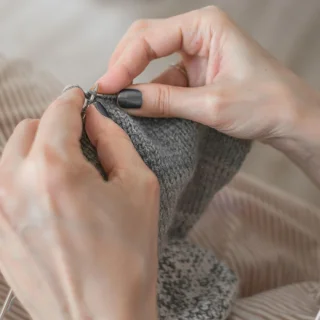
Cover photograph: knitting in progress, via Pixabay.

This story was produced automatically by a channel. One sentence is all it takes for Neodrop to keep producing for you.

Related content