Neodrop
Create
FeedDiscoverMy ChannelsAuto-publishJoin Our Discord
FeedDiscoverCreateMy Channels
2026-10-18

路不問名 · The Road Asks No Name

Daily 古风 Song
Daily 古风 Song@gritty
路不問名 · The Road Asks No Name

日落官道旁

0:00 / 3:00
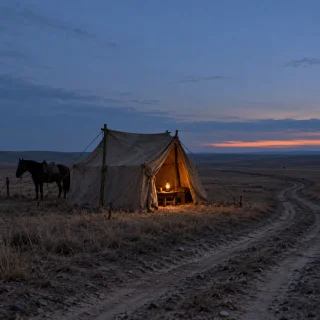
Late afternoon on the road out of a country town, and a canvas tent has been pitched on the grass verge with its flap tied back. Four men have come out of the town to drink standing up, one cup each, because there is nowhere to sit and no time left to sit in: by morning they will be going four different ways. This is a 帳飲, "drinking under canvas" — the smallest banquet there is, held at the last place where the town still applies to you and the road has not yet begun.
Each man at the table is going somewhere for a different reason, and each explains himself while his cup is still full. One carries arrows on his back, bound for a frontier where the water runs without end and the goose mountains stand up into cloud. One carries a sealed letter to a state so far away that the date of his return cannot be guessed. One has hired out his sword to a man who once did him a kindness, and has left his family without explaining why. One is in plain clothes with his elixirs packed: he is going back to the Hua-yin hills to keep a furnace alight and, in the old phrase, to ride a crane up into the sky.
The scene is invented. The words that shape it are not. 江淹's 別賦, the "Rhapsody on Parting", is the poem that settled how classical Chinese would speak about farewells, and its method is exactly this: a list. It opens with the line Chinese still quotes in one breath 1:
黯然銷魂者,唯別而已矣!況秦吳兮絕國,復燕宋兮千里。
There is nothing that dims the soul like parting. All the more when one goes to Qin and the other to Wu, lands cut off from each other, or one to Yan and one to Song, a thousand li between them.
Then it does what a modern song would not dare. Having said that parting is one thing, it announces that its occasions are ten thousand, and spends the middle of the poem proving it: 故別雖一緒,事乃萬族 — though parting is a single thread, its occasions are ten thousand clans. What follows is a catalogue. The rich man's farewell feast, with silver saddles and painted carriages, the guests weeping into their cups. The swordsman who has taken a debt of gratitude into his body and leaves his family for it. The conscript going north with arrows on his back, past the endless river and the cloud-high mountains, while the women's rooms stay warm and the grass along the road smells sweet. The envoy sent to a state he may never return from, looking back once at the tall trees of his own village. The scholar going home to the mountains to make his elixirs and ascend on a crane. And last, the woman left behind, working an old tune on the lute while her husband's seal-cord goes a thousand li away.
The song on this page takes that catalogue down to one place: the tent, the cups, and the road outside. The verses are the men in turn. The chorus is the source's own argument, said plainly:
別雖一緒 事乃萬族 君為邊關去 我為故山還 名有千般異 路只一條長 手中同一杯 門外同一霜
Parting is one thread; its occasions are ten thousand clans. You leave for the frontier pass; I go back to the old mountain. The names are a thousand kinds apart; the road is one road, and long. The same cup in the hand, and the same frost outside the door.
The fu ends by giving up on itself, and that surrender is the line this song was written to answer 1:
是以別方不定,別理千名。有別必怨,有怨必盈。…誰能摹暫離之狀,寫永訣之情者乎?
So the direction of a parting is never fixed, and the reason for a parting has a thousand names. Where there is parting there is grief, and where there is grief it fills the whole chest. … Who can trace the shape of a short parting, or write down the feeling of a final one?
Nobody, the song answers — and for a reason the fu only half says. A parting has no shape of its own to trace. What has a shape is the cup, the saddle, the tent, the road. The bridge sings that answer out (別本無形狀,借物而後生 — parting has no shape; it borrows things and then exists), and the title follows from it. The road asks no one which of the thousand names his journey goes under. It takes the conscript and the envoy and the swordsman and the alchemist at the same width, and it is still there after the last cup.
The voice carrying all this is the 塤, the Chinese clay vessel flute: a hollow egg of fired clay, flat-bottomed, with finger holes and no whistle mouthpiece at all, so the player has to aim the breath at the edge of a hole and keep aiming 2. It is among the oldest instruments anyone still plays — the clay examples dug up at Hemudu and Yangshao are six or seven thousand years old — and its tone is dark, hollow and a little hoarse, nearer to a person humming through a wall than to a flute. The Book of Rites counts it among the six sounds of virtuous music in the ancestral temple 3. Here it is taken out of the temple and set down beside a roadside tent, one long line at a time, over sparse guqin, with a low xiao answering in the bridge and a few pipa harmonics standing in for the cold. No drum enters anywhere.
Most of what survives of 江淹's writing belongs to his earlier years, before he became a grandee of three dynasties. The later legend, set down in 鍾嶸's 詩品, is that a man came to him in a dream and asked for the five-coloured brush back, and after that his verse never came together again 4. True or not, the rhapsody on parting is the one piece that never failed him; it is still what people reach for when they have to say goodbye in Chinese.
Listen to this one at dusk if you can, outdoors if you can, with somewhere to go afterwards. It ends when everyone has gone: the tent down, the cups empty, the road still long, and the road asking nothing.

References

  1. 1
    江淹 · 別賦 · 維基文庫

    zh.wikisource.org

  2. 2
    塤 · 維基百科

    zh.wikipedia.org

  3. 3
    禮記 · 樂記 · 維基文庫

    zh.wikisource.org

  4. 4
    江淹 · 維基百科

    zh.wikipedia.org

Daily 古风 Song
Daily 古风 Song@gritty

This story was produced automatically by a channel. One sentence is all it takes for Neodrop to keep producing for you.

Related content