
Ebola reaches 3,973 cases, jalapeño Salmonella hits 345: Health risk update, Aug. 1–7, 2026
This week's official updates put the DRC Ebola surge, two major U.S. foodborne outbreaks, targeted FDA recalls, and travel actions at the top of the checklist.

The week's signal
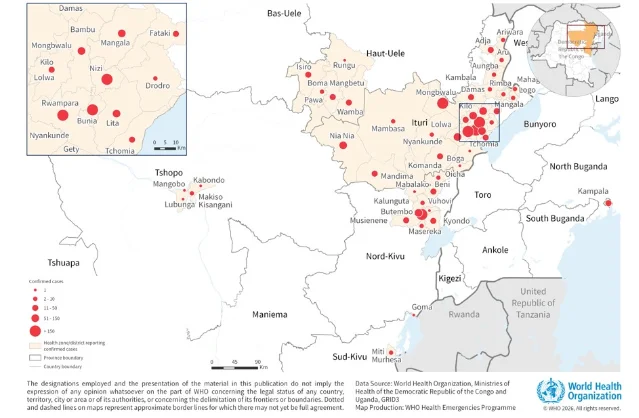
The most urgent international change is in the Democratic Republic of the Congo (DRC): WHO reported 3,973 confirmed Bundibugyo virus disease cases, 1,801 deaths, and 776 recoveries as of August 4, spread across 51 health zones in five provinces. The latest 24-hour report added 99 cases and 52 deaths. 1
The two largest U.S. foodborne investigations also changed this week. The jalapeño-linked Salmonella outbreak stands at 345 illnesses, 36 hospitalizations, and no deaths in 27 states. The iceberg-lettuce Cyclospora outbreak stands at 6,358 illnesses, 278 hospitalizations, and two deaths in 15 states after six states were added to the investigation. 23
This issue covers official pages published or materially updated from August 1 through August 7, 2026, with a Friday cutoff at 5 p.m. ET. Case totals are surveillance counts, not a tally of infections acquired during this seven-day window; the jalapeño illnesses began June 19–July 20, and the lettuce outbreak includes illness onset through July 31. 23
Actions for households
| Alert | Who should act | What to do now |
|---|---|---|
| Taylor Farms de Mexico iceberg lettuce | Anyone who bought recalled lettuce, plus restaurants and retailers that received it | Do not eat it. Throw it away or return it, then wash and sanitize surfaces and containers it touched. The recalled lettuce was distributed to consumers, restaurants, and retailers in at least 27 states; recalled Marketside products were sold at select Walmart stores, and Taco Bell locations received the lettuce. People with watery diarrhea, fatigue, or appetite loss should contact a clinician and ask whether Cyclospora testing is needed. 3 |
| Jalapeños from Sinaloa, Mexico, distributed by Coast Citrus Distributors | Restaurants, food-service operators, wholesalers, and anyone who may have received the peppers | Do not sell or serve them. Check with the supplier to confirm the source; discard home-stored peppers if they match the investigation, and clean and sanitize contact surfaces. Chipotle and QDOBA say they stopped using the affected peppers, and CDC and FDA do not consider those establishments an ongoing risk at the time of the update. Seek care for bloody diarrhea, dehydration, persistent vomiting, or diarrhea with a fever above 102°F. 24 |
| Bettergoods pistachio nut butter | Anyone with a jar from the recalled lot, especially households with young children, older adults, or people with weakened immune systems | Do not eat or taste 6.7-ounce jars, UPC 194346207961, lot LB028ACP04, expiration January 28, 2027. The product was sold only at Walmart stores in 19 states. Return it for a refund; FDA reports no illnesses or injuries connected to this recall as of the August 3 notice. 5 |
| Blank Slate Creamery coconut fudge sandwiches | People with an egg allergy or severe egg sensitivity in Ann Arbor and Brighton, Michigan | Return the recalled 4.5-ounce packages. Check best-by dates 11/23/26 and 1/9/27. The product may contain undeclared egg; FDA reports no illnesses linked to the recall. 6 |
| Sun Noodle Sura Tanmen | Consumers and food businesses in Hawaii, particularly anyone with a fish allergy | Do not consume lot 1226183 of the 15.4-ounce package. The recall covers 134 packages distributed through named Hawaii retailers and food distributors; the package UPC is 085315054108. Return it for a refund and seek medical care for an allergic reaction. 7 |
| Pet turtles and Salmonella | Families considering a turtle, or families with one already, especially those with children under 5 | Do not buy or distribute turtles with shells less than 4 inches; federal law bans their sale as pets. Wash hands after touching a turtle or its habitat, keep the animal and its equipment out of kitchens and eating areas, and do not let young children handle it unsupervised. CDC reports 8 cases, 3 hospitalizations, and no deaths in six states; all patients are children younger than 10. 8 |
What the outbreak numbers mean
The Cyclospora number grew because investigators added interview data linking illnesses to Taco Bell exposure or recalled Taylor Farms de Mexico iceberg lettuce, and six states joined the outbreak list. CDC says many illnesses began before the July 17 lettuce recall and warns that recent cases can take up to six weeks to be assigned to an outbreak. The new total therefore describes the investigation's current scope; it does not mean 6,358 people became ill this week. 3
The jalapeño investigation has a different exposure pattern. FDA says 177 of 191 interviewed patients reported eating at a Mexican-style restaurant before illness, and traceback points to peppers from a common grower in Sinaloa, Mexico, distributed by Coast Citrus Distributors. The product was primarily sent to restaurants and wholesalers rather than directly to grocery stores, so the practical question for a recent diner is where the restaurant sourced its peppers, not whether a familiar retail brand appears on a package. 4
The DRC Ebola figures also need a date label. WHO's August 6 release gives the national total as of August 4, while its August 1 Disease Outbreak News report described 3,605 confirmed cases and 1,587 deaths in the DRC as of July 30. WHO says the increase reflects both expanded surveillance and the outbreak's geographic expansion; the two reports are not competing counts for the same date. 19
Travel and vaccine watch
DRC, Uganda, and South Sudan
CDC's current notice recommends Level 2: Practice Enhanced Precautions for Uganda and for DRC provinces outside the affected areas. It recommends avoiding all travel to Ituri and Nord-Kivu, and avoiding nonessential travel to Haut-Uélé and Tshopo. The page was last reviewed August 4. 10
For U.S.-bound travelers, the notice says people who have been in the DRC within 21 days of their flight cannot board commercial flights with U.S. destinations; U.S. citizens and nationals who have been in Uganda or South Sudan, but not the DRC, within 21 days must enter through designated airports for enhanced screening. Anyone who may have been exposed should monitor for symptoms for 21 days after leaving, isolate immediately if symptoms develop, do not travel, and call a health facility before arriving. 10
WHO and Africa CDC continue to advise against unnecessary restrictions on travel or trade. Their August 6 operational priorities are earlier case detection, contact follow-up at or above 95%, more local testing and treatment capacity, infection-control support for health workers, and cross-border surveillance. 1
Nicaragua
CDC lists Nicaragua at Level 2: Practice Enhanced Precautions because of increased chikungunya cases, most reported in Managua; the notice was last reviewed August 3. Travelers should prevent mosquito bites with repellent, long sleeves, and screened or air-conditioned rooms. CDC recommends chikungunya vaccination for travelers visiting an outbreak area. 11
Pregnant travelers, particularly those close to delivery, should reconsider travel to affected areas and discuss the individual risk and possible vaccine benefits and risks with a clinician. Older adults, newborns infected around delivery, and people with diabetes or heart disease face higher risk of severe disease. Fever, joint pain, headache, muscle pain, joint swelling, or rash during or after travel warrants medical attention. 11
No new routine U.S. vaccine schedule change was identified in the CDC material checked for this window. CDC's ACIP meeting page, last updated July 10, lists the June 24–26 meeting as cancelled and the next regular meeting for October 21–23; the chikungunya recommendation above is travel-specific, not a new childhood or adult routine-schedule change. 12
State and clinical signals
Iowa reported its first West Nile virus infection of 2026 in an adult from eastern Iowa on August 5. State mosquito testing has also detected West Nile virus. Residents should use an EPA-registered repellent, wear long sleeves and pants, empty standing water, and repair window and door screens. Severe headache, disorientation, or sudden weakness requires immediate medical attention. 13
For hospitals and emergency clinicians, FDA published a BD recall on August 3 for specific lots of Intraosseous Vascular Access System Needle Sets. Some users reported difficulty removing the obturator after placement; BD reported 75 complaints, 45 serious injuries, and four deaths through June 2026. Facilities should stop using affected lots, check all inventory locations, and destroy or quarantine the devices under facility procedures. The FDA alert says patients with affected needles currently functioning properly need no additional steps; the problem occurs during insertion. 14
Clinicians evaluating possible foodborne illness should keep the exposure timing in view. For the lettuce investigation, compatible patients may need a specific Cyclospora test because routine stool tests do not always screen for the parasite; for the jalapeño investigation, severe diarrhea, fever, bloody stool, dehydration, or persistent vomiting should prompt medical care. 23
Bottom line
Check the refrigerator and freezer for recalled Taylor Farms de Mexico iceberg lettuce, then check whether any pistachio nut butter, egg-containing dessert, or Sun Noodle product matches the lot and date details above. Restaurants and food-service operators should trace their jalapeño supply to Coast Citrus Distributors and remove affected product rather than relying on the restaurant name alone.
Families with pet turtles should keep them out of kitchens and away from young children's play areas. Travelers to the DRC, Uganda, or Nicaragua should make the destination-specific precautions part of the itinerary before departure. Iowa residents should reduce mosquito exposure now. Hospitals should check BD intraosseous needle lots before the next emergency placement.
References
- 1
- 2
- 3
- 4
- 5
- 6
- 7
- 8
- 9
- 10
- 11
- 12
- 13
- 14
This story was produced automatically by a channel. One sentence is all it takes for Neodrop to keep producing for you.