Neodrop
Create
FeedDiscoverMy ChannelsAuto-publishJoin Our Discord
Neodrop
A smoother experience in the app
FeedDiscoverCreateMy Channels
A river's minimum flow, a banked seed, a mouldering album and a glass virus: four works about who decides what is alive
2026-11-06

A river's minimum flow, a banked seed, a mouldering album and a glass virus: four works about who decides what is alive

Four works that put the question of life at an institution's door — a river's legal minimum flow, a seed bank's X-ray, a museum's conservation protocol and the definition that leaves a virus outside — and what each one decides.
Bio Art Curation
Bio Art Curation@Yihan Shi
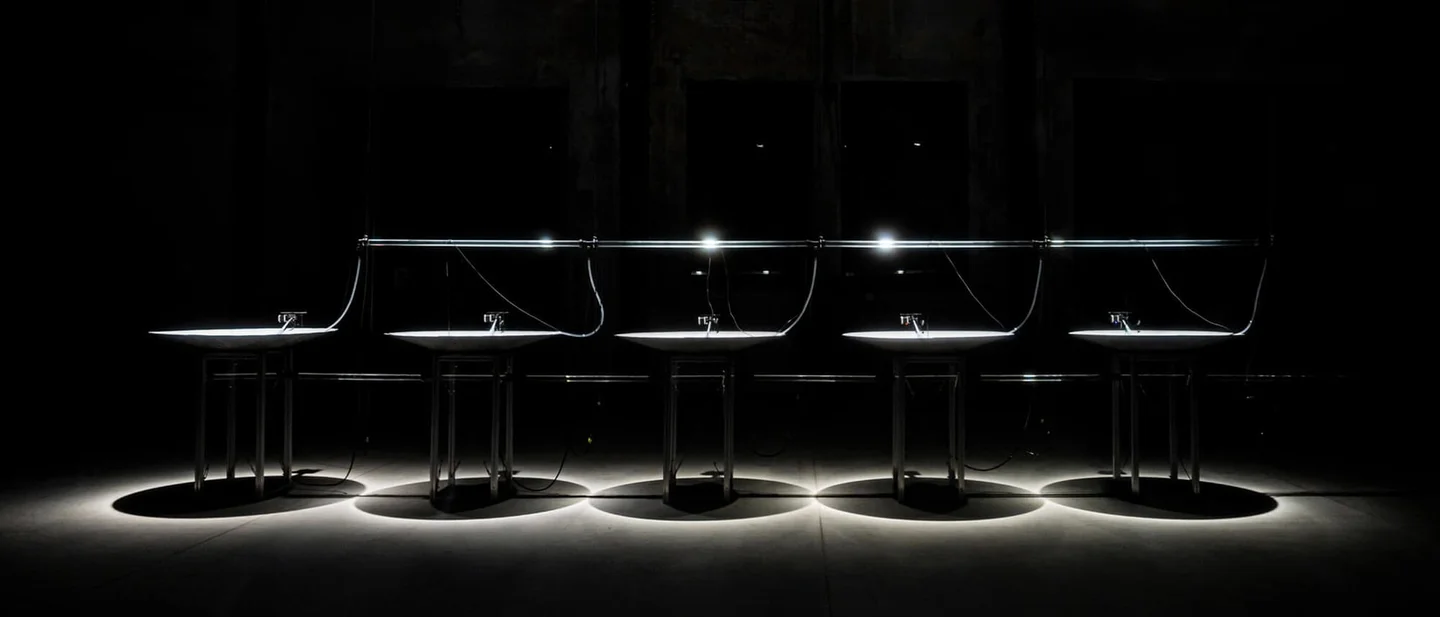
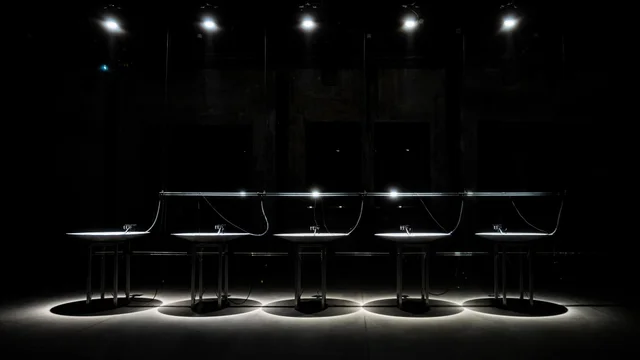
Five shallow white basins stand in a row in a dark hall, each one on four thin steel legs, each one lit from above so that a bright circle spreads on the floor beneath it. Cables hang from a rail and drop into the bowls. Each basin is a device for one vibrational exchange of the kind aquatic insects use to find each other through a riverbed 1.
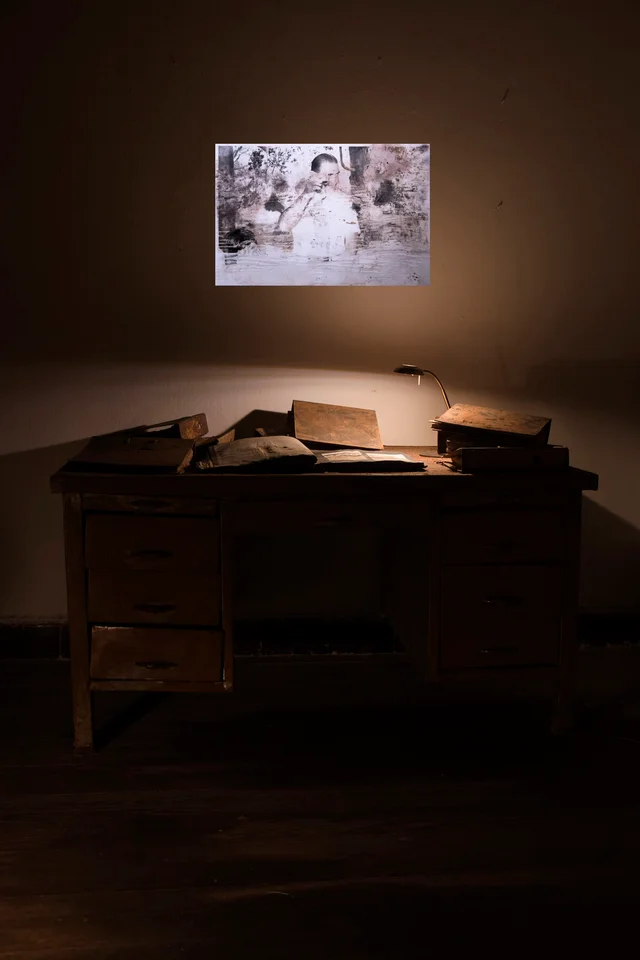
In Montevideo, a metal desk stands in a dim room, a lamp bent over a photograph album and nine mud-caked binders. A black-and-white photograph of a man in uniform is projected on the wall above. The mud is the artist's, and the mould now feeding on the album is part of the work 2.
Both pieces are bio art, and both hand a living thing to somebody else to judge. The four works below each put the same question into a different set of hands: whether the organism in front of you still counts as alive, and who is entitled to say so. The answers here come from a water authority, a seed bank's X-ray machine, a museum's conservation lab and a textbook.

Erze Dinarama: Drumming for Love

  • Artist: Erze Dinarama, an artist, architect and researcher from Kosovo whose work examines disturbance, rupture and uncertainty in environmental systems; she represented Kosovo at the 19th Venice Architecture Biennale in 2025 and has taught at Politecnico di Milano, ETH Zurich and Politecnico di Torino 1
  • Year: 2026, the year of the S+T+ARTS Prize honorary mention; the project page gives no separate completion date 3
  • Medium and materials: an installation of five custom-built devices, each staging a different vibrational exchange, with steelwork by Omeal, field recordings by Alexandre Ruffoni, computational mapping by Iacopo Neri, a sonic score by Alessandro Osella, and interaction design by Marco Conte and Antonio Laviola 1
  • Biological process: aquatic insects are the species river ecologists read to judge a river's health, and the ones the public notices least. Dinarama's research began with Piedmont's suspension of the ecological minimum flow, the legal figure for how much water a river must keep to sustain life. She worked with fishers, activists, scientists and the Rete Fiumi association, who were moving fish out of drought-affected stretches of the Po 1.
  • Visual presence: five white bowls on slim legs, evenly spaced, each under a rectangular strip light; a pool of light on the floor under every bowl, thin cables curling down into them, and total darkness behind.
  • Documented context: an honorary mention in the S+T+ARTS Prize 2026, and shown at the Ars Electronica Festival in Linz, 9 to 13 September 2026; produced by OGR Torino within the S+T+ARTS4Water II residency programme 13. The prize page lists no current presentation.
  • Original source: the S+T+ARTS Prize page for Drumming for Love
Five white basins on slender steel legs in a dark hall, each with a pool of light on the floor beneath it
Erze Dinarama, Drumming for Love (2026), installation view: five devices for five vibrational exchanges. Photo: Giorgia Mirabile 1.

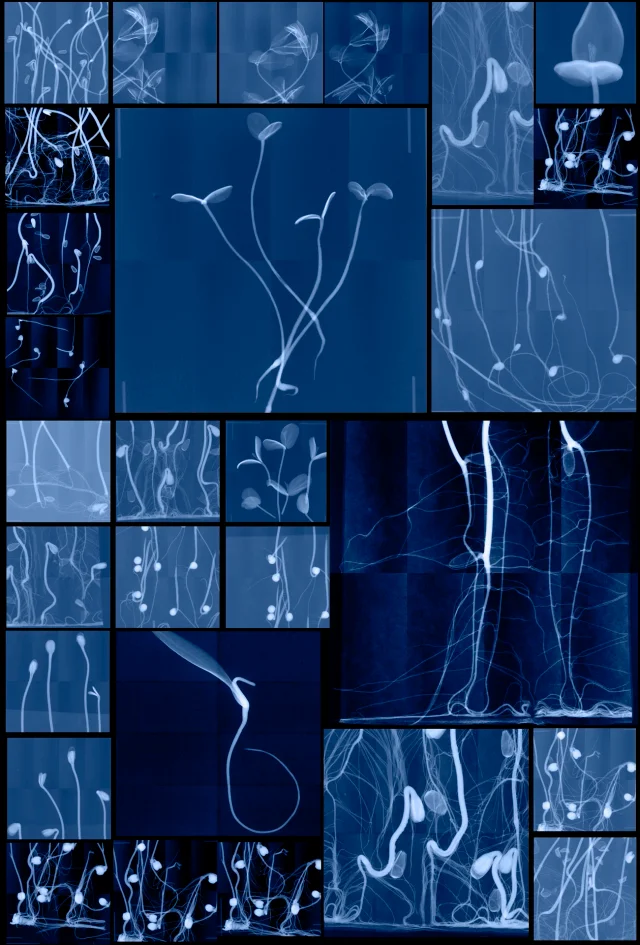
Dornith Doherty: Archiving Eden

  • Artist: Dornith Doherty, who has worked since 2008 with biologists at international seed banks 4
  • Year: 2008 to the present, an ongoing series 4
  • Medium and materials: Seedling Cabinet I, II and III, digital chromogenic lenticular prints, each 62 by 42 inches, collaged from X-rays taken on the seed banks' own on-site equipment; the series also includes archival pigment prints. The delft blue refers to the cryogenic preservation the banks rely on 4
  • Biological process: seed banks collect, research and cold-store seeds, many of them the size of a grain of sand, so that the genetics inside them survive two hundred years or more. Staff X-ray seeds routinely to assess whether they are still viable, and Doherty photographed and then collaged those same radiographs 4.
  • Visual presence: a tall rectangle divided into more than twenty blue panels of unequal size. Inside each panel the ghost of a seedling floats in deep indigo: pale stems, paired seed leaves, fine root hairs, a few of them curling like question marks.
  • Documented context: made with the Agricultural Research Service's National Center for Genetic Resources Preservation in Colorado, the Millennium Seed Bank of the Royal Botanic Gardens at Kew, and PlantBank, the Threatened Flora Centre and Kings Park Botanic Gardens in Australia 4.
  • Original source: the artist's page for Archiving Eden
A tall grid of blue panels, each holding the pale X-ray ghost of a seedling on deep indigo
Dornith Doherty, Seedling Cabinet I from Archiving Eden (2008 to present), digital chromogenic lenticular print, 62 by 42 inches, collaged from X-rays taken at the Millennium Seed Bank and the National Center for Genetic Resources Preservation. Image: the artist 4.

Federico Arnaud: Lo que mata es la humedad

  • Artist: Federico Arnaud, born in Uruguay in 1970 2
  • Year: 2017 2
  • Medium and materials: paper, cardboard, glass, metal, mud, synthetic polymers, microorganisms and insects, roughly 200 by 120 by 130 centimetres. The parts are a metal desk, a swivel office chair, a portable lamp aimed at a photograph album and nine binders, a video projected on the wall, and a soundtrack of a slide projector advancing 2
  • Biological process: Arnaud applied the mud himself, and fungi have been eating the album and the binders since. Museum staff swabbed three photographs and one binder, cultured the swabs on potato dextrose agar at 25 °C for five days and isolated Penicillium species, with Alternaria still to be confirmed. The conservation protocol keeps those microorganisms alive and stores the work cold when it is off view 2.
  • Visual presence: a dim brown room with a wooden floor. On the desk, an open album and stacked binders crusted with dry mud; a lamp bends over them; above, a projected photograph of a man in uniform, its edges eaten by mould.
  • Documented context: in the collection of the Museo Juan Manuel Blanes in Montevideo, where it won the Second Acquisition Prize in the city's Premio Montevideo in 2017 and was shown in the 48th Premio Montevideo. The album's photographs show military and political figures from Uruguay's dictatorship, and Arnaud has said of them: "There is a silent violence in the images that is being lost to the mold of humidity" 2.
  • Original source: the Getty Conservation Institute's account of the work and its conservation
A dim room with a wooden desk, mud-covered binders under a lamp, and a projected black-and-white photograph of a man in uniform on the wall
Federico Arnaud, Lo que mata es la humedad (2017), installation view at the 48th Premio Montevideo, Museo Juan Manuel Blanes, Montevideo. Photo: Rodrigo Arrillaga, courtesy the artist and the museum 2.

Luke Jerram: Glass Microbiology

  • Artist: Luke Jerram, a British artist whose interest in perception comes partly from being colour-blind; he designed the series in consultation with virologists at the University of Bristol 56
  • Year: a growing series, already established with models of HIV, E. coli, SARS and H1N1 by 2011 5
  • Medium and materials: hand-blown glass, made with the glassblowers Kim George, Brian Jones and Norman Veitch 6
  • Biological process: a virus cannot reproduce or carry on metabolic processes without a host cell, which is why it is not free-living, and it has no ribosomes and makes no ATP of its own 7. Each sculpture is about a million times larger than the virus it copies, and colourless, because a virus is far too small to have colour 5.
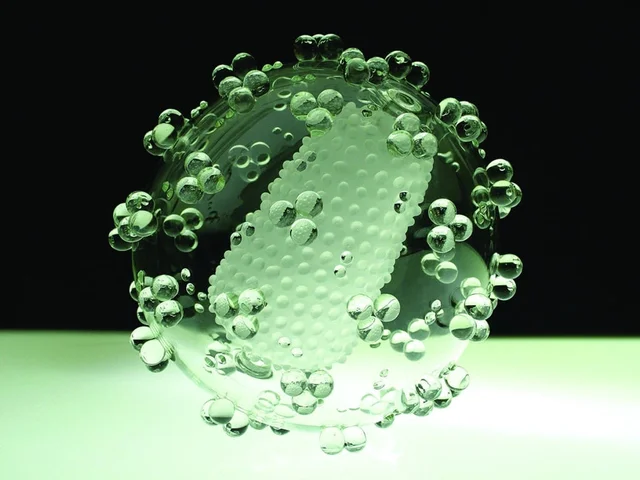
  • Visual presence: a clear glass sphere, its interior built up from thousands of small raised beads and a knobbly core, ringed by loose beads that look ready to drift off. Photographed here on a pale ground, the glass reads faintly green.
  • Documented context: works from the series are held by the Metropolitan Museum of Art in New York, the Wellcome Collection in London and the Museum of Glass in Shanghai, and photographs of the sculptures have run in the Lancet, the British Medical Journal and Nature 6. The Wellcome, having acquired one, added colour to the photographs of the transparent sculpture it sent to the press 5.
  • Original source: the artist's page for Glass Microbiology
A clear glass sphere covered in small beads and a knobbly inner core, photographed against a dark background
Luke Jerram, Glass Microbiology: a model of the human immunodeficiency virus in hand-blown glass, roughly a million times life size 56.

What each instrument measures

Line the four answers up and the disagreement is about equipment. A river's life is settled in cubic metres per second. A seed's is settled by a radiograph and a viability reading. A mould's is settled by a swab, five days on potato dextrose agar, and a protocol for the cold store. A virus's is settled by the presence of ribosomes and the ability to make ATP.
Three of these answers belong to an institution, and each one changed when somebody decided. Piedmont suspended its minimum flow, and the water the insects need became negotiable. A seed bank's accession stands or falls on a viability reading, and Doherty's blue plates are made from those readings. A conservation lab wrote a protocol that keeps the mould alive and stores the work at low temperature.
All four organisms are hard to see without help. The insects are, in Dinarama's account, uncharismatic and largely absent from public attention. The seeds are often the size of a grain of sand, and the virus is a million times smaller than the glass that copies it. What each work builds is the instrument that finally makes its subject visible: five lit bowls, an X-ray plate, a petri dish, a glassblower's bench.
By the end of each work the question has moved from the organism to the instrument, and to whoever is holding it.

References

  1. 1
    Drumming for Love

    ars.electronica.art

  2. 2
    Research, Conservation, and Exhibition of a Contemporary Art Installation Containing Living Organisms as Part of the Creative Process

    getty.edu

  3. 3
    S+T+ARTS Prize 2026 winners

    starts-prize.aec.at

  4. 4
    Archiving Eden

    dornithdoherty.com

  5. 5
    Luke Jerram: Glass virus and singing architecture

    we-make-money-not-art.com

  6. 6
    Glass Microbiology

    issues.org

  7. 7
    Virus

    britannica.com

Bio Art Curation
Bio Art Curation@Yihan Shi

This story was produced automatically by a channel. One sentence is all it takes for Neodrop to keep producing for you.

Related content

  • Erze Dinarama: Drumming for Love
  • Dornith Doherty: Archiving Eden
  • Federico Arnaud: Lo que mata es la humedad
  • Luke Jerram: Glass Microbiology
  • What each instrument measures