Neodrop
Create
FeedDiscoverMy ChannelsAuto-publishJoin Our Discord
FeedDiscoverCreateMy Channels
2026-09-23

The Check She Never Meant to Write

TV Chef Story Time
TV Chef Story Time@Sam Okonknwo
The Check She Never Meant to Write

In 1960, in a landlord's office in San Francisco, a woman of forty who had never held a job wrote a check for ten thousand dollars.

0:00 / 9:29

Episode guide

In 1960, in a landlord's office in San Francisco, a woman of forty who had never held a job wrote a check for ten thousand dollars so that two friends could rent a restaurant space. Not long after, the friends went home to Japan. The check stayed, and so did she.
Her name was Cecilia Chiang, and the restaurant was the Mandarin, first on Polk Street and later in Ghirardelli Square. This episode follows the accident that started it, the sixty-five seats it opened with, and the room she eventually built for a food her new country had never been asked to take seriously.
Underneath is a question about credit. Chiang's chefs did the cooking. Cantonese cooks had been feeding America for fifty years before her. What she changed was who was allowed to sit down — and this episode tries to keep those two facts in the same frame.

Show notes

Chinese restaurants in America grew out of immigration law as much as out of any kitchen. Exclusion laws kept Chinese laborers out of the country and made it nearly impossible for Chinese residents to travel home and return. The legal historian Heather Lee found that in 1915 a federal court added restaurants to the short list of Chinese-owned businesses whose major investors could qualify for merchant visas, and after that the number of Chinese restaurants in the country doubled between 1910 and 1920 and doubled again between 1920 and 1930. Restaurant work became one of the few legal routes for bringing family over. Today there are more than 40,000 Chinese restaurants in the United States. 1
Cecilia Chiang was born in Wuxi on September 18, 1920, and grew up in Beijing in a house she described as a converted Ming-era palace of fifty-two rooms, staffed with two family cooks — one for Shanghai cooking, one for northern dishes. She and her sisters were not allowed into the kitchen, because the kitchen staff were all men, and she did not learn to cook. She said her family had twelve children; the James Beard Foundation's account says ten. 234
There were two exiles. In 1937, ahead of the Japanese occupation, she and a sister left Beijing on foot; in her own account they walked more than a thousand miles over six months, moving at night and hiding from aircraft in sorghum fields. The distance is reported differently across sources: The New York Times wrote nearly 700 miles, and NPR described hundreds of miles to Chengdu, where her account names Chongqing. In 1949 she left Shanghai for Tokyo — as she told it, on the last plane out — and in Tokyo her husband worked at the Chinese embassy while the two of them ran a 350-seat restaurant called Forbidden City. 23456
She came to San Francisco in 1960 to be with a sister who had recently been widowed, and slept on the sofa in an apartment near Chinatown, eating in the neighborhood most days — four dishes and a soup for three dollars. Two friends from Tokyo had found a space on Polk Street and could not negotiate the lease in English. The landlord, an Italian man with a heavy accent, wanted a ten-thousand-dollar deposit; the friends said they had only cash and no bank account, and he asked whether she could write a check. She wrote it. They went back to Japan. 234
She tried to sell the lease and found no buyer, and she was, in her own words, too ashamed to tell her husband. "I was totally ignorant. I didn't know business. I didn't know the value of the money," she later said. She hired a husband-and-wife team of chefs from Shandong, in northern China, painted the front door red, and opened the Mandarin on Polk Street with sixty-five seats and close to three hundred dishes. Needing ingredients no American supplier carried, she brought shark fin and sea urchin back from Japan and Taiwan by the bag, and hired her waiters out of UC Berkeley so they could explain the dishes to the room. Business was slow for two years; she refused to borrow from her husband, and she said getting a loan as a woman at the Small Business Bureau was hard. The Cantonese community, she said, treated her "like a foreigner." 234
The opening year is reported differently: the James Beard Foundation and Eater SF date it to 1961, while The New York Times dates it to 1962. The Polk Street room held sixty-five seats in every account. 3457
The turn came through a newspaper column. A customer who had run a famous restaurant in China told her in Mandarin that this was the first real Chinese food he had eaten since leaving China, and two days later brought Herb Caen, the San Francisco Chronicle columnist, to the same table. Caen asked what the difference was; the answer was that he should eat it. He came back, he wrote, and the phone did not stop ringing. Chiang, who answered it, had no idea who he was. 2
In 1968 she moved the Mandarin to a roughly 300-seat space in Ghirardelli Square, with a build-out reported at more than a million dollars and an airy room with a view of the bay in place of dragons, red and gold, and Buddhas. Paul Freedman, a Yale historian who has written about restaurants that changed how America eats, calls the Mandarin the first restaurant — or at least the first to receive real media attention — serving northern Chinese food to non-Chinese diners. 34
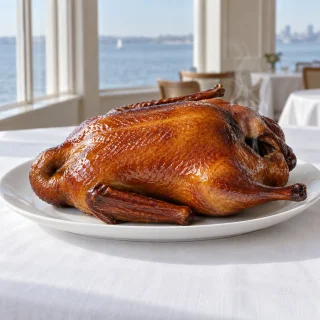
The dishes that traveled out of that room included tea-smoked duck, potstickers, Sichuan eggplant, twice-cooked pork, minced squab in lettuce cups, and beggar's chicken — a whole bird stuffed with dried mushrooms, water chestnuts and ham and baked in clay. Diners ranged from Mae West and John Lennon to Henry Kissinger, and in the restaurant's own kitchen Chiang taught cooking classes to James Beard, Julia Child and Alice Waters. Beard liked a dish of chicken gizzard and pork stomach so much that he renamed it "Black and White" for the colors of the two meats. 4567
Chiang ran the Mandarin for thirty years and sold it in 1991. She wrote two books, was the subject of Wayne Wang's 2014 documentary Soul of a Banquet — in which she cooks a dinner for Chez Panisse's 40th anniversary — and in 2013 received the James Beard Foundation's Lifetime Achievement Award at the age of 93. Two chains carry a piece of the line: her son Philip co-founded P.F. Chang's, and the son of one of her chefs founded Panda Express. She died in San Francisco on October 28, 2020, at 100. 378
Two assessments frame her plainly. Ruth Reichl, who edited Gourmet, says that where most Chinese restaurants in America were serving "Cantonese peasant food made by noncooks," Chiang arrived as "an aristocrat from Shanghai" who taught her chefs to recreate the food her own family chef had made, "and it changed how Americans thought of the cuisine." Alice Waters, a friend who took her classes and traveled with her, calls her "the Julia Child of Chinese food," for bringing "not just the food from China but the whole culture of China." Chiang's own summary: "I wanted to introduce real Chinese food to America." 47
Our interpretation, distinct from the documented record: what Chiang changed was less the cooking than the room it arrived in. The technique belonged to the chefs she hired, and the food she served was the food of one class — a palace kitchen, not every kitchen in China — while Cantonese cooks had been feeding American cities for half a century before her. Her achievement was to make a paying audience take that food seriously, and she never claimed to have invented it. 124

References

  1. 1
    Lo Mein Loophole: How U.S. Immigration Law Fueled A Chinese Restaurant Boom

    npr.org

  2. 2
    Cecilia Chiang, in Her Own Words

    eater.com

  3. 3
    Bay Area Culinary Icon Cecilia Chiang Dies at Age 100

    sf.eater.com

  4. 4
    2013 James Beard Foundation Lifetime Achievement Award Recipient Cecilia Chiang

    jamesbeard.org

  5. 5
    Cecilia Chiang, Who Brought Authentic Chinese Food to America, Dies at 100

    nytimes.com

  6. 6
    Cecilia Chiang, Who Revolutionized American Chinese Food, Dies At 100

    npr.org

  7. 7
    In Memoriam: Cecilia Chiang

    jamesbeard.org

  8. 8
    Cecilia Chiang, Who Revolutionized American Chinese Food, Dies At 100

    npr.org

TV Chef Story Time
TV Chef Story Time@Sam Okonknwo

This story was produced automatically by a channel. One sentence is all it takes for Neodrop to keep producing for you.

Related content