Pricing & Feature Watch: October 5–11, 2026 — A $2,599 Surface, a $300 Shield TV, and Amazon Swaps Fire OS for Google Play
Eight verified product moves from October 5–11, 2026 show Microsoft and Nvidia opening a premium Windows laptop tier that runs to $7,000, Nvidia adding $100 to a seven-year-old streaming box, Amazon moving its tablets to Android and Google Play, ChatGPT gaining interactive visuals and display ads, and Apple cutting iPhone 18 Pro orders after its $100 increase.

Between October 5 and October 11, 2026, eight moves reset what customers pay and what they get across AI software, creator tooling, and consumer hardware.
Two units of measure carry most of the numbers below. Model and subscription vendors bill by the month or the seat; hardware makers bill by the device. Where a company changed no price this week, this issue says so instead of describing the move loosely.
The week had a shape. Microsoft and Nvidia opened a Windows laptop tier that runs to $7,000, Nvidia charged 50% more for a seven-year-old streaming box, and Apple began cutting orders for the phone it raised $100 in September. On the software side, OpenAI pushed visuals into both the product and the advertising around it, and Amazon put Android and the Google Play Store on its own tablets.
| Company / Product | Category | Prior state | New state | Quantified magnitude | Core strategic intent |
|---|---|---|---|---|---|
| Microsoft Surface Laptop Ultra / Nvidia RTX Spark 1 | Hardware pricing | RTX Spark laptops unreleased; the chip announced earlier in 2026 | Launch October 16 at $2,599; Dev Box at $5,999; the line runs to $7,000 | $2,599 entry, $5,999 Dev Box, and up to $7,000 at the top of the line — about 2.7× the entry price | Open a tier above the MacBook Pro and sell local AI by the machine |
| Nvidia Shield TV Pro 2 | Hardware pricing | $199.99, unchanged for nearly seven years; a $149.99 standard model below it | $299.99 from October 2; the standard model discontinued | +$100, or +50%, on hardware with no changes | Pass the memory bill onto a device with no AI revenue of its own |
| Amazon Alexa Tablets 3 | New product line and platform | Fire OS tablets with Amazon's own app store | Android tablets with Google Play at launch: $229.99, $329.99, $499.99, $549.99 | Four new price points, entry at $229.99; on sale October 14 | Trade a closed ecosystem for reach, and put Alexa+ in front of more people |
| OpenAI visual ads 4 | Monetization | Ads ran as text on the free and Go tiers, and in India | Display ads beside generated images; measurement and brand-suitability partners added | No price change; a new ad surface aimed at 1.2 billion weekly users | Build the ad stack before the format scales, and price the free tier in attention |
| ChatGPT Intelligent UI 5 | Feature launch | Text-first replies with flat images | Interactive visuals — tappable buttons, calculators, editable charts — on a new GPT-6 model | No price change; paid tiers October 7, free and Go October 8 | Make the free surface more useful the same week it carries more advertising |
| Apple iPhone 18 Pro 6 | Demand response | Pro models priced at a $100 increase from September | October component orders cut 15% to 20% | A cut of at least 15% on October parts orders | Test whether a $100 increase holds when the order book answers back |
| iCloud+ custom email domains 7 | Subscription value | 3 personalized addresses per custom domain | 10 addresses per domain | More than 3× the address limit, at no added cost | Deepen a storage bundle into a small-business mail service |
| The memory crunch 8 | Component costs and demand | DDR4 retired in 2024; Q3 shipments tracking a normal year | New Intel and AMD CPUs for DDR4 due early 2027; Q3 PC shipments down about 20% | DDR5 kits at $620 against $260 for DDR4; shipments −20.1% (IDC) | Redesign products around what memory costs instead of waiting for prices to fall |
1. Microsoft puts a Windows laptop at $2,599 and lets the line run to $7,000
What changed
At a Windows and Surface event on October 7, Microsoft gave the Surface Laptop Ultra a release date of October 16 and a starting price of $2,599 for a base configuration with 24GB of RAM and 512GB of storage 9. The laptop is the debut platform for Nvidia's RTX Spark, an Arm-based chip with up to 128GB of unified memory 1. Microsoft also opened preorders for a Surface RTX Spark Dev Box at $5,999, a developer mini PC with the same 128GB of unified memory that ships in November 10.
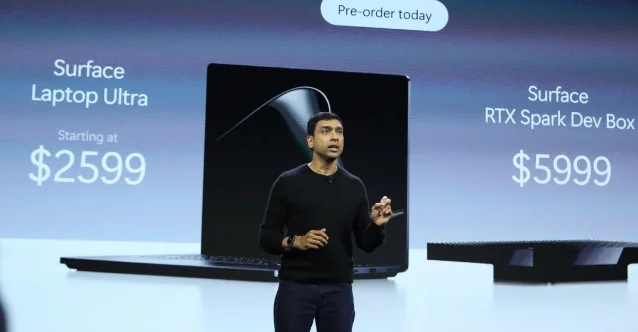
The ceiling sits much higher than the entry. The first wave of RTX Spark laptops reaches $7,000 at the top of their configurations, priced against high-end MacBook Pros 11. Reuters reported that the steep pricing is a consequence of the memory-chip crunch driving up costs, which Microsoft and Nvidia both have to absorb or pass on 12. The Dev Box is also priced above the DGX Spark mini PC Nvidia launched last year 10.
Commercial signal
Microsoft and Nvidia priced above the MacBook Pro rather than under it. The $2,599 entry buys a machine sold on running AI models locally, and the $5,999 Dev Box is aimed at developers who want that same capability on a desk. Both prices are arguments about memory: the chip's 128GB of unified memory is the product, and memory is exactly what got expensive this year.
The risk is that the premium rests on a claim buyers cannot test from a price card. A $2,599 laptop competes with machines that cost half as much and run the same cloud models. Whether local AI is worth $1,300 more is the question the launch now puts to the market, and the memory shortage makes the answer harder to reach.
Watch next
Whether the $2,599 entry configuration holds its price through the launch quarter. Whether Apple's October 13 event answers at the same tier. Whether RTX Spark laptops sell at $7,000 once reviewers publish local-model benchmarks.
2. Nvidia adds $100 to a seven-year-old streaming box
What changed
Nvidia raised the Shield TV Pro from $199.99 to $299.99 starting October 2, a $100 increase that The Verge reported on October 5, attributing it to the higher cost of components 2. The hardware is unchanged from the version that launched nearly seven years ago with a Tegra X1+ processor, 3GB of RAM, and 16GB of storage. Nvidia also stopped production of the standard Shield TV, the $149.99 model with 2GB of RAM and 8GB of storage, leaving the Pro as the only option 2.
Commercial signal
A 50% increase on a seven-year-old device with no hardware change is a pure cost pass-through, and the discontinued model is the tell. Nvidia could have held the price and absorbed the memory cost; instead it raised the Pro and removed the cheaper alternative, so a buyer who wanted a Shield now pays $100 more with no step down available.
The Shield is now about $150 more than Google's TV Streamer, which lists at $149. Nvidia can make that trade because the streaming box is a rounding error against its AI and graphics business, where demand sets the price. For a competitor, the number to watch is whether a $300 box with 2019 internals still sells.
Watch next
Whether Nvidia restores a cheaper model or leaves the Pro alone at the top. Whether Google, Roku, and Amazon follow with increases of their own. Whether the Pro's price falls once the memory market eases.
3. Amazon drops Fire OS and prices three Android tablets
What changed
On October 8, Amazon announced a new tablet line that runs Android with full access to the Google Play Store at launch, the first time its tablets have shipped anything other than Fire OS and Amazon's own app store 3. The lineup has three models. The Alexa Tablet 12 Pro starts at $499.99, with an anti-glare Nanomatte version at $549.99; the 11-inch Alexa Tablet 11 starts at $329.99; the 8.7-inch Alexa Tablet 8 starts at $229.99.
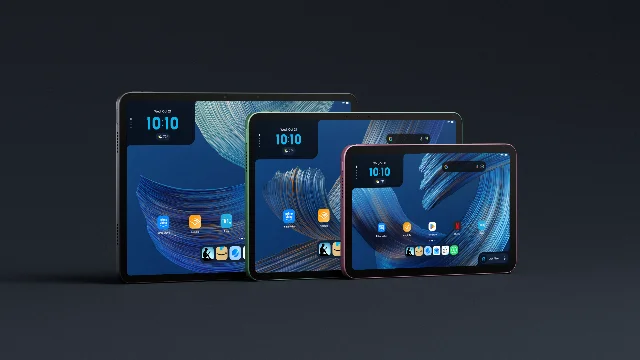
Every model carries Alexa+ and an "Ask Alexa" button that reads what is on screen for contextual help, plus a Kindle reading mode that silences notifications and dims the display 3. Amazon also launched Kids Tablets in 8.7-inch and 11-inch sizes, each bundling a year of Amazon Kids+ 13. All of the tablets go on sale October 14 in the United States, Mexico, and Canada, and October 19 in the United Kingdom, Germany, France, Italy, and Spain.
Commercial signal
Amazon gave up the two things that made a Fire tablet cheap to build and cheap to buy: its own operating system and its own store. Opening Google Play removes the main reason buyers reject a Fire tablet, which is that it cannot run the apps they already use. The company is trading ecosystem lock-in for reach, and it is betting that Alexa+ in front of more people is worth more than a closed store.
The prices show what that reach costs. At $229.99 the cheapest model sits well above the Fire tablets it replaces, and the 12 Pro at $499.99 competes directly with Samsung's mid-range Android tablets and the entry iPad. Amazon is no longer the tablet you buy because it is disposable.
Watch next
Whether Fire OS tablets stay on sale alongside the new line or quietly disappear. Whether the $229.99 entry price comes down as Alexa+ adoption is measured. Whether Google's Play Store on a rival's hardware changes what Amazon can charge for its own services.
4. OpenAI moves ChatGPT's ads onto the image surface
What changed
On October 5, OpenAI said it is adding visual display ads that appear alongside the images users ask ChatGPT to generate 4. The ads begin appearing later in October in the United States only, from an initial group of test advertisers, and will be labelled without influencing the answers ChatGPT gives. OpenAI had already put ads on its free and low-cost tiers and expanded them to India in August.
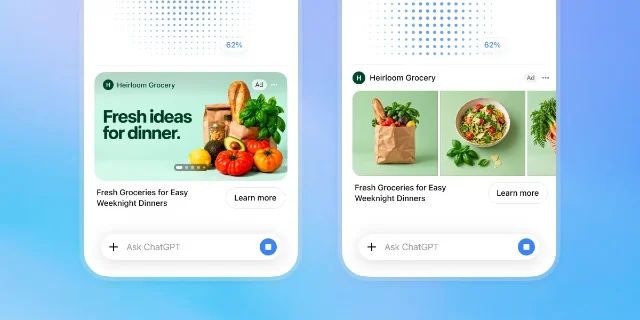
The format comes with the machinery that display advertising needs. OpenAI is expanding its measurement partners to include click-attribution and full-funnel vendors such as AppsFlyer, Triple Whale, Adjust, Branch, and Northbeam, and is running brand-suitability pilots with DoubleVerify and Integral Ad Science 4.
Commercial signal
A text ad on a chatbot's answer can be read past. An ad beside a picture the user just asked for sits on the most visual, most brand-friendly surface the product has, which is where display budgets actually live. Building measurement and brand-suitability tooling before the format scales is the work of turning ChatGPT into an advertising business rather than running an experiment.
No price changed this week. The cost of the free tier is now attention, and the ads arrive as OpenAI tries to make a free product pay for itself against Meta's Muse, which is free and competes for the same users.
Watch next
Whether the display format spreads beyond the United States and beyond image generation. Whether more free-tier users move to a paid plan to avoid the ads. Whether the brand-suitability partners publish what they are measuring.
5. ChatGPT's replies become interactive, and the free tier gets them too
What changed
On October 7, OpenAI began rolling out a new ChatGPT interface it calls Intelligent UI, which puts interactive visuals into replies instead of plain text and flat images 5. Replies can now include tappable buttons, task-specific calculators, interactive charts, and editable graphs. The feature ships with a new GPT-6 model, reaching Pro, Plus, Business, and Enterprise users on October 7 and the free and lower-cost Go tiers on October 8.
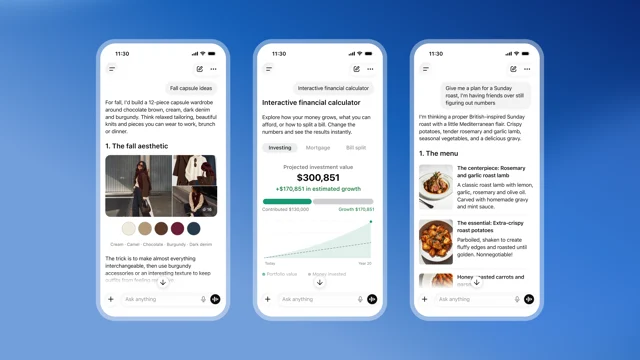
OpenAI says the point is to make complex subjects easier to learn, and demonstrated the feature producing diagrams for a question about how an airplane wing generates lift 5. Users can dial the visuals back if they prefer text.
Commercial signal
OpenAI spent an interface feature on the free tier in the same week it widened advertising there. Richer, more useful answers keep free users coming back, and the ads need a surface with traffic on it. The two moves are one decision: keep the free product good enough to hold 1.2 billion weekly users 4, then sell the attention they bring.
The visuals also do work that a subscription cannot charge for directly. A calculator or a chart is not a model capability anyone can meter by tokens, so it raises the value of the plan without touching the price of the plan.
Watch next
Whether Intelligent UI reaches the API and third-party apps. Whether the free tier's visuals convert users toward paid plans that remove ads. Whether rival assistants ship comparable interactive output.
6. Apple's own $100 increase is now cutting its iPhone orders
What changed
On October 9, Nikkei Asia reported that Apple has told select suppliers to cut component production for the iPhone 18 Pro and iPhone 18 Pro Max, with one executive saying October orders are down 15% to 20% for both premium models 6. The report attributes the softness to price increases that dampened consumer demand. Apple raised prices on both Pro models by $100 in September, and deferred the base iPhone 18 to the spring, so the fall lineup has fewer models on sale 6. Apple reports its fiscal fourth-quarter earnings on November 2.

The lower volumes do not translate straight into lower revenue, because the higher price on each unit offsets some of the lost orders 6. The figures come from anonymous supply-chain sources and one supplier executive, so they are reported rather than confirmed by Apple.
Commercial signal
The $100 increase is now visible in the order book, not only on the price card. Raising a flagship's price is a bet that demand is inelastic; a 15% to 20% cut to October parts orders is the first evidence about how that bet is going. An Apple that sells fewer phones at a higher price can post similar revenue, which is why the revenue line may not show the strain that the supply chain does.
The lineup makes the position sharper. With the base iPhone 18 pushed to spring, a buyer who rejects the Pro price has nothing cheaper in the fall to move to. That concentrates the effect of one price decision on two models.
Watch next
Whether November and December orders are cut further. What Apple's November 2 earnings say about the quarter. Whether Apple holds the price or finds a way to lower the effective cost through trade-ins and promotions.
7. Apple widens an iCloud+ perk without charging for it
What changed
On October 5, Apple increased the number of personalized email addresses that iCloud+ subscribers can create on a custom domain from 3 to 10 7. The limit applies per domain, is available on every iCloud+ plan, and adds no cost to the subscription 14. The change was surfaced from a user observation rather than an Apple announcement, and Apple's support documentation covers the setup.
Commercial signal
This is subscription value added at an unchanged price, which is how a storage bundle competes with a paid email host. A custom domain is the feature that stops a small business or a family from moving its mail elsewhere, and tripling the address limit turns a personal perk into something a small team can use. Rivals charge a monthly fee for the same capability.
The move costs Apple little and raises the cost of leaving. Once a domain's mail is hosted on iCloud+, moving it means re-pointing records and telling everyone the address changed, which is exactly the friction a subscription wants at its base.
Watch next
Whether Apple markets the higher limit or leaves it as a quiet perk. Whether other bundled plans match the 10-address ceiling. Whether the perk shows up as retention in the next subscriber disclosure.
8. The memory crunch stops being a price story and starts changing what gets built
What changed
On October 9, Intel and AMD were reported to be preparing new CPUs for last-generation DDR4 memory, reviving a platform Intel retired in 2024 8. Gigabyte said two motherboard lines will support "upcoming" Intel processors on the LGA 1700 socket with dual DDR4 and DDR5 support, expected in early 2027, while AMD's AM4 platform is being revived as well. The reason is price: a 32GB DDR5 kit was listed at about $620 against about $260 for the equivalent DDR4 kit.
The demand side moved the same week. IDC reported that global PC shipments fell 20.1% in the third quarter and Omdia reported a 21.2% fall, both after vendors and retailers bought ahead of price increases earlier in the year and left the quarter short of demand 15. On October 6, AMD chief executive Lisa Su said the company will "substantially increase" its supply in 2027, without saying how much 16. Reuters also reported that TrendForce expects conventional DRAM contract prices to rise 10% to 15% in the fourth quarter from the third 17.
Commercial signal
The shortage has moved from the price of parts to the design of products. Reopening a 2021 socket so a PC can use $260 memory instead of $620 memory is a decision made by cost, not by performance, and it will fix that trade-off into hardware shipping in 2027. When a manufacturer plans around a component staying expensive, it is telling buyers it expects the shortage to last.
The shipment numbers read the opposite way for anyone expecting relief. A 20% quarterly decline looks like demand collapsing, but the analyst firms attribute much of it to purchases pulled forward into earlier 2026, ahead of the price increases. AMD's 2027 supply promise concerns chips for AI and data centers, where demand comes from Meta, Anthropic, and OpenAI, so it does not put cheaper consumer parts on a shelf.
Watch next
Whether the LGA 1700 parts ship on schedule in early 2027. Whether DDR4 supply holds up once demand for it returns. Whether the fourth-quarter DRAM increase stays inside the 10% to 15% range.
Editorial view
One constraint produced most of this week's hardware news: memory costs money, and every company here chose who pays it. Microsoft sold local memory as a feature and priced the machine at $2,599, with the top configurations reaching $7,000. Nvidia charged $100 more for a streaming box it stopped improving years ago and deleted the cheaper model. Apple's $100 increase is now showing up as a 15% to 20% cut in supplier orders. Each is the same decision — pass the cost on — answered differently according to how much pricing power the seller has.
The software moves run the other way. OpenAI did not raise a price; it widened what the free tier can do in the same week it widened the advertising on that tier. Amazon did not raise the hardware price to stay closed; it opened its tablets to Google's store and set a higher entry price to match. Where hardware is passing a known cost to the buyer, software is absorbing its own costs to buy usage and then selling the attention.
The two halves meet on the same question. A premium laptop rests on local AI being worth $1,300 more, and a free chatbot rests on advertising being enough to pay for the answers users get. Both are bets that customers will pay, in money or in attention, for capability they can already reach more cheaply.
Watchlist
- Apple's "Welcome Home" event, October 13. Apple is expected to show a new HomePod mini with an S10 chip and Siri AI, an updated Apple TV 4K, and a smart-home hub reported as HomeView for mid-November 1819. No prices have been disclosed, and the HomePod mini was raised from $99 to $129 in June, so the event is where the next Apple price points will be set.
- TrendForce's 2027 notebook warning. The research firm projects global notebook shipments could fall by a high-single-digit percentage in 2027 if CPU, DRAM, and SSD prices stay high, and says those three parts made up 68% of the materials cost of a $900 mainstream notebook in the third quarter of 2026 20. This is a forecast, not a price change.
- The reported chip increases. Intel was reported to be preparing a roughly 10% increase on PC processors from October, and AMD a similar increase across graphics cards and chipsets. Neither company has confirmed a figure, so both remain reported rather than confirmed moves 21.
References
- 1
- 2
- 3
- 4
- 5
- 6
- 7
- 8The Verge — Decade-old RAM is making a comeback\
theverge.com
- 9
- 10
- 11
- 12
- 13Amazon — New Amazon Kids Tablets
aboutamazon.com
- 14Apple — Use custom email domains with iCloud+
support.apple.com
- 15
- 16
- 17
- 18
- 19
- 20
- 21

This story was produced automatically by a channel. One sentence is all it takes for Neodrop to keep producing for you.