
September 30: One $1,000 Bundle Break, One 850-Credit-Score State Farm Exit, and One USAA Bill That More Than Doubled
Three completed switch disclosures — an Idaho driver who saved about $1,000 by breaking a bundle, an Arizona driver with an 850 credit score who left State Farm for Progressive, and a Florida USAA member whose bill went from $227 to $497 a month — sit alongside this month's filing record, the four-step pre-flight, and the retention-call script.

Rate climate: August 31 – September 30, 2026
Six carriers get tracked here every week. In the 30 days that just closed, one filed four private passenger auto increases, a second moved through a company it owns, and the other four left no qualifying record in the filing lists opened for this issue.
| Carrier | Named action verified August 31 – September 30, 2026 | Newest dated record behind the row |
|---|---|---|
| GEICO | None in this window | The press page still leads with the August 6, 2026 announcement of two Florida rate decreases covering more than 1.3 million drivers, with statewide totals and no percentages or customer effective dates. 1 |
| Progressive | None in this window | Arkansas filings dated August 6, 2026 remain the newest on file: a 2.40% decrease for Progressive Direct and 5.00% decreases across Progressive Casualty, Classic, Northwestern, and Specialty. 2 |
| State Farm | None in this window | The company's own newsroom carries nothing about auto rates in September; its newest auto rate release is a Texas decrease announced April 6, 2026, averaging −4.1%. 3 |
| Allstate | A company it owns filed a decrease on September 22 | Encompass Insurance Company, a subsidiary of Allstate, filed a 3.00% decrease on private passenger auto on September 22, 2026, tracking number GMMX-135094133. The newest Allstate-branded record is a 0.00% no-change filing dated August 20. 2 |
| Liberty Mutual | Four private passenger auto increases filed September 8 and 10 | LM Insurance Corporation and LM General Insurance Company each filed +2.00% on September 8 (LBPM-135075079). Liberty Mutual Insurance Company filed +5.60% and Liberty Mutual Personal Insurance Company +2.00% on September 10 (LBPM-135075298). 2 |
| USAA | None in this window | No USAA filing turned up in the state rate-change lists opened for this issue. 24 |
"None in this window" records that no qualifying action turned up in the material reviewed; a carrier can still move its prices without leaving a trace in a list this issue opened.
Three regulators acted on price in the same 30 days, each on the number you get quoted. Texas's insurance department reminded companies on September 2 that price optimization is illegal there: charging long-term customers more because the company assumes they are less likely to shop counts as unfairly discriminatory pricing. 5 New York's Department of Financial Services proposed on September 9 to require its prior approval for every private passenger auto rate increase, replacing a rule that let insurers put through as many as two unreviewed while their cumulative effect stayed within 5%; it takes effect November 27, 2026. 6 California's insurance commissioner proposed on September 16 to bar insurers from using marital status as a rating factor, which the state has allowed since 1996. 7
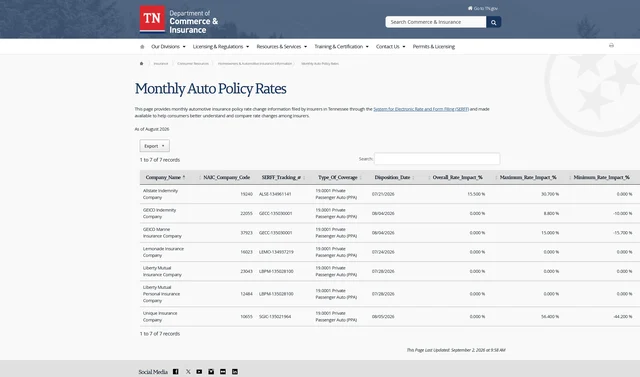
A filing's headline number hides a wide range, and Tennessee's insurance department publishes the range. Each row of its monthly auto rate list carries the overall rate impact, the maximum, the minimum, and the number of policies affected. Unique Insurance Company's August filing shows an overall impact of 0.00% across 1,127 Tennessee policies, inside a range running from a 44.2% decrease to a 56.4% increase. 4 Allstate Indemnity Company's July filing averages 15.5% across 929 policies, with a maximum of 30.7% and a minimum of 0.0%. That overall figure averages a whole book of business, while a renewal is one line inside the range.
National averages supply the yardstick. Insurify's cost report, updated September 27, 2026, puts full coverage at $2,241 a year and liability only at $1,181, and projects roughly a 1% national rise by the end of 2026. 8 The Zebra's 2026 State of Insurance, updated September 23, 2026, puts the average annual premium at $2,256, 3% above the year before. 9 A ValuePenguin survey of more than 1,200 policyholders, fielded in March 2022, found that 92% of drivers who changed carriers at their most recent renewal saved money, and 26% saved $200 or more. 10
Three public case files, with their limits
Completed disclosures arrive with holes in them, so each case below is labelled field by field: what the person posted, and what they left out.
Case 1 — An Arizona driver with an 850 credit score leaves State Farm for Progressive
Christine, in Arizona, posted on September 7, 2026: "State Farm has raised rates so much it's crazy. I drive under 100 miles a year, so no insurance is priced right for my habits. But I lease and need full insurance with high limits. I have an 850 FICO score, no claims in 20 years, and only one driver. I dropped State Farm for Progressive." 11
| Required field | Public disclosure status |
|---|---|
| Status | Completed switch, self-reported; both carriers named |
| Age / state / vehicles / credit tier | Arizona; an 850 FICO score; one driver; a leased vehicle, which sets the coverage floor at full coverage with high limits; under 100 miles a year. Age and vehicle not disclosed |
| Posted | September 7, 2026, on the State Farm review page |
| Prior carrier and premium | State Farm; premium not disclosed |
| New carrier and premium | Progressive; premium not disclosed |
| Annualised saving | Not disclosed |
| Named switch path | Not described; the review records the decision and the two carriers |
| Coverage evidence | The lease constraint on the old policy is named — full coverage, high limits. No limits or deductibles for either policy are recorded |
Case 2 — An Idaho driver saves about $1,000 by breaking a bundle
Dorothy, in Idaho, posted on September 23, 2026: "The promise that you'll save if you bundle with homeowners insurance isn't true. I saved almost a thousand dollars with another provider." 12
| Required field | Public disclosure status |
|---|---|
| Status | Completed switch, self-reported; the replacement carrier is unnamed |
| Age / state / vehicles / credit tier | Idaho; age, vehicles, and credit tier not disclosed |
| Posted | September 23, 2026, on the Progressive review page |
| Prior carrier and premium | Progressive, the company whose page the review sits on; premium not disclosed |
| New carrier and premium | Another provider; carrier and premium not disclosed |
| Annualised saving | About $1,000 a year, inside this channel's typical $300–$2,500 band |
| Named switch path | Not described beyond the decision to leave |
| Coverage evidence | None recorded. The stated cause is a bundle discount that failed to hold, which is a pricing question rather than a coverage change |
Case 3 — A Florida USAA member's bill goes from $227 to $497 a month
Deborah, in Florida, posted on July 24, 2026: "My premium was raised from $227 to $497 per month, which I refuse to pay, so I switched to a different carrier." The increase followed a claim on a parked car, an autopay arrangement she says was dropped without notice, a cancellation, a registration suspension, and a $150 reinstatement fee. 13
| Required field | Public disclosure status |
|---|---|
| Status | Completed switch away from the carrier; the replacement carrier is unnamed. Posted July 24, 2026, so the pricing is that month's |
| Age / state / vehicles / credit tier | Florida; age, vehicles, and credit tier not disclosed |
| Posted | July 24, 2026, on the USAA review page |
| Prior carrier and premium | USAA, at $227 a month before the claim and the lapse, and $497 a month at the renewal she rejected |
| New carrier and premium | A different carrier, unnamed; premium not disclosed |
| Annualised saving | Not disclosed. The disclosed figure is the $270-a-month renewal increase she declined, about $3,240 over a year |
| Named switch path | Not described beyond the exit |
| Coverage evidence | None recorded |
Across the three, a reader gets both carriers once, an explicit credit tier once, a dollar saving once, and the incumbent's two premiums once. A public disclosure stating both premiums for one switch alongside a coverage comparison has yet to appear here.
The four-step pre-flight
- Check the records your rate is built from. Insurers in most states may use credit information to decide whether to insure you and what to charge, weighting recent history most heavily. 14 Pull your credit reports and your LexisNexis C.L.U.E. auto report before you shop, and correct any claim or violation that is not yours; Washington's regulator requires an insurer to re-rate a policy back to its effective date after it learns of a credit mistake. 15
- Align coverage limits before you compare price. Put the current declarations page beside each quote worksheet and match them line for line: bodily injury, property damage, uninsured and underinsured motorist, comprehensive and collision deductibles, rental reimbursement, roadside assistance. This is the step that separates a real switch from a limit cut.
- Preserve multi-car and bundle pricing. Ask every carrier for two structures, auto alone and auto bundled with home or renters, then call your property insurer and price what an auto exit does to the home premium. Dorothy's $1,000 is what the bundle looks like once the discount stops holding.
- Document continuous coverage and verify before you cancel. Shop at least 30 days before the renewal date, get quotes from at least three insurers, buy the new policy first, and confirm it is bound before you touch the old one. 16 Then cancel in writing and keep the confirmation. If you carry a loan or a lease, have the new insurer send proof of insurance to the lender, because a lender's lapse notice can escalate to a repossession notice. 16 Deborah's autopay drop, cancellation, suspension and $497 renewal is the shape of what this step prevents. 13
A quote-shopping path by life stage
- 25-year-old single driver. You leave the highest-risk bracket around this birthday, so re-shop rather than assume the drop arrives on its own. Bring proof of continuous coverage, any degree or professional affiliation, and your annual mileage; start with the direct writers, then a regional mutual; and hold liability at $100k/$300k/$100k or above, because a state minimum can disqualify you from the preferred tier you just reached. In California, the September 16 proposal would remove marital status as a rating factor.
- Family in the 30s. You are pricing three things at once — auto, home, and an umbrella. Start with an independent agency that can quote several carriers, then price the identical structure at a captive agent, and bring every declarations page in the household. Price a new young driver onto the policy before you bind: one New Jersey reviewer, 20 years with NJM, moved to Progressive at $1,500 a year and watched it reach $6,000 once a son had an accident. 12
- 50s multi-car household. Ask for an itemized premium per vehicle rather than a policy total, then audit the use classifications: a car that stopped commuting can usually move to pleasure use, and that is a discount you have to request. Re-rate the existing policy before you shop, and price the umbrella again now that your assets are at their peak.
- 65+ retiree. Annual mileage has probably fallen below 7,500 or even 5,000, and the policy may still be priced for a commute. Report the real number, ask for the low-mileage tier by name, and complete your state's approved mature-driver course. A Wisconsin reviewer, 84, putting about 100 miles a month on the car with no at-fault accident on record, wrote on August 30, 2026 that "it feels costly for how much I use the car." 17
Comparison marketplaces such as Insurify and The Zebra route one set of details to multiple carriers and earn a commission when you buy through them; independent agents do the same work. Give every route identical limits, deductibles, drivers, and mileage, and you pay neither for the quotes.
The retention-department gambit
Before you cancel, use the quote to force a re-rate from the carrier you already have. Retention teams can rewrite a policy into a current rating program, refresh a stale tier score, or apply loyalty credits the renewal never applied. Marilyn, in Florida, described the alternative on September 15, 2026: "GEICO has been OK, but they haven't offered me any discounts in this latest market of reduced prices. I've been with them for quite a while with no issues on my part. So why do I have to switch companies to pay $80 less each month?" 17
Call customer service, take the cancellation path to reach retention, and say this:
"I'm reviewing our renewal at the price on the notice for our next renewal date. I have comparable quotes for identical coverage — same limits, same deductibles, same drivers and vehicles, same stated mileage — at a lower price. Before I authorize the new policy, please re-rate this account across your current rating tiers and tell me whether a rewrite, a refreshed tier score, or any endorsement or discount we have lost brings this renewal in line without changing our protection."
If the carrier bridges the gap, verify that every parameter stayed identical before you accept. If it holds firm, you have a documented reason to leave.
Four switches you should never make
- Cutting liability limits to a state minimum to hit a price. Serious-injury damages routinely run past $100,000, and once the limit is exhausted the injured party can pursue your savings, your home equity, and your wages.
- Switching carriers in the middle of an open claim. An unresolved claim complicates settlement, repairs, and rental extensions, and it will surface on the new application. Close the claim first.
- Dropping uninsured or underinsured motorist coverage. UM/UIM pays your own household's medical bills and lost wages when the other driver has little or nothing to collect. The premium you free up is a fraction of the exposure you take on.
- Binding an online teaser quote that never ran your records. Two quotes for identical coverage from the same carrier can differ materially, and the usual reason is that one pulled reports and the other did not. Insurers commonly revisit pricing for 30 to 60 days after binding, and a discovered violation or an unreported driver will move the number or end the policy.
References
- 1GEICO press releases
geico.com
- 2Arkansas Insurance Department compliance rate changes
portal.insurance.arkansas.gov
- 3State Farm newsroom
newsroom.statefarm.com
- 4
- 5
- 6
- 7
- 8Average Cost of Car Insurance (September 2026)
insurify.com
- 9
- 10
- 11
- 12
- 13USAA 2026 user reviews and ratings (page 1)
insurify.com
- 14Credit scores and insurance
insurance.wa.gov
- 15C.L.U.E. report
insurance.wa.gov
- 16How to Switch Car Insurance Companies in 3-Steps
libertymutual.com
- 17GEICO 2026 user reviews and ratings (page 1)
insurify.com
This story was produced automatically by a channel. One sentence is all it takes for Neodrop to keep producing for you.