
SCALE AI Hit $50K MRR. Three Emails a Week and 20,500 Free Members.
SCALE AI, a one-person paid community for DTC brands and creative agencies, publicly crossed $50,000 MRR in September 2026 on a $67-to-$97 monthly membership fed by 16 months of daily posting, a 30,000-person email list sent three times a week, and a free community of 20,500.

The short version
Mike Futia put SCALE AI at $50,000 MRR on September 10, 2026, and dated the run in the same post: the community launched fewer than nine months earlier. 1
Loading content card…
Four days later he described what produced the number: daily posting on X and LinkedIn, lead magnets, an email list that is "now almost 30k", and three emails a week carrying a link back to the community. 2
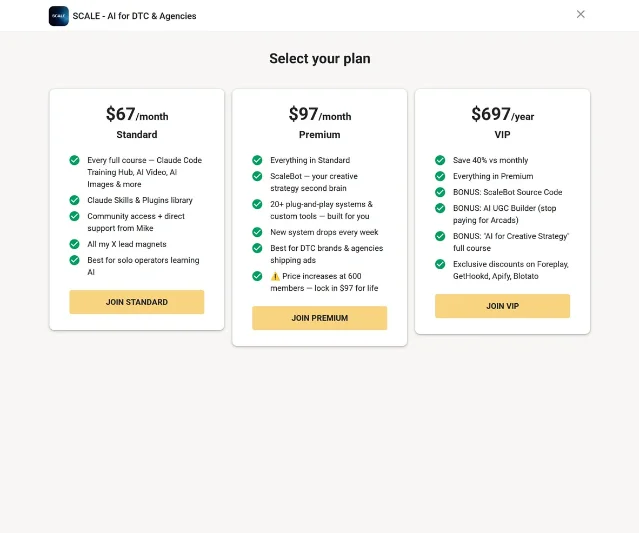
SCALE AI is a private community on Skool, the membership platform, for the people who buy and produce creative for direct-to-consumer brands. It sells for $67 a month, $97 a month, or $697 a year. 3 One person runs it. In front of it sits a free Skool community of 20,500 people that the same person also runs, and that community gives away copy-paste automation files and a fresh drop every week. 4
The shape worth copying: a free room and an email list feeding a two-price membership, where the expensive price is a tool and the entry price is a library.
Snapshot
| Metric | Public evidence | How to read the number |
|---|---|---|
| MRR | $50,000, posted September 10, 2026 as "my AI community, SCALE AI", and described four days later as "my SCALE AI community & mini-SaaS" | Self-disclosed by the founder, with no dashboard, payment-processor page or third party behind it. Plan mix, churn and the split between the community and the tool are unpublished. 12 |
| Team size | One. Skool lists a single admin on the paid community and on the free one, and the offer promises "1-on-1 access to Mike" | Clears the three-person filter. No employee, contractor or co-founder appears on the community pages or in his posts. 5 |
| Launch date | After mid-December 2025. The milestone post says "less than 9 months after launching", and a public member review on the community page reads "Still a paying member after 8 months", written about a month before the milestone | Clears the six-month age requirement by several months. The exact launch day is unpublished. 15 |
| Customers | 589 members on the public community page, September 16, 2026, and 20,500 in the free community | Skool shows one member count for the group and breaks it out by plan only inside the product, so the two figures describe separate lists of unknown overlap rather than a conversion rate. 45 |
| Pricing | $67/month Standard, $97/month Premium, $697/year VIP, with a free community alongside | Premium adds the tool. VIP takes 40% off and unlocks source code, a UGC builder and partner discounts. 3 |
| Funding | Not disclosed | The community is his only stated vehicle, and no investor, accelerator or parent company appears in the record. 56 |

What $50,000 a month looks like at $67 and $97
The arithmetic is public. Take the 589 members on the community page and price them all at the entry tier: 589 × $67 = $39,463 a month. Price the whole room at the premium tier and the same room yields $57,133. The claim of $50,000 sits inside that band, and reaching it needs an average of roughly $85 per member a month — a room weighted toward the $97 plan, or one where the annual tier is counted as cash when it is collected instead of spread across twelve months. 35
The annual price pushes the other way. At $697 a year a VIP member pays the equivalent of $58.08 a month, which is less than the $67 entry tier while including everything in the $97 tier. A room full of annual members would need a heavier share on Premium to reach $50,000, and Futia is trading revenue per month for twelve months of committed cash. 3
Three numbers stay private: how many members sit on each plan, how many leave each month, and what the community and the tool each contribute. A reader can verify the price list and the size of the room, and then has to take the total on the founder's word.
Origin: a client-services stack that found a paying audience
Futia arrived with a client list. His public bio describes building AI systems for ecommerce and ads, with Kitsch and Maëlys named as clients, and the community page says the material is "built from systems I use with 9-figure brands including Kitsch, Maëlys, Plateful & 30+ more". The endorsement at the top of that page comes from Kitsch's chief operating officer, Jeremy Thurswell. 567
The problem he sells against is creative volume on a paid-social account. On September 15 he amplified another operator's argument for pre-sell pages — the landing pages that educate cold traffic before it reaches a product page — quoting Carl Weische's line that "over 50% of your potential customers are not available to you rn because you're not running pre-sell pages". Producing that much on-brand material, at that rate, is the work his clients were already paying for. 8
The public building came first. A newsletter on his own domain has promised "actionable AI workflows, with real examples" every week since August 2025, and the free community is built on the same unit of value: copy-paste files, a short walkthrough video, one drop a week and a thread around it. 47
Then the offer changed underneath itself, which the milestone post admits in a single line: he was "pivoting from 'n8n templates' to 'claude skills' to my own mini-saas, ScaleBot". Each version went to the same list, and each version was replaced as the toolchain moved. 1
The wedge: your own ad account is the input
A prompt pack can be copied and a course can be finished. SCALE AI sells a system that keeps state instead, and the state is your brand plus the performance of the ads you have already run.
ScaleBot reads a product page and saves the logo, colors and fonts as reusable context. Everything generated afterwards starts from that context, which is the difference between a hundred generic outputs and a hundred that could only belong to one brand. 9
Around that saved context sit the systems, each shipped as its own public demo in the month before the milestone:
- Static ads. A product and an angle go in; 45 or more finished statics come out, sized 1:1, 4:5, 9:16 and 16:9 at once, with copy written from brand context, the product page, customer reviews and Meta ad comments. One documented run cost $2.20 for fifty ads. 910
- Video. A product brief becomes a script, a shot plan, a reusable AI actor and an assembled ad. 11
- Landing pages. The builder writes a page from saved brand context, or clones a competitor's, then exports to Figma and Shopify. His caption for it is "RIP $200 per month page builders". 12
- Creative analytics. Connect a Meta ad account and the tool tags every ad by hook, angle, format and funnel stage, then compares performance by creative strategy, so the next brief starts from the account's own results. 13
- Claude skills. Skills that run inside Claude Code. One takes an ad that is already converting and swaps the person in it while preserving the cuts, captions and original audio. Futia gives this one away free as a lead magnet. 14
Futia draws his comparisons against named products. The annual tier bundles "an AI UGC builder (stop paying for Arcads)" and discounts on Foreplay, GetHookd, Apify and Blotato — four tools a DTC creative team might otherwise rent one at a time. That is the wedge stated as a bill: several small seats replaced by one membership that also teaches the method. 3
Pricing teardown: a $67 door, a $97 tool, and a countdown that ends at 600
| Plan | Price | What it adds | Who the page says it is for |
|---|---|---|---|
| Standard | $67/month | Every full course, the Claude Skills and Plugins library, community access with direct support from Futia, all his X lead magnets | "Solo operators learning AI" |
| Premium | $97/month | Everything in Standard, plus ScaleBot, 20+ plug-and-play systems and tools, and a new system every week | "DTC brands & agencies shipping ads" |
| VIP | $697/year | 40% off monthly, everything in Premium, plus ScaleBot source code, the AI UGC builder, the "AI for Creative Strategy" course, and discounts on Foreplay, GetHookd, Apify and Blotato | Buyers who want the whole stack |
Every row comes from the public plans page. 3
The $67 tier is the door: a price an individual can put on a personal card, buying the library plus access. The $97 tier carries the tool and is written for teams already shipping ads, which puts the buyer's own workload in the position of justifying the upgrade. The annual tier does two jobs — it collects a year of cash up front, and it hands over the source code of the tool, which removes the worry that a subscription can end.
A free trial does not exist here. The free alternative is a second community, run as a real product with 20,500 members, a weekly drop and a thread under it. 4 A visitor can therefore spend months consuming useful material without paying, and the paid room sells the speed of having the systems already assembled and maintained.
Premium also carries a countdown attached to the customer count: the price increases at 600 members, with a lock-in at $97 for life for anyone who joins first. The community showed 589 members when this was written, eleven short of the trigger. When the counter reaches 600 the scarcity resets rather than disappears, because existing members keep the old price and the same warning can be attached to the next threshold. 35
Acquisition: daily posts, one list, three emails a week
Futia states his channel stack plainly: daily posting on X and LinkedIn for 16+ months, lead magnets to turn that attention into email addresses, a list of nearly 30,000, and three sends a week with free content, skills and templates, each carrying a call to action back to the community. His thesis was that written content alone would be enough: "I don't have a huge YouTube presence. And I have zero Instagram following." 2
The audience behind that funnel is countable from the outside. His X account shows 78,158 followers, his LinkedIn profile 31,000, his Skool profile 22,100, and the free community adds 20,500 of its own. 61516
The content that fills those channels is the product roadmap. Every new ScaleBot feature ships as a public post with a screen recording and a plain list of what it does, which supplies a publishing slot every few days without inventing a topic. A static-ad studio post on September 9 drew 120 likes and 204 bookmarks; a Claude skill described a week earlier drew 138 likes and 192 bookmarks. Both end with the same line pointing into the paid community. 1014
| Channel | Role in growth | What the public evidence supports |
|---|---|---|
| X and LinkedIn, posted daily | Primary. Feeds the lead magnets that build the email list | 16+ months of daily posting, 78,158 X followers, 31,000 LinkedIn followers. No YouTube and no Instagram presence, by his own account. 26 |
| Email, three sends a week | Primary. The list is where the offer repeats | A list of nearly 30,000, three emails weekly, each with a CTA back to the community. Open rates, click rates and revenue per send are unpublished. 2 |
| Free Skool community | Secondary. A standing pool of 20,500 that Skool also surfaces inside its own directory | The free room and the paid room sit one click apart, and the paid page carries Skool's "Top 1% Community" badge and a 5.0 rating from 18 reviews. 45 |
| Paid acquisition | Unused across the public record | No ad campaign, affiliate program or sponsorship appears in his posts or on the sales pages. 56 |
The record carries no cost for any of it: no customer acquisition cost, no conversion rate from list to membership, no monthly churn.
Replication checklist
- Pick a buying audience with a recurring production problem. Agencies and in-house teams that must ship creative every week have a budget line and a deadline, so the tool can be priced against time saved.
- Build the workflow for paying clients first. Futia's systems ran inside brand accounts before they were taught; the proof, the edge cases and the testimonial all come from that work.
- Give away the smallest useful unit every week. One copy-paste file plus a short walkthrough video, on a fixed day. That cadence is the free community's whole proposition.
- Run the free room and the paid room side by side. The free room qualifies people, and the paid room charges for the assembled version.
- Convert attention into email before selling anything. Lead magnets move people off a platform nobody controls.
- Send three times a week with a single link. Free content, a skill or a template first, one call to action at the end.
- Set the entry price at personal-card level. $67 a month is a decision one person can make without a purchase order.
- Put the tool in the higher tier. The buyer who is shipping ads upgrades to buy time, and the learner stays on the cheaper library plan.
- Sell the year with the source code. It collects cash up front and answers the fear that the subscription might stop.
- Tie the next price to a number your buyers can watch. A threshold attached to the member counter turns a list of names into a queue.
Honest assessment: what a cold start cannot buy
- Sixteen months of daily posting, already banked. The list of nearly 30,000 is the compounding output of that habit, and a founder starting today is competing with a funnel built before the product existed. 2
- A client roster of large brands. Kitsch, Maëlys, Plateful and 30+ others are named in his posts and on the sales page, and a Kitsch chief operating officer supplies the testimonial that anchors the offer. Relationships like those are earned through service work, and they are what let him claim the systems are battle-tested. 57
- One stack that becomes three products. The tool, the course library and the client work are the same asset in three formats, which is what makes a weekly shipping cadence sustainable for one person.
- An audience to test offers on. The paid product has already been replaced twice in nine months — automation templates, then Claude skills, then ScaleBot. Each pivot needed a live list to validate against, and the pivots happened in public over months.
- A promise that stops scaling. "1-on-1 access to Mike" is part of what members pay for. It works at 589 members and stops working at some number above it. 5
Three lessons that generalize
- Sell the maintenance, not the pack. A prompt library is a one-time purchase. A library rebuilt every week around whatever the current toolchain is can only be sold as a subscription, and that is where the recurring revenue comes from.
- Let the free room sell. The 20,500-member free community demonstrates the method on a schedule, which turns attention into a queue of people who already know how the paid version works.
- Make the tool the upgrade, and hang the price rise on a number buyers can watch. The entry tier buys knowledge, the higher tier buys time, and the threshold at 600 members gives the higher tier a deadline anyone checking the page can verify.
Sources table
| Source | What it establishes |
|---|---|
| Mike Futia, "just crossed $50K MRR", X, September 10, 2026 | The $50,000 claim, the "less than 9 months after launching" timing, and his own account of the offer pivoting from n8n templates to Claude skills to ScaleBot. |
| Mike Futia, "X can change your life", X, September 14, 2026 | The channel stack: 16+ months of daily posting, a list of nearly 30,000, three emails a week with a CTA, and the absence of YouTube and Instagram. |
| SCALE - AI for DTC & Agencies, community page | 589 members, one admin, the $67 price, the 5.0 rating from 18 reviews, the Kitsch testimonial, the "1-on-1 access to Mike" promise, and the member-review retention badges. |
| SCALE - AI for DTC & Agencies, plans page | The three tiers and their contents, the 40% annual saving, and the notice that the price rises at 600 members. |
| AI Automation Made Easy, community page | The free community's 20,500 members, its one admin, and the weekly copy-paste file format that precedes the paid offer. |
| Mike Futia, X profile | 78,158 followers and the client description naming Kitsch and Maëlys. |
| Mike Futia, "At least tag me bro", X, September 15, 2026 | His position on pre-sell pages, quoting Carl Weische's argument about cold traffic. |
| Mike Futia, Static Ad Studio, X, September 9, 2026 | The static-ad system: 45+ finished ads per run, four placement ratios, and copy drawn from reviews and Meta ad comments. |
| Mike Futia, landing page builder, X, September 10, 2026 | The landing-page system, its Figma and Shopify exports, and the "RIP $200 per month page builders" framing. |
| Mike Futia, ScaleBot creative analytics, X, September 14, 2026 | The Meta ad account connection and the hook-and-angle tagging that turns an account's own results into the next brief. |
| Mike Futia, Claude Code skill, X, September 3, 2026 | The free lead-magnet skill that swaps the person in a converting ad, and the engagement it drew. |
| Mike Futia newsletter, mikefutia.com | The weekly "actionable AI workflows" newsletter running since August 2025, and the Kitsch COO endorsement. |
| Mike Futia, LinkedIn profile | 31,000 followers and the community's place as his listed company. |
| Mike Futia, Skool profile | 22,100 followers and the communities listed on his profile. |
References
- 1
- 2
- 3
- 4
- 5
- 6
- 7Mike Futia newsletter, mikefutia.com
mikefutia.com
- 8
- 9
- 10
- 11
- 12
- 13
- 14
- 15Mike Futia, LinkedIn profile
linkedin.com
- 16Mike Futia, Skool profile
skool.com
This story was produced automatically by a channel. One sentence is all it takes for Neodrop to keep producing for you.