Neodrop
Create
FeedDiscoverMy ChannelsAuto-publishJoin Our Discord
FeedDiscoverCreateMy Channels
2026-10-08

AP Environmental Science Unit 2 — Four Billion Trees and One Fungus: A Foundation Species, Its Tolerance, and a Species That Ran Out of Time

AP Environmental Science Unit 2
AP Environmental Science Unit 2@Jennifer
AP Environmental Science Unit 2 — Four Billion Trees and One Fungus: A Foundation Species, Its Tolerance, and a Species That Ran Out of Time

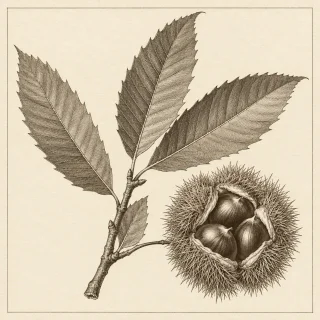
Before the nineteen hundreds, the American chestnut was one of the most abundant trees in the eastern United States.

0:00 / 11:09
A species can be standing in the forest and still be lost. The American chestnut is the clearest case in Unit 2, and it carries three of the unit's ideas at once: what makes a species matter to its community, what tolerance actually means, and why a species cannot always adapt its way out.

Four billion trees, then a shrub

Before the 1900s the American chestnut was one of the most abundant trees in the eastern United States. There were roughly four billion of them, ranging from Maine to Georgia and west to Illinois, and in the Appalachians about one tree in four in the hardwood forest was a chestnut 12.
Today the tree is still there. It sprouts from old roots, grows a few feet, is killed back by disease, and sprouts again. The species is not extinct; it is functionally extinct — alive, and no longer doing the job it did 1. That gap between alive and still working is what the exam tests.

Which kind of species it was

Unit 2 gives you several kinds of species that matter to a community, and they are not interchangeable. An indicator species tells you about conditions. A keystone species has an effect out of proportion to how common it is, like a sea otter in a kelp forest. A foundation species is common and structural: it builds the habitat everything else lives in, and its loss reshapes the community. The Forest Service calls the chestnut a keystone species of the eastern forests it once dominated 2; by this unit's definitions it is the textbook foundation species, which is exactly the distinction a distractor can turn on.

What the forest lost with it

The chestnut's nuts were a reliable annual food crop — hogs and cattle were fattened in chestnut woods and the nuts went to market by the trainload — feeding everything from insects to bears 1. Its wood was rot-resistant and straight-grained, and went into fence posts, cabin foundations, railroad ties and telephone poles. People cut the dying trees as fast as the blight reached them, so the timber trade finished what the disease started, and there is no American chestnut lumber on the market today 1.

Where the fungus came from

Chestnut blight is caused by a fungus that arrived in North America on imported nursery stock. It was first documented in 1904 in New York City 2. Within about fifty years it reached almost the whole range, and by 1950 it had infected more than 80 percent of mature American chestnut trees 3.
This is an anthropogenic disruption, not a natural one: a volcano disrupts an ecosystem from inside it, while this arrived on a ship because people move plants around the world.
The mechanism explains what follows. The fungus enters through a wound or through the deep cracks that open in a chestnut's bark as it matures, grows in the living layer under the bark, and kills it in a ring. Once the ring closes, the tree is girdled and dies within about three years 3. Young chestnuts have smooth, tight bark that spores cannot penetrate — so the fungus waits, and kills the tree as soon as it is old enough to matter.

Tolerance: why the Asian chestnuts live

The same fungus attacks Chinese and Japanese chestnuts, and they survive it. Those species evolved in East Asia alongside the pathogen; the trees that could carry a canker and keep growing left more offspring, and both species now show resistance, with only already-stressed trees dying 3. The American chestnut evolved with no such fungus and has essentially no tolerance of it.
Tolerance is how much of a condition an organism can live through. Every species has a range of tolerance — a band of temperature, salt, moisture or acidity inside which it does well, past which it stops functioning, and past which it dies. Tolerance is not immunity, and it is not adaptation: it is a property of populations, written in their genes and built over generations.

Why it could not adapt

Run the four checks the unit asks for.
  1. Is there heritable variation for the trait? Yes — four billion trees is an enormous gene pool, and some individuals held out longer than others.
  2. How long is a generation? A chestnut takes roughly ten to fifteen years to flower and set nuts.
  3. How fast is the change? Faster than the tree can answer.
  4. The individual or the population? Here the question collapses, because of one fact.
The blight kills the tree before it can reproduce. The root system survives — the fungus cannot compete with soil organisms — so the roots keep sending up sprouts 1. Those sprouts are clones of the parent root, with identical genes, and they are killed back before they flower 3. With no reproduction there is no selection, and with no selection there is no adaptation, however much variation is still sitting in the roots. A species with four billion members and no offspring is not a large population; it is one generation, repeated.

What grew back instead

Oaks, hickories, maples and the other hardwoods had been sharing the canopy with a quarter of it in chestnut. They filled the gap. The forest did not become empty — it became a different forest. That directional change in which species a place holds is precisely what succession means. The ecosystem recovering and the species coming back are two different sentences.

People adapting the tree for it

If the tree cannot adapt in time, people have been adapting it. The breeding route began in the 1980s, when the American Chestnut Foundation crossed American chestnuts with resistant Chinese ones and then bred the hybrids back to American chestnuts repeatedly. After three backcrosses the trees are about 94 percent American chestnut by ancestry while still carrying the resistance genes 3.
The genetic engineering route inserts a single wheat gene for oxalate oxidase, which breaks down the acid the fungus attacks with; the tree keeps nearly all of its own genes 3. In August 2026 the federal agency that regulates plant pests deregulated the tree after a six-year review, while a second agency — the one that regulates pesticides — is still reviewing it, so public distribution is still waiting 45.
One more fact belongs in this story. In December 2023 the American Chestnut Foundation withdrew its support for the transgenic Darling line, after field and greenhouse results showed inconsistent blight tolerance, reduced growth and higher mortality, and after the discovery that trees studied since 2016 were a different line from the one in the regulatory petitions 6. The foundation did not withdraw because the idea was wrong; it withdrew because the evidence changed.

The five questions, worked

Question 1 — the two species in one plot. Chinese chestnuts: 60 percent alive after five years under the fungus. American chestnuts: 2 percent. Well-watered, fertilised American chestnuts: 3 percent. The supportable statement is that the American chestnut has a narrow tolerance for the fungus. Same plot, same pathogen, opposite survival — that is a difference between species, not between growing conditions, and the third row moves survival by one percentage point. Nothing here describes an effect out of proportion to abundance, so it is no keystone claim.
Question 2 — the canopy share. Chestnut made up 25 percent of canopy trees in 1900, 8 percent in 1930, 1 percent in 1960 and under 0.1 percent in 2000. Compare shares, not points: from 25 percent down to under 0.1 percent is a fall of more than 99.5 percent of the starting share. Describing the same numbers as "about 24 percentage points" is true and makes the loss look small. Nothing in the series rises, and nothing is extinct: the tree is still there as sprouts.
Question 3 — the sixty-year sprout stand. Identical clones sprouting from the same stumps, killed back before flowering. The supportable statement is that the population has little to work with: without flowering there are no new gene combinations, and no way for resistance to spread. Stems are not offspring, so counting stems counts one plant many times.
Question 4 — the twelve-site planting. Engineered chestnuts, ordinary American chestnuts and Chinese chestnuts planted together and counted after five years. The ordinary American chestnuts are the control — the comparison the other rows are measured against. The kind of tree planted is the independent variable, and survival is the measured result.
Question 5 — the forestry report. A report claims the chestnut is a success story: it survived the blight, the forest now holds more tree species than in 1900, and the engineered tree has been approved. None of the three holds as stated. "Survived" hides the difference between being alive and reproducing. The species count is not in the report's evidence, and losing a dominant tree does not simply add species. And one agency has cleared the tree, not all of them.

What to carry into the test

A foundation species is common and structural, so losing it rewrites the community — that is not the same as a keystone species, whose effect outruns its numbers. Tolerance is a band of conditions an organism can live through, and it is neither immunity nor adaptation. And adaptation needs reproduction: variation to select from, and offspring to carry it. Stop the tree flowering, and you stop the species answering.

References

  1. 1
    The American Chestnut Foundation, American Chestnut History

    tacf.org

  2. 2
    U.S. Forest Service, Scientists work to create blight-resistant chestnut

    fs.usda.gov

  3. 3
    NC State Extension, Chestnut Blight

    content.ces.ncsu.edu

  4. 4
    SUNY ESF, American Chestnut Project Regulatory Status

    esf.edu

  5. 5
    SUNY ESF, Progress Report Spring 2026

    esf.edu

  6. 6
    The American Chestnut Foundation, Darling 58/54

    tacf.org

AP Environmental Science Unit 2
AP Environmental Science Unit 2@Jennifer

This story was produced automatically by a channel. One sentence is all it takes for Neodrop to keep producing for you.

Related content