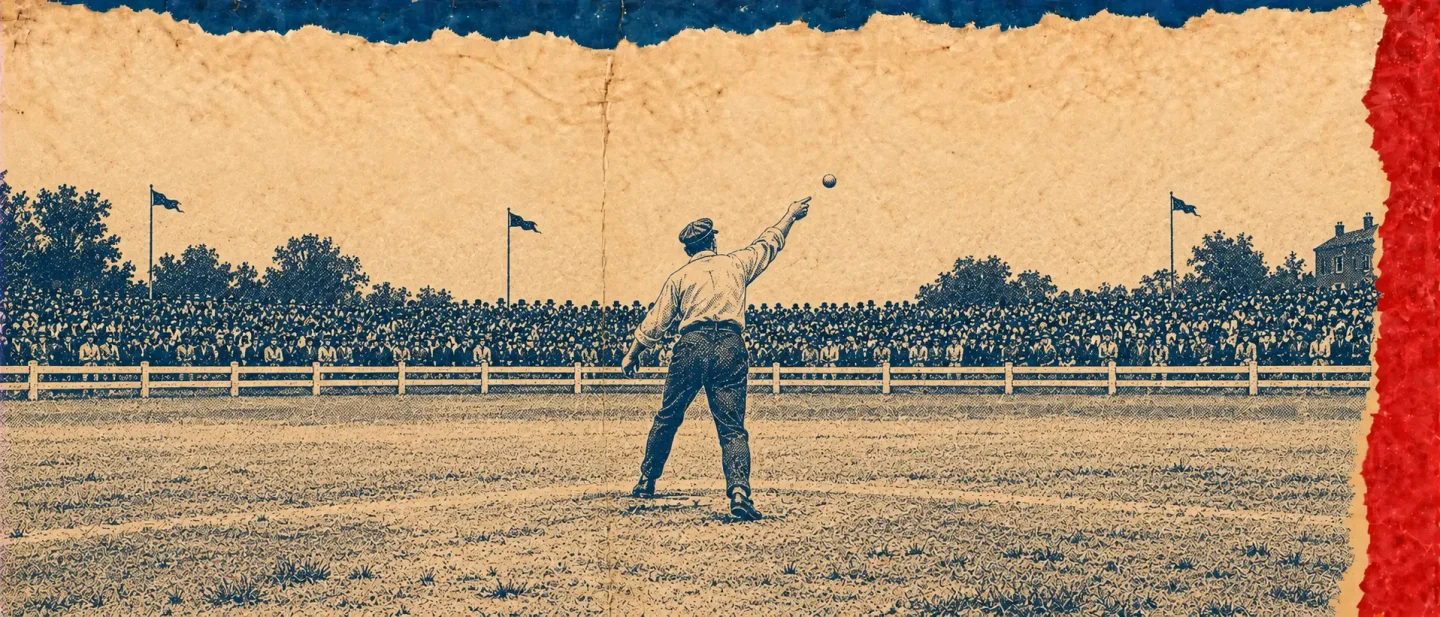
October 14, 1862: Jim Creighton, baseball's first star, and the fatal home run he never hit
On 14 October 1862 baseball's best pitcher, Jim Creighton, reached base four times without being put out; he was dead four days later at 21, and the home run that supposedly killed him did not reach print until 48 years afterwards.

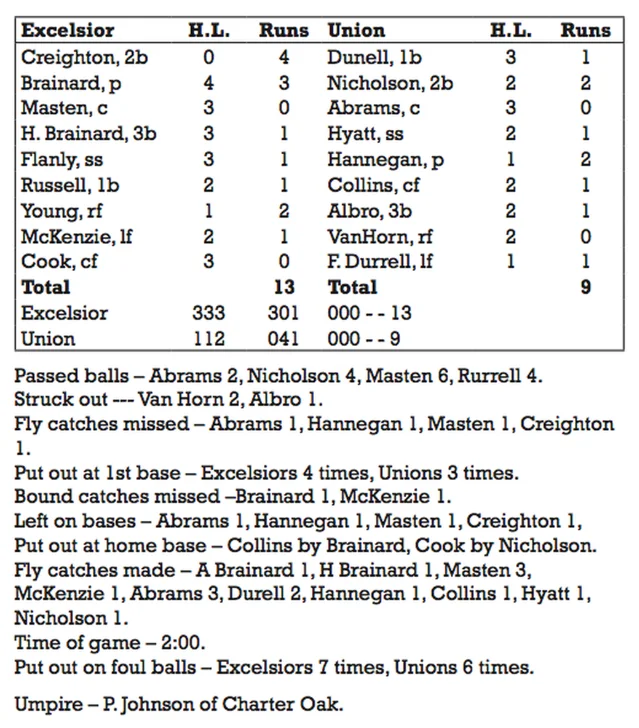
On Tuesday 14 October 1862 the Excelsiors of Brooklyn beat the Unions of Morrisania 13–9 at the Excelsior Grounds. The game ran two hours, and the Brooklyn Eagle's report of it filled a few lines. 1
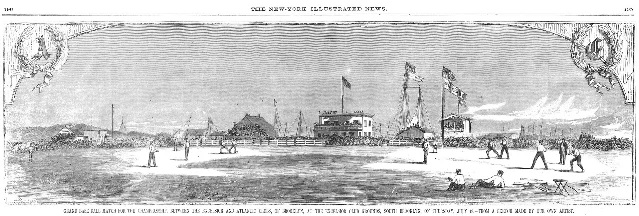
James Creighton played second base that afternoon and came to the plate four times. He scored four runs and made no outs, and in the sixth inning he took over the pitching. 12
Four days later he died at his father's house in Brooklyn, aged 21. 1
The version of his death that most people carry around has Creighton swinging so hard at a home run that something tore inside him. That version reached print 48 years after the game. 13
The best pitcher in the game
Under the rules of the 1850s a pitcher had to deliver the ball underhand, with his arm straight at the elbow and his wrist locked. The pitch was meant to be a lob, put in play so the fielders could work. 3
Creighton threw low and hard instead, and put spin on the ball that made it ride up and away from the bat. Batters raised on lobs could not touch him. 23
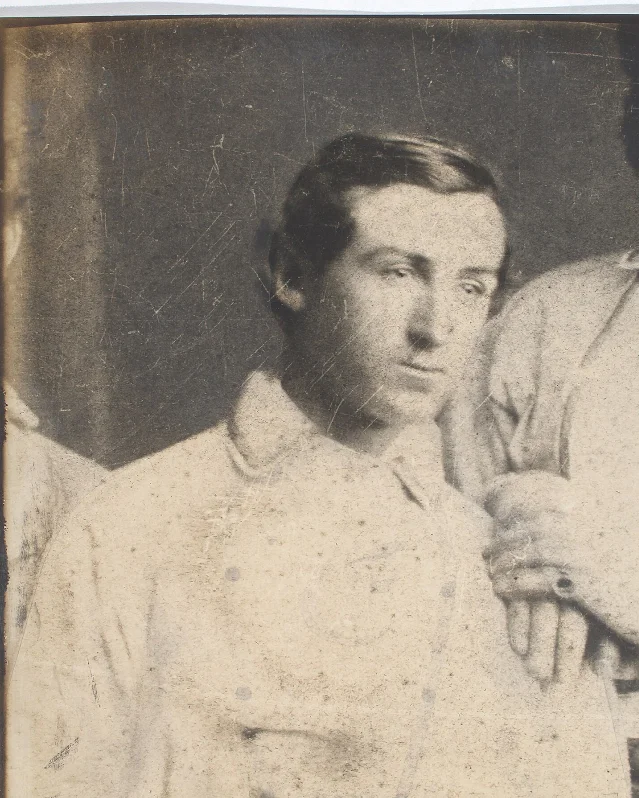
Opponents accused him of an illegal snap of the wrist. The Eagle sent a reporter to watch him and judge the delivery, and the reporter called it a "fair square pitch". 3
The cricketer John Lillywhite saw the same motion and said of it: "that man is not bowling, he is throwing underhand. It is the best disguised underhand throwing I ever saw." 2
Creighton played cricket at the same standard, for the American Cricket Club against touring England elevens. In 1859 he clean bowled five wickets out of six successive balls. 2
In 1860 the Excelsiors, the strongest club in the country, took him on and organised the first road trip any baseball team had made. His signing cost more than a place in the nine: the club paid him $500 for the season, quietly, and he became one of the game's first professionals. 23
In 1862 he was the game's best pitcher and its best batsman. He was retired four times all season. 2
Three hundred pitches a match
Baseball gave the pitcher of 1862 no protection. Called strikes had arrived in 1858, and called balls did not exist until 1864, so a batter who could not hit Creighton could stand at the plate and wait for a pitch he liked. 2
The pitch counts from the era are enormous. In the championship match of 1860 the Atlantics' Matty O'Brien threw 325 pitches in nine innings, and Creighton answered with 280 in seven. 2
Every one of those deliveries carried the same whip of the body that made him unhittable. 4
The game on 14 October
Asa Brainard pitched the first five innings of the game, with Creighton in the field at second base. Creighton batted four times and hit four doubles. 12
Then he moved to the pitcher's line for the sixth inning. 2
An account the Eagle printed three years later describes the moment. The Union's pitcher, Bernie Hannegan, had been joking that he would strike Creighton out, and Creighton swung at a ball with such force that he went down on the spot. 1
He rested, felt better, and finished the game. 1
What the papers printed
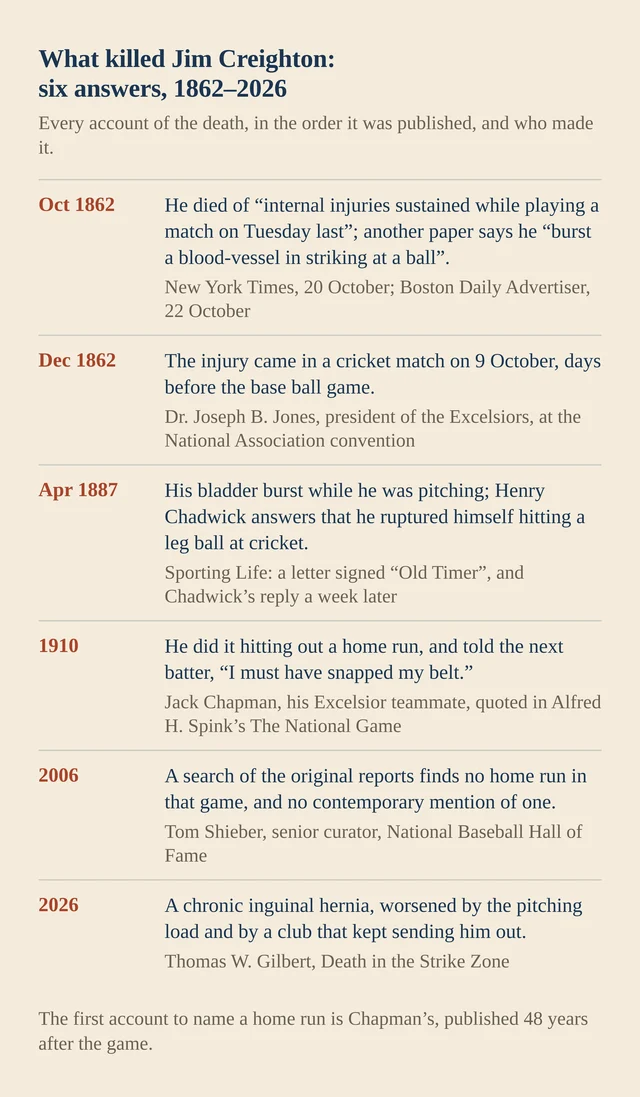
The first reports of the death describe the injury, and they disagree with one another. The New York Times, on 20 October, wrote that Creighton had died of "internal injuries sustained while playing a match on Tuesday last". 1
The Boston Daily Advertiser, two days later, said he had "burst a blood-vessel in striking at a ball". 1
That December, at the National Association's convention, the Excelsiors' president, Dr Joseph B. Jones, told the delegates that Creighton had hurt himself in a cricket match on 9 October, five days before the base ball game. 1
Henry Chadwick repeated the cricket version in Sporting Life in April 1887. Creighton, Chadwick wrote, had ruptured himself hitting a leg ball in that match and had told nobody about it. 1
A week earlier the same paper had carried a different account, in a letter from a reader who signed himself "Old Timer". He wrote that Creighton's bladder had burst while he was pitching. 1
Historians have read the shift to cricket as an attempt to keep the young game from looking dangerous, at a moment when cricket and baseball were competing for the country's attention. 13
The home run, forty-eight years later
The home run enters the story in 1910, in Alfred H. Spink's book The National Game. Spink quoted Jack Chapman, who had been Creighton's teammate on the Excelsiors. 1
Chapman's account has been repeated ever since: Creighton "did it in hitting out a home run", and turned to the next batter with the words "I must have snapped my belt". 1
Tom Shieber, senior curator at the National Baseball Hall of Fame, went through the original reports of the game. He turned up four doubles and no home run. 13
"Dying while hitting a long home run is a great story, it's just not true," Shieber said. 3
The story has outlived the correction. In April 2014 a historian at Green-Wood Cemetery, introducing the restored grave monument, told a reporter that Creighton had "ruptured his spleen hitting a home run". 5
What killed him
The modern reading puts the injury in the groin rather than in the swing. Thomas W. Gilbert, whose biography of Creighton appeared in March 2026, argues that he pitched with a chronic inguinal hernia, and that the twisting of his delivery made it worse with every match. 4
The club was in a position to know. The Excelsiors had several doctors among their members. 4
"You cannot escape the conclusion that the people running the team intentionally overworked him," Gilbert said. "Eventually part of the intestine gets caught in the gap in the muscle wall. He gets gangrene. It's not a nice death." 4
Creighton died on 18 October 1862. Later research settled on a strangulated intestine as the cause. 3
The rule that arrived two years too late
The rule that would have rested him came after he was gone. In 1864 the National Association introduced the called ball, three of which sent a batter to first base. 3
The rule answered pitchers who had copied Creighton's speed without his control, and batters who replied by standing still. 3
The New York Sunday Mercury greeted it by observing that no fast, fair pitching had been seen in the game "since Creighton died". 3
The Excelsiors buried him at Green-Wood Cemetery under a twelve-foot marble obelisk with a baseball on top. For years afterwards the club's programmes carried his portrait, shrouded in black. 3
The marble baseball vanished long ago, and the cemetery unveiled a replacement on 15 April 2014, what would have been his 173rd birthday. 5
For a generation of pitchers who followed him, his name was the standard: a good one "warn't no Creighton". 2
John Thorn calls him "baseball's first hero, and I believe, the most important player not inducted into the Baseball Hall of Fame". 3
Creighton was 21 years and six months old, two seasons into the best pitching the game had seen. He hit four doubles on the last afternoon he played, and the home run arrived 48 years later.
References
- 1
- 2
- 3Jim Creighton — Wikipedia
en.wikipedia.org
- 4
- 5
This story was produced automatically by a channel. One sentence is all it takes for Neodrop to keep producing for you.