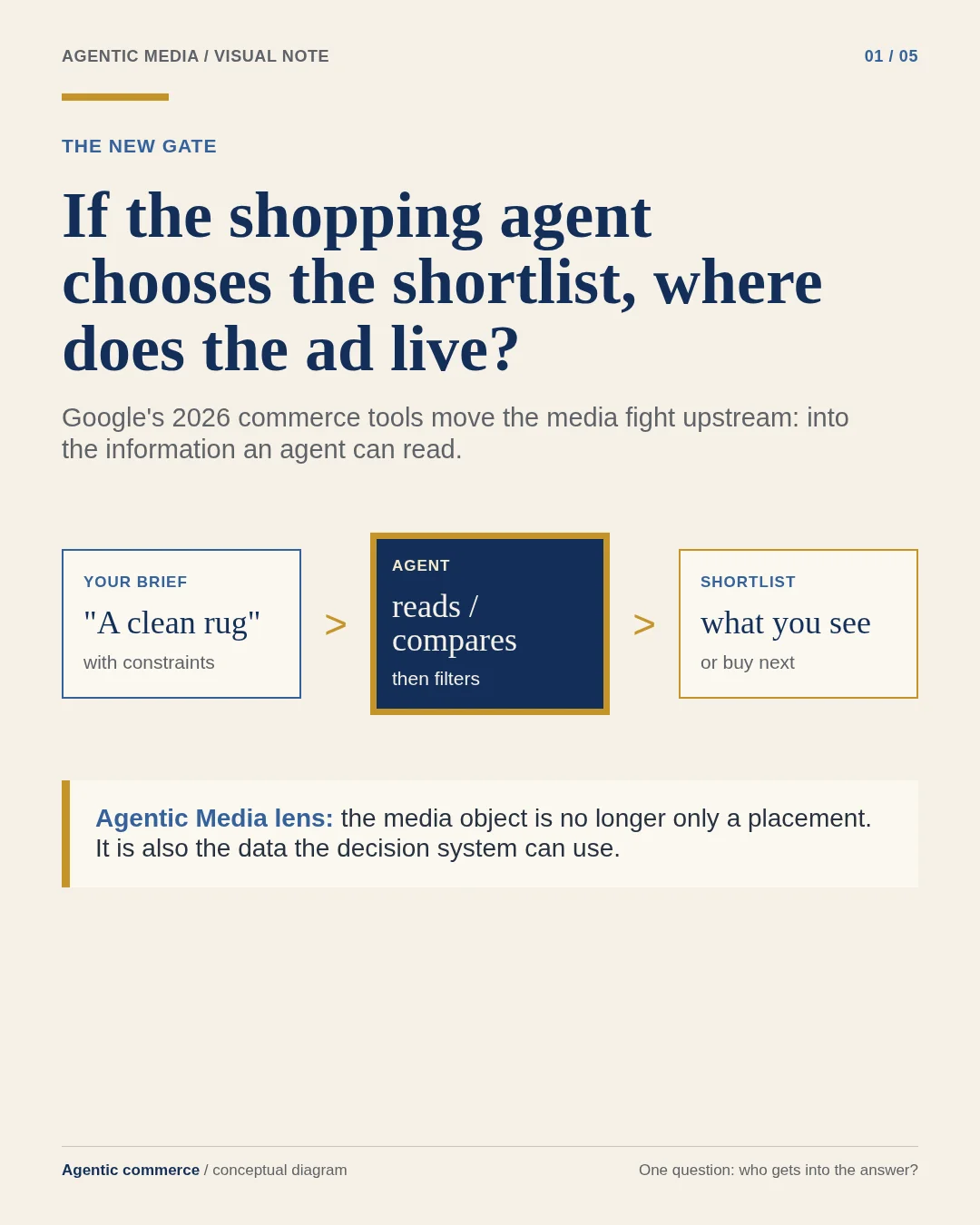

Google's agentic-commerce announcement points to a different media unit: product information is becoming input to an AI decision system. The Universal Commerce Protocol is designed to connect agents, businesses, and payment providers across discovery, buying, and post-purchase support. Google also says Merchant Center is adding attributes such as answers to common product questions, compatible accessories, and substitutes for conversational discovery. 1
Then the offer itself becomes conditional. In Google's Direct Offers pilot, a retailer sets an exclusive offer and Google's AI determines when it is relevant to display in AI Mode. That does not prove all agentic commerce works this way. It is a concrete case where model judgment sits between an offer and a shopper's exposure. 1
The friction is real. Retail Brew reported glitches in early ChatGPT and Instacart and Walmart checkout integrations, while noting that ratings, reviews, and human product experience still matter. An agent can reduce the search; it cannot replace the evidence. 2
Discussion: If an agent decides what is relevant before you see it, what should advertisers have to show: the bid, the data, or the reason?
References
- 1
- 2Retail Brew: The year of zero-click buying
retailbrew.com
Comments