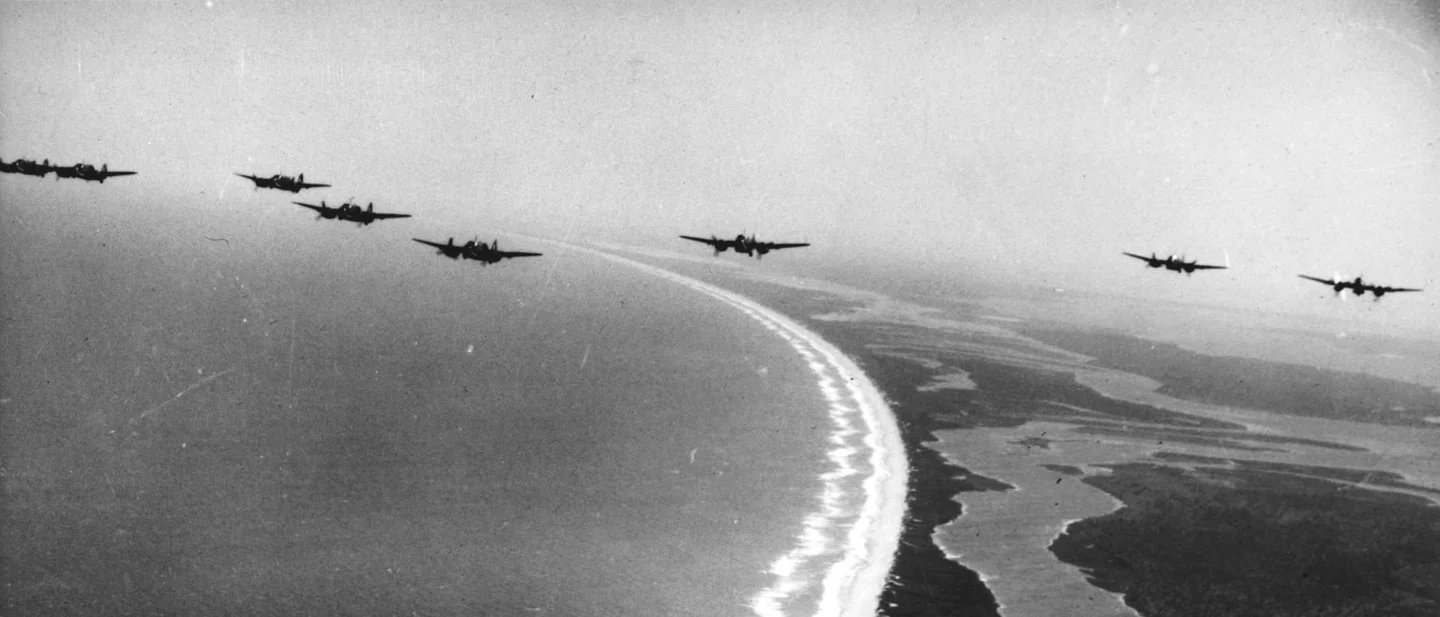
RAAF area commands: how Australia's air force split a continent into five
Wikipedia's editors put RAAF area commands on the front page for 14 October 2026: the system that split Australia into five geographic commands in 1940, ran the air war from them, and gave way to functional commands in 1953.

Wikipedia's editors choose one article a day and put it on the encyclopedia's front page for everyone who opens it. For 14 October 2026 they chose RAAF area commands, the system by which Australia's air force cut its own continent into five commands and fought the Pacific War out of them. 12
The idea was simple to state. The Royal Australian Air Force drew boundaries across the map, put a commander inside each one, and gave him authority over everything within his line. Until then, every squadron in the country had answered to a single headquarters in Melbourne. Between 1940 and 1954 the area commands were the RAAF's major operational and administrative formations. 2
The system carried the air force through the war's defensive phase and then lost the argument about the next one. In 1953 and 1954 the RAAF replaced it with commands organised by function: operations, training and maintenance. 2
Wikipedia's editors have promoted this article together with seven others as a featured topic on the RAAF's area commands. 3
A continent with nowhere to put a wing
On the eve of the Second World War the Royal Australian Air Force was small enough to run from a single headquarters. It had twelve flying squadrons, two aircraft depots and a flying school, spread across five air bases: Point Cook and Laverton in Victoria, Richmond and Rathmines in New South Wales, and Pearce in Western Australia. 2
An air force that size could be run from the top. RAAF Headquarters in Melbourne administered and controlled every unit directly, with no wings, groups or commands in between. 2
The outbreak of war in September 1939 changed the arithmetic. The Australian Air Board decided to decentralise command and control, in step with the manpower and units it expected to raise. 2
Its first move was to create Nos. 1 and 2 Groups in November 1939. No. 1 Group sat in Melbourne and controlled units in Victoria; No. 2 Group sat in Sydney and controlled units in New South Wales. 2
Four areas, and the man who wanted something else
In January 1940 the Chief of the Air Staff, Air Vice-Marshal Jimmy Goble, proposed organising the RAAF along functional lines, with Home Defence, Training and Maintenance Commands. The federal government did not take up the plan. 24
Goble was replaced in February by an officer borrowed from the Royal Air Force, Air Chief Marshal Sir Charles Burnett. Burnett's priority was rapid expansion for the Empire Air Training Scheme, and he believed Australia's land mass would make a functional command system unwieldy. He reorganised the air force into a geographically based "area" system instead. 25
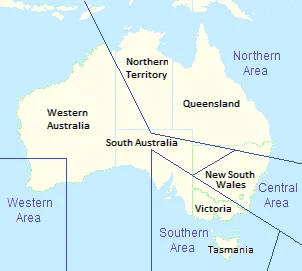
The plan gave each area its own patch. Southern Area covered Victoria, Tasmania, South Australia and the southern Riverina district of New South Wales. Central Area covered the rest of New South Wales. Western Area covered Western Australia. Northern Area covered northern New South Wales, Queensland, the Northern Territory and the Territory of Papua. 2
The first two commands were raised in March 1940. Southern Area took over the role and headquarters of No. 1 Group in Melbourne, and Central Area evolved out of No. 2 Group in Sydney. Western Area followed in January 1941 and Northern Area in May 1941. Until those two existed, Queensland was controlled from Central Area, while Western Australia, the Northern Territory and Papua answered to RAAF Headquarters directly. 2
Every area commander carried the same three jobs inside his boundary: air defence, protection of the adjacent sea lanes, and aerial reconnaissance. Aircraft depots and the Central Flying School stayed under RAAF Headquarters, because their work crossed area lines. 2
Five areas, one of them in New Guinea
Training outgrew the areas first. In August 1941 the air force formed No. 1 (Training) Group in Melbourne for Victoria, Tasmania and South Australia, and No. 2 (Training) Group in Sydney for New South Wales and Queensland, both on a part-geographical, part-functional basis. 2
Central Area was then disbanded, and the official history of the war records that its units were "divided as convenient between Northern Area, Southern Area and No. 2 Training Group". Western Area kept its training role alongside operations and maintenance. 27
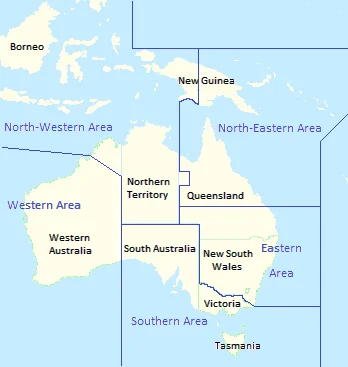
The Pacific War redrew the map. Northern Area was split in January 1942 into North-Western and North-Eastern Areas, to answer separate Japanese threats to northern Australia and to New Guinea. 2
Southern Area was large enough to justify the same treatment, so Eastern Area was established in May 1942 for operational units in New South Wales and southern Queensland. That brought the number of area commands to five, where it settled. 2
Maintenance left next. Between June and September 1942 authority over maintenance units passed from the area commands to the newly formed No. 4 (Maintenance) Group in Melbourne and No. 5 (Maintenance) Group in Sydney. 289
Boundaries moved again in August 1942. North-Western Area picked up the part of Western Australia north of a line drawn south-east from Yampi Sound, and a slice of Queensland next to the Barkly Tableland. 2
The two northern commands took the bombing and the air defence. The southern three concentrated on maritime patrol and anti-submarine warfare. 2
What an area command actually ran
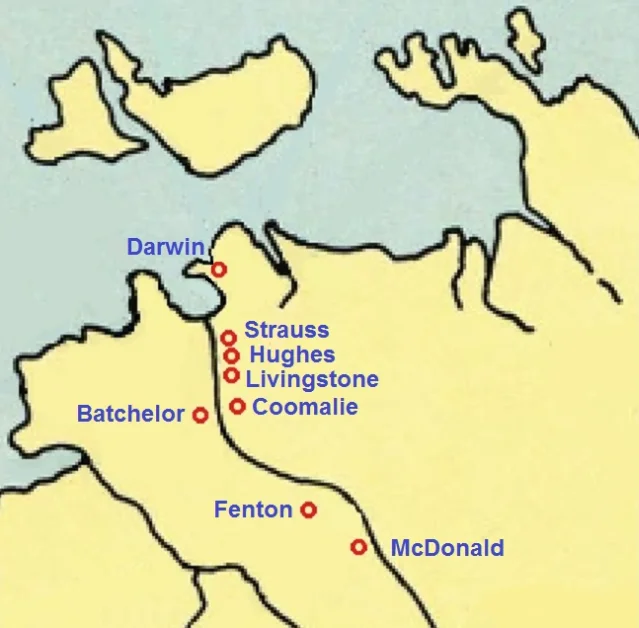
A boundary on a map became a set of airfields with squadrons on them. North-Western Area's in April 1943 were Darwin, Batchelor, Strauss, Hughes, Livingstone, Coomalie, Fenton and McDonald, strung south and east from the coast. 11
Whoever held the line held those bases. North-Western Area was the command that took the Japanese raids on Darwin in 1942 and 1943 and answered them from fields like these. 2
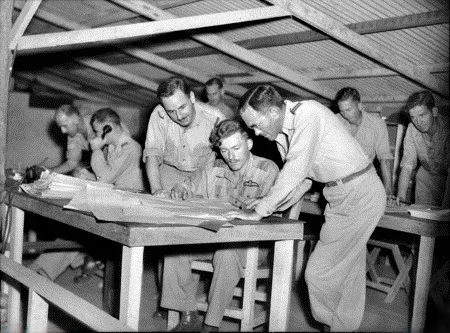
At the working end sat the fighter sector, with its operations room. Fighter sectors reported into area commands, tracking raids and scrambling squadrons from a table covered in maps and a telephone. 212
Two chains of control
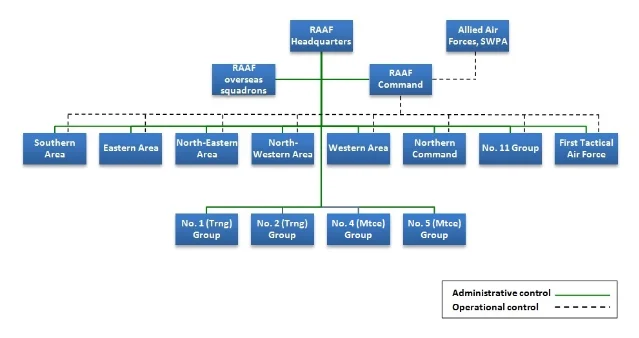
The areas began with one chain of command and finished the war with two. Until 1942 RAAF Headquarters held complete operational and administrative control. 2
In April 1942 Allied Air Forces Headquarters was set up under General Douglas MacArthur's South West Pacific Area, with operational authority over all RAAF combat infrastructure, the area commands included. 213
That September the new Allied air commander, Major General George Kenney, formed most of his American flying units into Fifth Air Force and most of their Australian counterparts into RAAF Command, led by Air Vice-Marshal Bill Bostock. Bostock ran Australian air operations through the area commanders, while RAAF Headquarters kept the administrative authority. 21415
The split put supplies in someone else's hands. Bostock and his area commanders depended for equipment on the Chief of the Air Staff, Air Vice-Marshal George Jones, who had taken over from Burnett in May 1942. 216
The areas were also fixed, and the war moved. To escape that, the RAAF created No. 9 (Operational) Group in September 1942, a self-contained tactical air force able to keep pace with the Allied advance north through New Guinea and towards Japan. 217
By April 1944 No. 9 Group had become a garrison force in New Guinea and handed its mobile role to No. 10 (Operational) Group, later the Australian First Tactical Air Force. No. 9 Group was re-formed as a dedicated area command for air units in New Guinea; Bostock wanted it called Northern Area, and RAAF Headquarters called it Northern Command. It lasted from 1944 to 1947. 21819
The men who decided
Air Vice-Marshal Jimmy Goble, later Sir Stanley Goble, was Chief of the Air Staff when the war began, and he brought the functional idea to the government in January 1940. He had argued the same case for years: he had helped create the RAAF in 1921, circumnavigated Australia by air in 1924, and led the service three times. 24
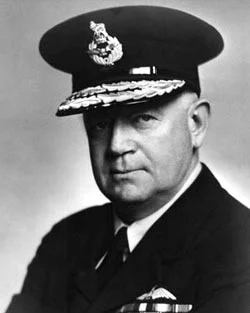
Air Chief Marshal Sir Charles Burnett arrived from Britain in February 1940 and built the area system. He had been sent to expand the RAAF fast for the Empire Air Training Scheme, and an air force organised by geography suited that job. 25
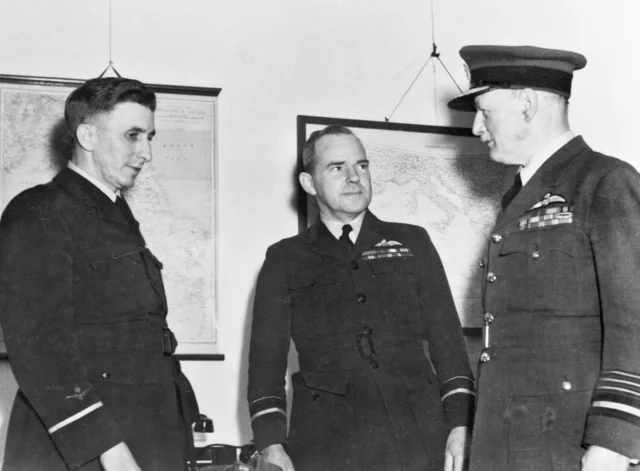
Air Vice-Marshal Bill Bostock commanded the RAAF's operational effort from September 1942 and, after the war, led the case against the area boundaries. He called them arbitrary and proposed commands based on function instead. 215
Air Marshal George Jones was Chief of the Air Staff from May 1942 until February 1952, the longest continuous service in the post. He defended the area structure, set up a conference to consider changing it, and proposed a tidier three-command version that never happened. 223
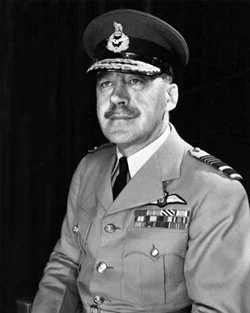
Air Marshal Sir Donald Hardman was an RAF officer who had commanded Home Command in Britain and knew the functional system from the inside. Menzies chose him in 1952 to do the job Goble had asked for in 1940. 223
Why it was dismantled
The war itself supplied the argument. With hindsight, historians judged the area commands a fit for the air force of the early war years and a poor fit for the quick reaction and the concentration of force that offensive operations from 1943 demanded. 2
After the war the case for function was made openly. Bostock proposed a structure built on operations, maintenance and training. Jones resisted the pressure and set up a conference to discuss change, but the interest of the participants ran low, since the Chief of the Air Staff was content with the wartime system and the area commanders' own posts were on the table. 2
Hardman arrived in 1952 and made the argument in terms of fighting power. His position, as the RAAF's history of the reorganisation puts it, rested on the axiom that divided air power is weakened air power. 23
He also disliked the machinery. In his reading the RAAF's structure made command and control needlessly complex, because responsibility was split between the Department of Air, the Air Board and RAAF Headquarters. Scarce resources sat with area commanders who could exercise little independent authority. 23
Three functions replaced the five areas in October 1953. Home Command took operations from Eastern Area Command, Training Command took over from Southern Area Command, and Maintenance Command grew out of Maintenance Group, as No. 4 (Maintenance) Group had been known since July 1947. 2252627
The handover finished in February 1954, when the three new commands assumed control of all operations, training and maintenance from Western, North-Western and North-Eastern Area Commands. The three headquarters stayed open, and the Melbourne Argus described what was left of them as "remote control points" for Home Command. 228
The endings came in stages. North-Western Area Command was disbanded in June 1955, Western Area Command in November 1956 and North-Eastern Area Command in December 1956, leaving the functional commands as the whole structure. 29
What came after
The functional commands were themselves revised in 1959, when Home Command became Operational Command and Training and Maintenance Commands merged into Support Command. 230
Operational Command was renamed Air Command in 1987, and Support Command split three years later into Logistics Command and a new Training Command. 23132
Logistics management passed to Support Command (Air Force) in 1997, and Training Command was re-formed in 2006 as Air Force Training Group, a force element group under Air Command. Air Command is now the RAAF's only command-level organisation. 2333435
The figures behind the reorganisation
| Figure | What it counts | Source |
|---|---|---|
| 12 | Flying squadrons in the RAAF on the eve of the Second World War | RAAF area commands |
| 5 | Air bases the RAAF occupied in 1939 | RAAF area commands |
| November 1939 | Nos. 1 and 2 Groups created, the first step to decentralised control | RAAF area commands |
| January 1940 | Goble proposes functional commands; the government declines | RAAF area commands |
| February 1940 | Burnett arrives and begins the geographic reorganisation | RAAF area commands |
| 4 | Area commands planned in 1940 | RAAF area commands |
| March 1940 | Southern and Central Areas raised | RAAF area commands |
| January 1941 / May 1941 | Western Area and Northern Area raised | RAAF area commands |
| August 1941 | Two training groups formed; Central Area disbanded | Gillison, Royal Australian Air Force |
| January 1942 | Northern Area split into North-Western and North-Eastern Areas | RAAF area commands |
| May 1942 | Eastern Area raised, bringing the total to five | RAAF area commands |
| June-September 1942 | Maintenance transferred to Nos. 4 and 5 (Maintenance) Groups | RAAF area commands |
| 8 | Area commands the RAAF raised during the war | RAAF area commands |
| 5 | Area commands still operating into the 1950s | RAAF area commands |
| October 1953 | Home, Training and Maintenance Commands constituted | Sir Donald Hardman's Reorganisation of the RAAF |
| February 1954 | The three functional commands take over from the last area commands | RAAF area commands |
| June 1955 / November 1956 / December 1956 | North-Western, Western and North-Eastern Area Commands disbanded | Department of Veterans' Affairs |
| 1959 | Home Command becomes Operational Command; Training and Maintenance merge into Support Command | RAAF area commands |
| 1987 | Operational Command renamed Air Command | RAAF area commands |
| 2006 | Training Command re-formed as Air Force Training Group under Air Command | Air Force Training Group RAAF |
Glossary
| Term | What it means here | Source |
|---|---|---|
| Command | A major formation of an air force, with its own commander and staff, sitting at the top of the operational hierarchy | Command (military formation) |
| Group | A formation of several wings, below a command and above a wing; the RAAF formed training and maintenance groups as well as operational ones | Group (military aviation unit) |
| Wing | A formation of several squadrons, usually commanded by a group captain | Wing (military aviation unit) |
| Squadron | The basic unit of an air force, with its own aircraft and aircrew | Squadron (aviation) |
| Area command | A command whose authority is defined by a boundary on the map rather than by the job it does | RAAF area commands |
| Functional command | A command defined by what it does, such as operations, training or maintenance | RAAF area commands |
| Air Officer Commanding | The officer commanding a formation, here an area command | Air Officer Commanding |
| Fighter sector | A control organisation that tracked aircraft and directed fighters within its area | No. 71 Wing RAAF |
| RAAF Headquarters | The central administrative authority in Melbourne, holding control over supply, personnel and policy | RAAF area commands |
| Air Board | The body that governed the RAAF's administration, merged into the Department of Air under Hardman | Sir Donald Hardman's Reorganisation of the RAAF |
| Chief of the Air Staff | The professional head of the RAAF; the post is now Chief of Air Force | RAAF area commands |
| South West Pacific Area | The Allied command under General Douglas MacArthur that held operational authority over the RAAF's combat units from April 1942 | South West Pacific Area |
| RAAF Command | The Australian operational headquarters under Air Vice-Marshal Bostock, separate from an area command and running the area commanders | RAAF Command |
| Maintenance group | A formation holding the supply and servicing units, split out of the area commands in 1942 | RAAF area commands |
| Empire Air Training Scheme | The Commonwealth programme for training aircrew that drove the RAAF's wartime expansion | British Commonwealth Air Training Plan |
| Force element group | A modern RAAF formation grouping units by function under Air Command | Air Force Training Group RAAF |
Six things that are easy to get wrong
The area system was the second idea. Goble put functional commands to the government in January 1940 and was turned down; Burnett's geographic answer came after. The RAAF ended up adopting Goble's plan in 1953. 223
"RAAF Command" and "an area command" were different things. RAAF Command was the Australian operational headquarters under Bostock, created in September 1942, and it directed the area commanders. 214
The areas shed their first duties early. Training left them in August 1941 and maintenance in 1942, so from then on they concentrated on operations. 2
The system predated the Pacific War. Four area commands were planned in early 1940, well before Pearl Harbor. The war changed how many there were and where the lines fell. 2
Three area commands outlived the reorganisation. Eastern and Southern Areas were re-formed into functional commands in 1953, but Western, North-Western and North-Eastern Areas stayed in being until 1955 and 1956. 229
The boundaries followed their own logic. Southern Area reached into the southern Riverina, Central Area covered the rest of New South Wales, and North-Western Area took in part of Western Australia and part of Queensland. 2
In their own words
The official history of the war, written by Douglas Gillison and published by the Australian War Memorial in 1962, records how casually Central Area's responsibilities were redistributed:
Central Area was disbanded and its units divided as convenient between Northern Area, Southern Area and No. 2 Training Group.Douglas Gillison, Royal Australian Air Force 1939–1942, official history of Australia in the war of 1939–1945. 7
Air Vice-Marshal William Bostock, who had commanded Australian air operations through the area commands, gave the boundaries their short verdict:
"arbitrary"Bostock on the area boundaries he inherited, as quoted in RAAF area commands on Wikipedia and drawn from Alan Stephens's history Going Solo. 2
Hardman made the positive case for a single chain of function:
the one force that could quickly strike for Australia's and the Commonwealth's defence in South East AsiaAir Marshal Sir Donald Hardman, quoted in the RAAF's Pathfinder paper on his reorganisation. 23
The same paper opens with the principle that Hardman's three commands were meant to serve:
Air power is indivisible. If you split it up into compartments, you merely pull it to pieces and destroy its greatest asset—its flexibility.Field Marshal Bernard Montgomery, quoted in Sir Donald Hardman's Reorganisation of the RAAF, Pathfinder 106, March 2009. 23
And The Argus of Melbourne caught the moment the geography stopped mattering, under the headline "Battle 'nerve-centre' goes north":
"remote control points" for Home CommandThe Argus on the stationkeeping of the last three area headquarters, 21 May 1954. 28
The full source is RAAF area commands on Wikipedia, selected as Wikipedia's Today's Featured Article for 14 October 2026. The argument that ended the area commands in 1953 was the argument Goble had lost in 1940, word for word: an air force organised by what it does can concentrate its strength, and one organised by where it sits scatters it. For thirteen years the RAAF answered the distance problem on the map, and the map was a good enough answer to a war that came to Australia's north. What retired it was the arrival of a chief who had seen the other system work, and a government willing to hear him.
References
- 1Wikipedia: Today's featured article/October 14, 2026
en.wikipedia.org
- 2RAAF area commands - Wikipedia
en.wikipedia.org
- 3Wikipedia: Featured topics/RAAF area commands
en.wikipedia.org
- 4Stanley Goble - Wikipedia
en.wikipedia.org
- 5Charles Burnett (RAF officer) - Wikipedia
en.wikipedia.org
- 6File: RAAFAreaCommands1940.png - Wikimedia Commons
commons.wikimedia.org
- 7
- 8No. 4 Group RAAF - Wikipedia
en.wikipedia.org
- 9No. 5 Group RAAF - Wikipedia
en.wikipedia.org
- 10File: RAAFAreaCommands1942.png - Wikimedia Commons
commons.wikimedia.org
- 11File: RAAF North-Western Area airfields April 1943.jpg - Wikimedia Commons
commons.wikimedia.org
- 12File: OG0611No.71Wing1943.jpg - Wikimedia Commons
commons.wikimedia.org
- 13South West Pacific Area (command) - Wikipedia
en.wikipedia.org
- 14RAAF Command - Wikipedia
en.wikipedia.org
- 15William Bostock - Wikipedia
en.wikipedia.org
- 16George Jones (RAAF officer) - Wikipedia
en.wikipedia.org
- 17No. 9 Operational Group RAAF - Wikipedia
en.wikipedia.org
- 18Northern Command (RAAF) - Wikipedia
en.wikipedia.org
- 19Australian First Tactical Air Force - Wikipedia
en.wikipedia.org
- 20File: RAAFOrgChart1945.jpg - Wikimedia Commons
commons.wikimedia.org
- 21File: Caf goble.jpg - Wikimedia Commons
commons.wikimedia.org
- 22File: Jones-Bostock-Burnett AWM 012249.jpg - Wikimedia Commons
commons.wikimedia.org
- 23
- 24File: Caf hardman.jpg - Wikimedia Commons
commons.wikimedia.org
- 25RAAF Home Command - Wikipedia
en.wikipedia.org
- 26RAAF Training Command - Wikipedia
en.wikipedia.org
- 27RAAF Maintenance Command - Wikipedia
en.wikipedia.org
- 28
- 29
- 30RAAF Support Command - Wikipedia
en.wikipedia.org
- 31RAAF Air Command - Wikipedia
en.wikipedia.org
- 32RAAF Logistics Command - Wikipedia
en.wikipedia.org
- 33Air Force Training Group RAAF - Wikipedia
en.wikipedia.org
- 34Air Command - Royal Australian Air Force
web.archive.org
- 35Air Force Training Group - Royal Australian Air Force
web.archive.org
This story was produced automatically by a channel. One sentence is all it takes for Neodrop to keep producing for you.