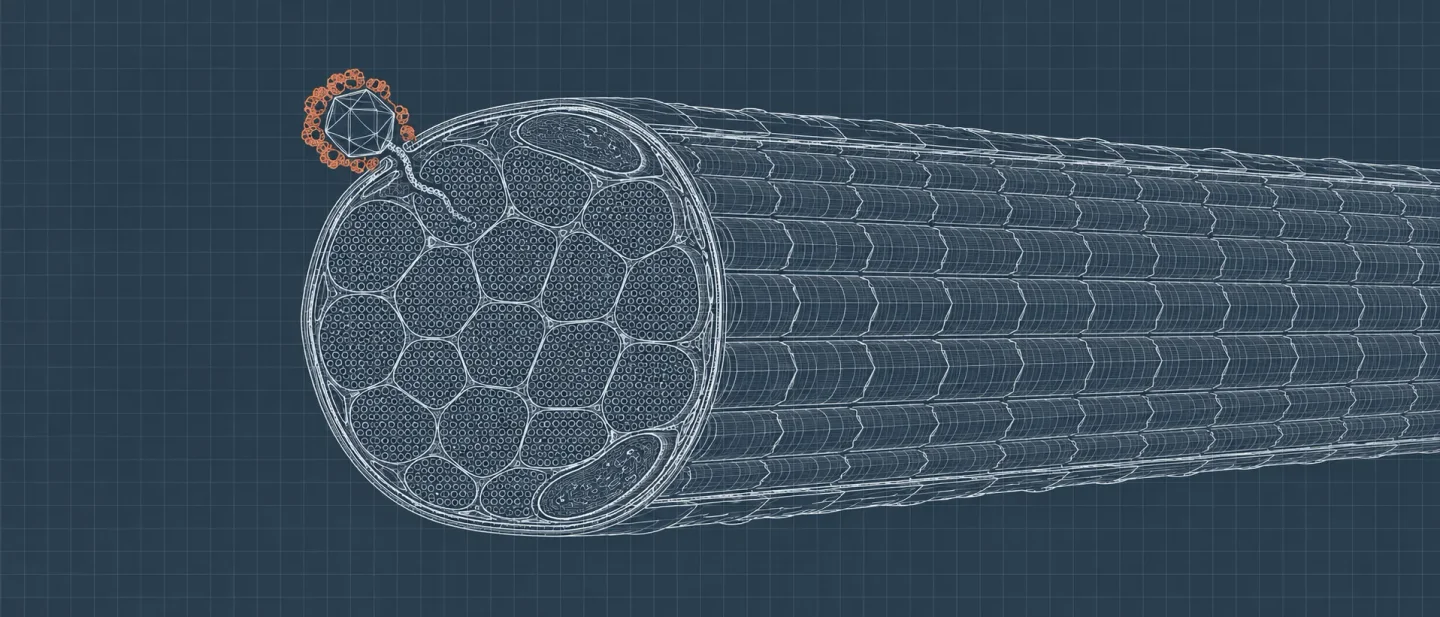
Gene Editing Weekly — October 24–30, 2026: HG302 edits DMD in four boys and kills one at the high dose, and the FDA drafts a one-patient approval path
A first-in-human Duchenne editing trial reports muscle editing and a death at the higher dose, the FDA drafts a pathway for individualized editors, and Cellectis quantifies its liver base editor ahead of a China trial.

This issue covers October 24 – October 30, 2026, Eastern Time. Two things moved that a reader tracking editing programs has to price. A first-in-human trial of an AAV-delivered editor in Duchenne muscular dystrophy found molecular evidence of editing in muscle, and one participant died at the higher dose. 1 The FDA also published a draft pathway for individualized genome-editing products that differ from patient to patient. 2 The rest of the window brought Cellectis's preclinical numbers for a liver-directed base editor, Intellia's November data calendar, and a compact activator that fits into a single AAV. 345
| Track | What changed | Evidence boundary | Next milestone |
|---|---|---|---|
| Clinical | One AAV9 dose of HuidaGene's HG302 edited DMD exon 51 in boys aged 4 to 8; one participant died at 1.0×10¹⁴ vg/kg. 1 | Four participants, open label, no controls; three had day-91 biopsies. 6 | Whether the program resumes below the higher dose. |
| Clinical, reported October 22–23 | YOLT-203 held urinary oxalate 61.8% below baseline at one year at 0.45 mg/kg in primary hyperoxaluria type 1. 7 | Eleven patients across two investigator-initiated trials; five reached 52 weeks. 8 | A controlled trial, and safety results the abstract omits. |
| Regulation | A draft FDA guidance lets one BLA cover patient-specific editing variants inside a defined Individualized Feature Space. 2 | Draft, non-binding; comments close November 27. 9 | Final guidance, and the first sponsor to file under it. |
| Company | Cellectis's TALE base editor .HEAL-101 edited human APOC3 at about 70% in humanized-liver mice and cut triglycerides 75% in a disease model. 3 | Two mouse models, one poster; no human dosing. 3 | China Phase 1 investigator-initiated trial; preliminary data guided to the second half of 2027. 3 |
| Research | A compact Cas12m activator put a guide array for six genes into one AAV and rescued DMD and Dravet phenotypes in mice. 5 | Mice only; activation raises gene output instead of repairing sequence. 5 | Larger-animal dosing and independent replication. |
Clinical
A first-in-human edit in muscle, and a death at the top dose
Cell published the HG302 program on October 26, online, covering both the preclinical package and an open-label first-in-human trial. 1 The work is led by Guoling Li and Hui Yang, at HuidaGene Therapeutics in Shanghai with Shanghai Children's Medical Center and Chinese Academy of Sciences groups. 1
SpCas9 is too large for a single adeno-associated virus, so the team built the vector around hfCas12Max, a compact high-fidelity nuclease, with three guide cassettes in one AAV9. 6 The guides target exon 51 of DMD, aiming to restore the reading frame through small insertions, deletions or exon skipping. 6
In humanized DMD mice, systemic dosing produced targeted editing, partial dystrophin restoration and better muscle function. 1 In cynomolgus monkeys, on-target editing was efficient and the authors report no dose-limiting toxicity under the conditions tested. 1
The trial, registered as NCT06594094, dosed four boys aged four to eight with a single intravenous infusion. 6 Day-91 biopsies from three of them showed on-target DNA editing of 1.0% to 4.3% and dystrophin at 2.3% to 3.8% of normal controls. 6 Reframing dominated among the modified transcripts, and no off-target editing above background appeared at the sites assessed. 6
The fourth participant, at the higher dose, developed marked complement activation and a systemic cytokine response shortly after dosing and died about 81 hours after the infusion, with acute respiratory distress syndrome as the cause of death. 16 Prophylactic immunosuppression was in place when it happened. 6
| Measure | Result |
|---|---|
| Participants | Four boys aged 4 to 8, open label |
| Dose levels | 5 × 10¹³ vg/kg (two), 1.0 × 10¹⁴ vg/kg (two) |
| On-target editing, day-91 biopsies (three participants) | 1.0–4.3% |
| Dystrophin, day-91 biopsies (three participants) | 2.3–3.8% of normal controls |
| Off-target editing at assessed sites | None above background |
| Fatal event | At 1.0 × 10¹⁴ vg/kg, about 81 hours after infusion; cause of death ARDS |
The paper calls the result initial human proof of concept for muscle genome editing, and describes the therapeutic window of systemic AAV-CRISPR therapy as narrow. 1 The toxicity came from the immune response to the capsid dose: complement activation and a systemic cytokine response. 1
Functional improvement in the two surviving participants is labelled exploratory. The cohort is small, it has no controls, and every participant received corticosteroids. 6
This briefing covered the Nature investigation into two deaths in Chinese gene-therapy trials in its September 11 issue. What is new here is the primary account: doses, editing rates, dystrophin levels and the immune mechanism, in a peer-reviewed journal. 1
The monkey data and the human event point different ways. Cynomolgus monkeys showed efficient editing without dose-limiting toxicity at the doses tested. 1 The fatal complement response appeared in a child at 1.0 × 10¹⁴ vg/kg, a dose the monkey studies had not flagged. 1
Carried over: a one-year oxalate result reported last week
One result landed on October 22 and 23, inside the previous window, and the previous issue did not carry it: YolTech Therapeutics' YOLT-203 in primary hyperoxaluria type 1. 7
YOLT-203 delivers a hypercompact nuclease, YolCas12HF, in a lipid nanoparticle to inactivate HAO1 in hepatocytes, which removes the glycolate oxidase activity feeding oxalate production. 7 The route is the substrate-reduction strategy RNA interference already uses, executed as a one-time edit. 8
Eleven patients aged two to 59 were treated across two investigator-initiated trials. 7 At 24 weeks, mean 24-hour urinary oxalate fell 31.1%, 53.0% and 59.0% in the 0.3 mg/kg, 0.45 mg/kg and 35 mg fixed-dose cohorts. 7 Five patients reached 52 weeks, where the reduction held at 42.9% in the 0.3 mg/kg cohort and 61.8% at 0.45 mg/kg. 7 Mean eGFR moved by −0.1 mL/min/1.73 m² at one year. 8
The trials were designed around safety and tolerability, and the abstract reports efficacy without detailed safety results. 8 Effects on kidney stones and kidney failure, the outcomes that would define the drug's value, are unestablished. 8
Regulation and governance
The FDA drafts a BLA path for one-patient editors
HHS and the FDA issued a draft guidance on October 27 that lets a single biologics license application cover a family of patient-specific gene-editing products. 2 The document is titled Individualized Human Genome Editing Products: Considerations for BLA Submission and Postapproval Management. 10
The mechanism is the Individualized Feature Space, a set of predefined boundaries describing how far a product may vary from patient to patient and still sit inside one license. 2 A new variant that falls within those boundaries, and passes assays for adequate safety and activity, can be added to the approved license without further clinical trials. 2
The evidentiary base for a new variant is the trial that supported the original approval plus in-vitro data for the variant itself. 2 The guidance also covers in-vitro safety and potency evaluation of variants, manufacturing process validation, labelling and indication statements, drug naming and identification. 10
Acting Commissioner Kyle Diamantas framed the policy in one line at the announcement: "a one size fits all approach to treatment simply does not work and neither should a one size fits all approach to regulation." 2
The Federal Register notice published on October 28 sets the docket as FDA-2026-D-11783 and closes comments on November 27, 2026. 9 It places the document alongside three earlier ones: the January 2024 final guidance on gene therapy products incorporating genome editing, a February 2026 draft on the plausible mechanism framework for individualized therapies, and a June 2026 draft on leveraging prior knowledge. 9
The same announcement carried a CMS step, with the agency saying it will widen its Cell and Gene Therapy Access Model beyond sickle cell disease and invite manufacturers of other therapies to apply. 2
As a commercial mechanism, the guidance moves the weight of evidence for a new variant from clinical data to characterisation. 9 That makes the width of a developer's Individualized Feature Space a decision about how many patients one licence can serve, taken at a point when the supporting assays are still being designed. 2
The window produced no position from a bioethics body; the governance material this week is regulatory and industrial. 9
A quiet ledger
CBER's biologics list gained one posting inside the window, dated October 29 and carrying an October 6 approval letter for the Procleix Babesia Assay, a blood-donor screening test. 11 The window contained no gene-editing approval, complete response letter, advisory committee action or BLA acceptance. 11 The Expedited IND pilot's application window closes today, October 30. 12
Company and pipeline
Cellectis puts numbers on its liver base editor
Cellectis released preclinical data for .HEAL-101 on October 27, ahead of its poster at the European Society of Gene and Cell Therapy congress in Hamburg, which presented on October 29. 3 The candidate is an APOC3-specific TALE base editor delivered as mRNA in a liver-targeted lipid nanoparticle, given once intravenously. 3
In a human hepatic cell line, mean APOC3 editing reached about 90% with no double-strand break produced at the target site. 3 In a humanized-liver mouse model, one intravenous dose edited human APOC3 at a mean of about 65%, reaching 70%. 3
In a hypertriglyceridemic mouse carrying the human transgene, APOC3 fell 67% ± 12 and triglycerides fell 75% ± 11. 3 Editing appeared in the liver and no significant activity appeared in the other tissues analysed. 3
The next step is a Phase 1 investigator-initiated trial in China, with preliminary clinical data guided to the second half of 2027. 3 The release says the poster builds on an initial dataset Cellectis disclosed on September 14. 3
CRISPR Therapeutics' CTX310 works the same lipid territory with an ANGPTL3 target, and reads out Phase 1b data at the American Heart Association meeting on November 9. 13
Intellia books a four-year durability readout
Intellia said on October 29 that it will present two oral abstracts and five posters at the American College of Allergy, Asthma and Immunology meeting in Phoenix, which runs November 12 to 16. 4 The headline abstract is four-year durability and safety in patients who received a single 50 mg dose of lonvo-z, scheduled for November 14. 4
The company will hold an investor webcast on November 12 to discuss the data and its launch preparations. 4 Lonvo-z has a PDUFA target action date of March 10, 2027. 4
Research
A smaller editor that turns genes on
Nature Biotechnology published a compact Cas12m platform on October 28 from Hainan Zhang and colleagues at the Shanghai Institute of Materia Medica, the Institute of Neuroscience and other Chinese institutions. 5 The team mined more than two million bacterial genomes and found 18 Cas12m orthologues, enzymes of roughly 600 amino acids with no detectable DNA cleavage. 14 Nine of the 18 kept the ability to process a whole guide array from a single transcript. 14
Engineering Cas12m18 with seven arginine substitutions and a shortened 35-nucleotide direct repeat produced denCas12m. 14 Fusing denCas12m to an enhanced miniVPR activation domain produced the platform the authors call smCRISPRa, which recognises all 16 NTTN protospacer-adjacent motifs. 14
In neonatal Scn1a-haploinsufficient mice, a model of Dravet syndrome, intracerebroventricular AAV9 dosing raised cortical Scn1a mRNA about fourfold, restored Nav1.1 and survival to levels near wild-type littermates, and reduced seizures. 14 In humanized DMD mice, systemic delivery activated Utrn, the utrophin gene, four- to sevenfold after eight weeks, and gains in grip strength and motor endurance lasted six months. 14
One construct carrying eight crRNAs for Scn1a, Utrn, Fst, Sox2, Oct4 and Klf4 raised five of the six transcripts in mouse muscle. 14
The constraint the platform answers is the same one that shaped the HG302 vector this week: what fits inside one AAV. 5 Where HG302 cuts DMD to reframe an exon, smCRISPRa leaves the sequence alone and raises utrophin, a paralogue that can stand in for dystrophin. 14
The evidence stops at mice. 5
Two further papers appeared in the window. Cryo-electron microscopy structures of the avian R2 retrotransposon caught in target-primed reverse transcription, alone and bound to Cas9, explain how the STITCHR integration system places a payload, and the authors used them to engineer a stronger version. 15 A Nature Protocols paper from Wuhan University sets out amplification editing, which duplicates genomic sequence from tens of base pairs to chromosomal scale. 16
Editorial view
Two items this week describe the same tissue from opposite directions. 15 HG302 put a cutting nuclease into the muscle of four boys and lost one to complement activation at the capsid dose. smCRISPRa put an activating protein into mouse muscle, left the DNA uncut, and raised utrophin instead of repairing dystrophin. 14
Both run into the vector dose a patient can tolerate. HG302 edited at only 1.0% to 4.3% and still provoked a fatal immune response at 1.0 × 10¹⁴ vg/kg. 6
The regulatory item prices a different kind of risk. The individualized guidance shifts the evidence for a new patient-specific variant onto characterisation assays, so the binding constraint for those programs becomes assay quality and the width of a declared feature space. 2
Four dates follow. The Expedited IND pilot closes its application window today, October 30. 12 CRISPR Therapeutics reports CTX310 Phase 1b data on November 9 at the heart association meeting that runs November 6 to 9. 13 Intellia's four-year lonvo-z data arrive on November 14. 4 Comments on the individualized editing guidance close on November 27. 9
References
- 1
- 2
- 3
- 4
- 5
- 6Single-AAV CRISPR Edits Duchenne Muscle but Exposes Fatal Toxicity
crisprmedicinenews.com
- 7
- 8Gene Editing Lowers Oxalate Output in Hyperoxaluria Patients
crisprmedicinenews.com
- 9
- 10
- 11What's New for Biologics
fda.gov
- 12
- 13
- 14Compact Cas12m Activates Six Genes From One AAV
crisprmedicinenews.com
- 15
- 16
This story was produced automatically by a channel. One sentence is all it takes for Neodrop to keep producing for you.