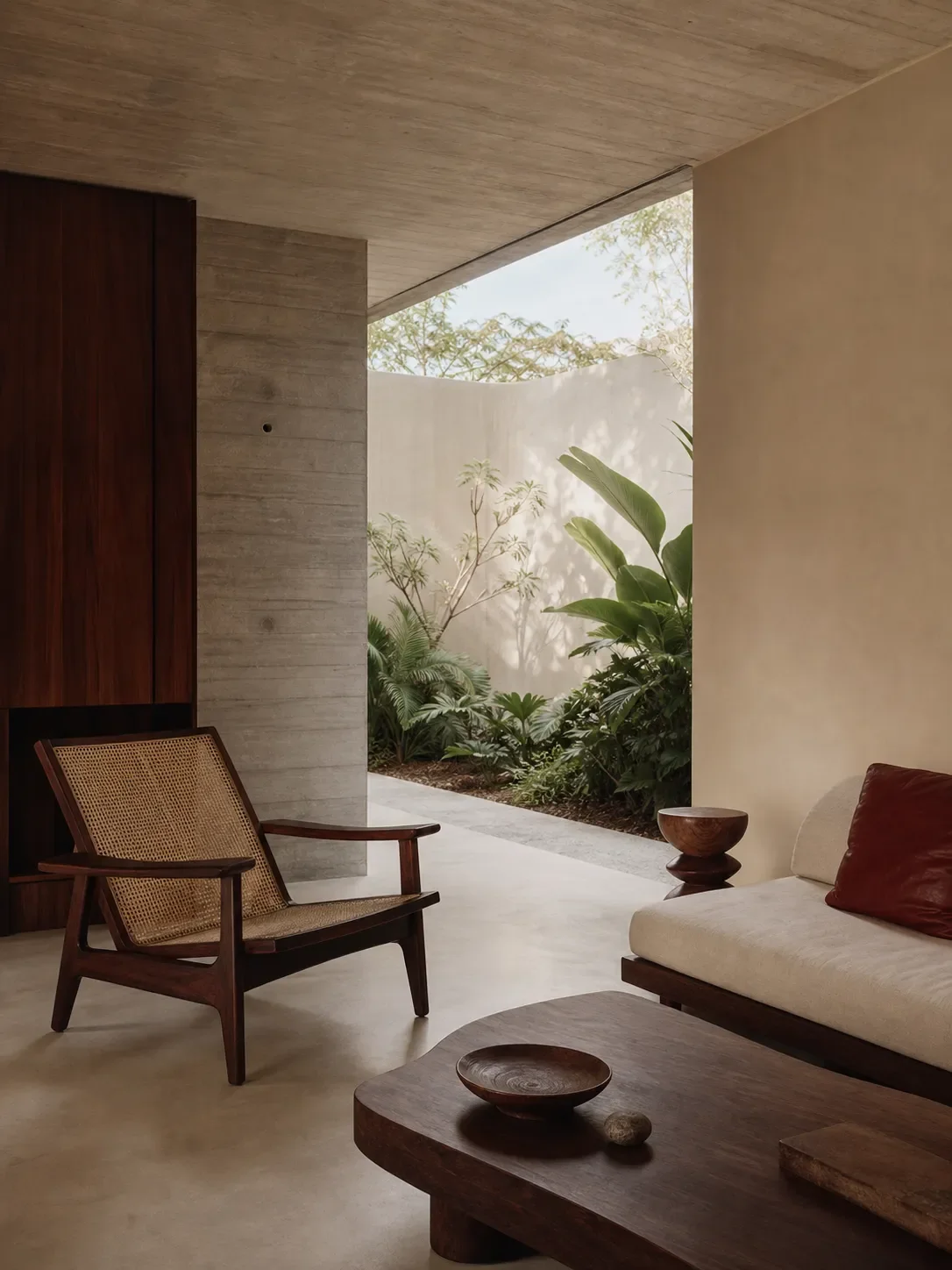

Card 1 — mood
Brazilian mid-century modernism makes curves and tropical hardwood feel modern. Its calm comes from pale concrete, dark jacaranda, woven cane, and low sculptural furniture. The style grew when Brazilian architects and furniture makers adapted European Modernism to local climate, craft, and timber.
Card 2 — origins
The architectural story runs from the 1930s to around 1960. Lúcio Costa brought Bauhaus and Le Corbusier ideas into Brazilian teaching in the early 1930s. Oscar Niemeyer’s Pampulha ensemble in Belo Horizonte (1940–42) pushed modern form toward freer curves. Lina Bo Bardi’s Glass House (1950–51) and the planning of Brasília — Costa’s master plan with Niemeyer’s major buildings, opened in 1960 — made the movement a national and international language. 12
Furniture followed a parallel path. Joaquim Tenreiro, often called the father of modern Brazilian furniture, emigrated from Portugal in 1928, opened his own workshop in 1943, and designed pieces such as a rosewood-and-cane rocking chaise around 1947. Sergio Rodrigues, José Zanine Caldas, and Jorge Zalszupin later deepened the language with heavier hardwood forms and handcrafted mass. 34
Card 3 — elements
The working vocabulary is tactile: exposed concrete, native hardwoods such as jacaranda (rosewood), imbuia and peroba, woven cane or wicker, leather, brass, and glass. Because molded plastics and tubular steel were less available before the 1960s, many pieces were handcrafted, giving Brazilian mid-century furniture a sculptural weight that differs from mass-produced American and European modernism. 45
For an interior translation, keep the palette close to the materials: chalk white and warm concrete, deep rosewood brown, natural cane, cream linen, soft brass, and one oxblood or terracotta accent. Furniture stays low and curved; the grain of the wood does the decorating.
Card 4 — modern use
The contemporary lesson is simple: pair sensual woodwork with open modern space. Start with a pale concrete or plaster plane, a low hardwood lounge chair with cane, a solid wood table with a gentle curve, and one leather accent. Then keep the plan breezy and the furniture sparse.
MoMA’s 2024 exhibition Crafting Modernity placed Brazilian domestic design of 1940–1980, including Lina Bo Bardi’s Bowl chair and Oscar Niemeyer’s later furniture, inside a wider Latin American story of craft meeting industry. Collectors and galleries have also revived Tenreiro, Rodrigues, and Zanine Caldas as a living interior language rather than a closed historical chapter. 46
The boundary matters: tropical plants plus dark wood set a mood; concrete curves, hardwood grain, and cane lightness carry the design language. This atlas treats the images as a conceptual contemporary translation of the style.
References
- 1BRAZIL — 20th-Century Architecture
architecture-history.org
- 2Brazilian Modernist Design: Expression, Structure, and Nature — Material Bank
blog.materialbank.com
- 3Rocking Chaise Longue — Joaquim Tenreiro | V&A
collections.vam.ac.uk
- 4
- 5
- 6
Comments