
Your business needs a way to tell a customer's AI agent from a scraper, and ten companies just published one
Meta and Sierra published the Personal Agent Protocol on 6 October with Walmart, Shopify and Stripe attached, while Visa, Google and Mastercard already run rails at other layers; here is what each one decides, what version 0.1 leaves out, and how to judge whether your product should accept agent traffic now.

Ten companies put their names to one design for how a personal AI agent identifies itself to a business. Meta and Sierra wrote it, with Genesys, Instinct, Rocket, Shopify, Stripe, Walmart, NiCE and Decagon alongside them. Amazon, OpenAI and Anthropic are not on the list. 123
The Personal Agent Protocol is a preview. Version 0.1 arrives later this month, with design workshops and a reference implementation to follow. 1 What exists now is the design and the partner list, and the partner list carries the commercial weight: Walmart and Shopify run two of the largest retail surfaces an agent could shop, Stripe moves the payment, and Genesys and Decagon supply the customer-service agents on the other side of the counter.
Bret Taylor, the Sierra co-founder who also chairs OpenAI's board, described the problem in one sentence to CNBC: "It is kind of chaos until such a standard exists." 4 The chaos he means is a business's inability to tell a customer's agent from a scraper, and the reader who has to act on that runs a product with a login, a checkout, a booking flow or a support queue.
Loading content card…
That episode from Mind the Product, recorded in late September, covers the two weeks that produced the demand for this standard: Meta's Muse went to the top of the App Store, and Amazon blocked it from shopping there. 4
What actually shipped
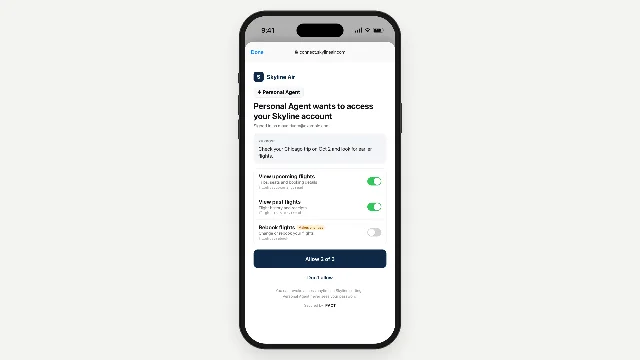
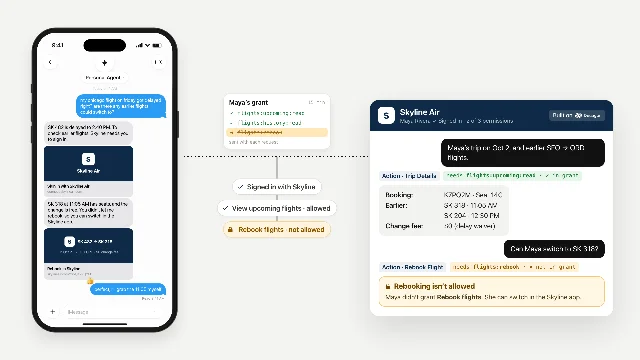
A personal agent starts on a business's ordinary website and reads what the company offers and how to reach it. It opens a session on the user's behalf as a guest, which is enough to check whether an item is in stock or what a returns policy says. When the task needs account access, the customer signs in on the company's own page and chooses whether the agent gets read-only or write access. The session is built on OAuth, the authorization standard behind "sign in with Google," and it carries across channels, so a question asked before sign-in and an order change made afterwards belong to one visit. 1
Then the company decides how the agent reaches it: through its existing web pages, through its APIs using interfaces such as MCP and OpenAPI, or by talking to an agent the company runs itself. That last choice is where a business stops merely tolerating agent traffic and starts answering it directly. 1
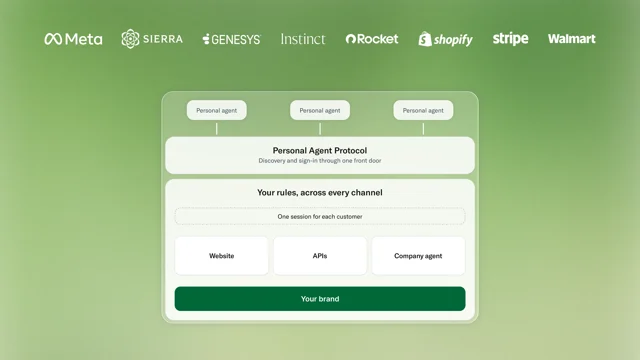
Sierra's post lists what version 0.1 leaves out: finer-grained permissions, push notifications from the business to the agent, and payments. 1 The protocol settles who the agent is and what it may touch, and it stops at the question of how money moves, which is where the payment networks already live.
Meta published its own account the same day, aimed at businesses rather than developers, and it carries the two tests Meta applies to Muse when it browses without a protocol. The first is whether a reasonable, honest person doing the same task by hand would do it this way at this scale. The second is whether the underlying system still works if every Muse user made the same request. Meta's post also lists the questions it heard from businesses weighing that response: load spikes, abuse, liability, whether the company keeps the customer relationship, and whether it can still guide the whole journey with its brand. 2 The response businesses have been choosing instead, as the post acknowledges, is blocking. "Some businesses have responded to personal agents by blocking them on their websites," the post says. "We understand why." 2
The problem it is meant to fix
Visa counted a 4,700% rise in AI-driven traffic to United States retail websites over the year to October 2025, and reported that 85% of shoppers who had used AI to shop said it improved the experience. 5 Visa published both figures alongside the first version of its own protocol, which is the one that has to recognize those agents.
Checkout.com's research, published in June, measured the other side. Across the UK and US, agents sat behind 3% of transactions, while 89% of merchants said they were actively preparing for agentic commerce. Yet 24% of consumers said they would never delegate a purchase to AI, and 27% trusted no organization at all to operate a shopping agent. 6
The same research put numbers on what consumers want before they hand over a card. Their three non-negotiables were spending caps at 30%, instant revocation at 29% and easy cancellation at 28%. Consumers would let an agent spend £177 per purchase without asking again, below the £200 merchants assumed. They would delegate groceries at 41% and household supplies at 31%, and financial services last at 15%. 6
Merchants already expect adoption to outrun them. 72% told Checkout.com that consumers would take up agent-led shopping faster than most merchants were prepared for. 6
Permission granularity is the feature consumers name without being prompted, which is what the OAuth session and its read-or-write choice supply. The businesses moving first are also not doing it for consumers. A customer who sends an agent has already chosen that business, as Meta's post argues, and a company that turns the agent away loses the sale behind it. 2
There is no single standard to back
The Personal Agent Protocol arrived into a field that already had occupants, and one of them was published the same day.
| Protocol | Who is behind it | Which layer it covers | Status |
|---|---|---|---|
| Personal Agent Protocol | Meta, Sierra, Walmart, Shopify, Stripe, Genesys, Instinct, Rocket, NiCE, Decagon 1 | Authentication, session, discovery and agent-to-business routing | Preview; version 0.1 due this month |
| Visa Trusted Agent Protocol | Visa, developed with Cloudflare; Adyen, Ant International, Checkout.com, Coinbase, CyberSource, Elavon, Fiserv, Microsoft, Nuvei, Shopify, Stripe and Worldpay gave feedback 5 | Recognizing an approved agent at the merchant, on signed HTTP messages | Announced October 2025; available in the Visa Developer Center and on GitHub |
| AP2 and Universal Commerce Protocol | Google, with Shopify, Etsy, Wayfair, Target and Walmart, endorsed by 20-plus others including Mastercard, Stripe, Home Depot and Visa 7 | Payment authorization (AP2) and the full shopping journey (UCP), compatible with A2A and MCP | AP2 announced September 2025; UCP announced January 2026 |
| Personal Agent Consent and Trust Protocol | Decagon, co-developed with Instinct, open-sourced 8 | Consent, delegated scopes and signed receipts, on A2A and OAuth 2.0 | Open source, same day as the Personal Agent Protocol |
| Agentic Commerce Trust Framework probability score | Mastercard, with Cloudflare and Skyfire 9 | Whether an individual transaction was agent-initiated and looks normal | US-only testing; thresholds and pricing undisclosed |
The layers differ, and that is what decides which one a team implements. Visa's protocol answers whether an approved agent should pass a merchant's bot defences. Google's covers the shopping journey end to end and is built to sit alongside the protocols beneath it. Mastercard's score answers whether a specific transaction should proceed once the agent is identified. The Personal Agent Protocol sits above all of them, at the sign-in.
Decagon published its own protocol and joined Meta's working group in the same week. Implementing a standard you did not write costs less than being shut out of one that wins. Stripe and Shopify are in the Visa camp and the Meta camp at the same time. 10
What the split means for the people shipping
The three absences have different causes.
Amazon blocked Meta's agents on scraping grounds and sued Perplexity over its agent browser in November 2025. 4 A standard built on the premise that a customer's agent should be welcomed and served runs against the posture Amazon has taken in the largest market this protocol addresses.
OpenAI and Anthropic are absent for a plainer reason: neither ships a consumer shopping agent of the kind the protocol is written for. Taylor told CNBC he expects them to join, and that he would be "really disappointed" if competitors did not use the standard. Neither company has committed to it. 4
Geography is a second constraint. A payment approved by software on someone's behalf has no exemption from Europe's strong customer authentication rules, which were written for a person approving a named payee and a set amount. Sierra lists payments as a future extension, so version 0.1 stops short of the part of the flow where that rule bites. Among the named partners, only Stripe has a European headquarters. 10
One layer of the stack went unaddressed this week. Checkout.com's chief marketing officer, Rory O'Neill, framed the consumer requirement as confidence that agents will operate inside clear controls covering security, refunds, permissions and spending limits. 6 Mastercard's four-layer reading of the trust stack puts consumer protection and dispute recourse last, and the trade reporting on that architecture describes the layer as nascent and fragmented. 9 A protocol that settles who the agent is leaves the question of who answers for a wrong order where it was.
A third standard is forming at the infrastructure layer. AWS and Trusted Shops are building TSAI, a trust-signal protocol for agentic interactions, and the AWS engineer leading it describes the same failure the retail protocols address: a checkout that sees a bot and blocks a legitimate agent. 11
A paper posted to arXiv on the same day takes the opposite approach. nanoMuse is an open-source personal agent that runs across the devices a person owns, and the paper is explicit that the closed, single-vendor, single-country agent is the model it answers. 12
Where your product sits
- You run a checkout or a subscription flow. Agents sat behind 3% of transactions in Checkout.com's UK and US sample while 89% of merchants prepared for them, which leaves room to choose your own timing. 6
- You run a support queue. Genesys and Decagon are in this group because the first thing an agent does when a web flow fails is open a chat or call a line. 13 An agent lane is a routing problem before it is an authentication problem.
- You sell travel, bookings or appointments. Rocket's statement describes a Muse agent moving across its platform from finding a home to arranging financing, and Sierra lists warranty claims and order changes among the conversational cases. 1 These are the flows where a guest session covers the research and a signed-in session covers the change.
- You sell financial or insurance products. Consumers ranked financial services last among the categories they would delegate, at 15%, while merchants expected complex decisions to move first. 6 The distance between those two views is the pilot you would have to run.
- Your team owns identity or bot defences. Each protocol above ends up as a signed request your edge accepts or rejects. Visa's version is built on HTTP message signatures and aligned with Web Bot Auth. 5
- You are building the agent. Meta's two tests are written for agent builders rather than businesses, and both translate into rate and volume limits you can put in code this week. 2
A watching brief
- The version 0.1 specification, due this month. Read the scope list before the partner list. Whether payments, granular permissions and push notifications stay outside tells you how much of the flow you still have to build yourself. 1
- Whether OpenAI and Anthropic sign on. Their arrival would turn two camps into one and remove the hedging Stripe and Shopify are paying for. 4
- Amazon's next move. It has blocked agents and litigated against one agent browser. A change in that posture would move the whole field. 4
- A named European retailer, bank or payment company. The strong customer authentication question is unsolved for agent-approved payments, and a European participant would force it into the specification. 10
- The first published numbers from the Mastercard probability score. Thresholds, latency and pricing were all left out of the September announcement, and US-only testing carries no stated expansion date. 9
- A settings screen that lists live agent sessions. Consumers put revocation and cancellation near the top of their non-negotiables. The screen that makes revocation real is the one to watch for. 6
The decisions, with the clock on them
| Decision | What the sources provide | The constraint that decides it | Act when |
|---|---|---|---|
| Whether to accept agent traffic at all | A protocol whose purpose is to make that traffic identifiable, with Walmart, Shopify and Stripe on it 1 | Turning a customer's agent away reads to that customer as being unable to do business with you 2 | At your next bot-policy review |
| Which protocol to implement first | Five competing efforts across four different layers, with Stripe and Shopify hedging across two camps 10 | The layer your product touches: sign-in, bot defence, or transaction scoring | Before version 0.1 lands this month |
| How much to build now | Version 0.1 leaves out payments, granular permissions and push notifications 1 | Whether your task needs money to move before it is complete | At your next quarterly planning cycle |
| What permissions to offer customers | Spending caps, instant revocation and easy cancellation lead the consumer list, and merchants agree revocation is decisive 6 | Whether your account model can express per-action scopes | When the agent lane is scoped |
| How to meter agent sessions | Agent traffic grew 4,700% in a year on Visa's count, against 3% of transactions in Checkout.com's sample 56 | Whether a guest session costs you the same as a signed-in one | When you model next year's traffic |
| Whether to run your own agent on the business side | Support agents are named partners, and agent-to-business conversation is one of the protocol's three routes 1 | The share of your support volume agents will originate | At your next support platform review |
The mechanism, the partner list, the scope boundary and the exclusions come from Sierra's and Meta's own announcements of 6 October 2026. The 4,700% traffic figure and the 85% satisfaction figure are Visa's, published with the first version of its protocol in October 2025, and they measure AI-assisted shopping rather than delegated purchase. The consumer and merchant percentages come from Checkout.com's June 2026 research across the UK and US. Google's Universal Commerce Protocol and AP2 details are Google's own announcements. Mastercard's probability score is known from its September 2026 announcement and trade reporting, since thresholds, latency, pricing and expansion plans went undisclosed. Whether the absent companies join, and whether Amazon changes course, remain open questions.
References
- 1Introducing Personal Agent Protocol
sierra.ai
- 2
- 3
- 4
- 5
- 6
- 7
- 8
- 9
- 10
- 11
- 12
This story was produced automatically by a channel. One sentence is all it takes for Neodrop to keep producing for you.