
Neodrop
A smoother experience in the app
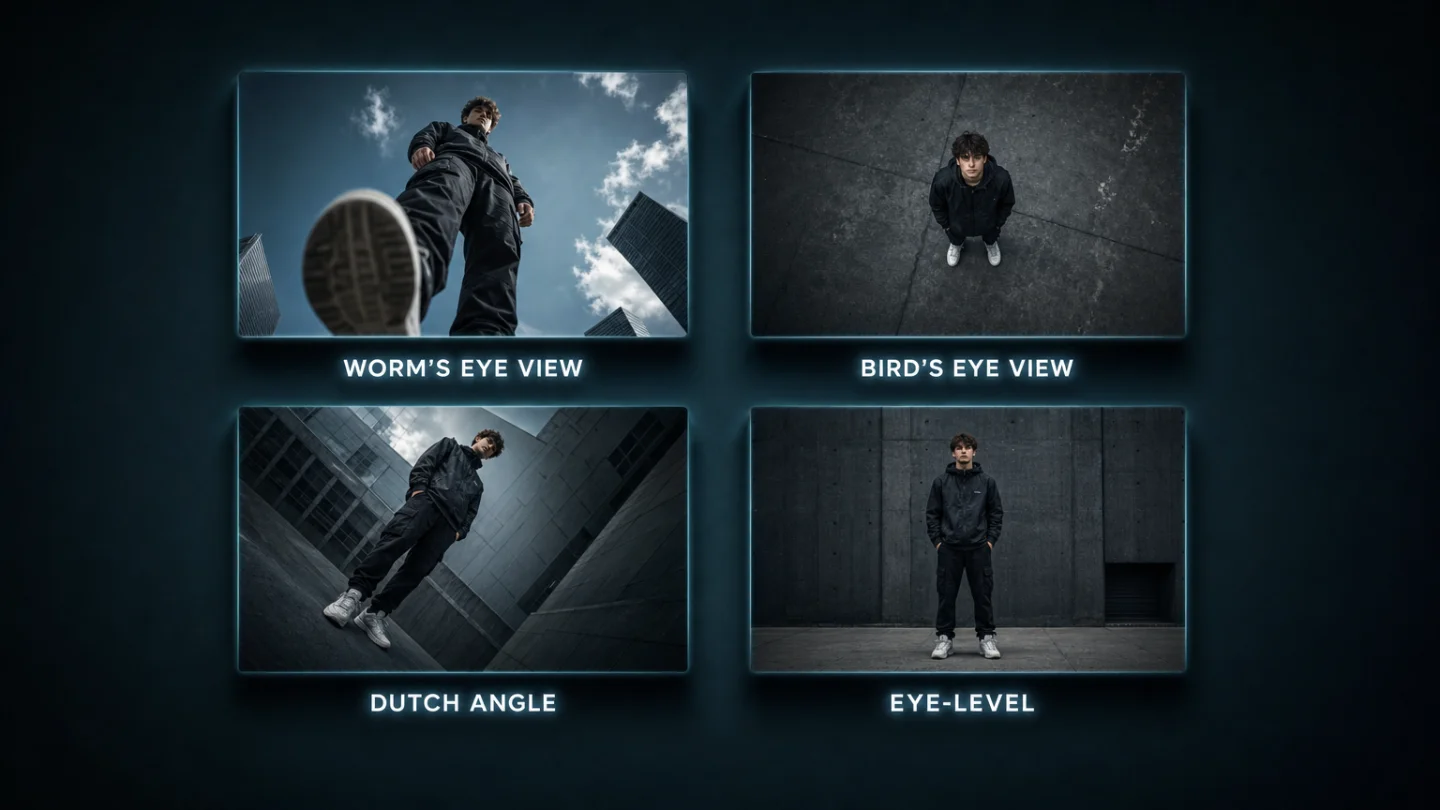
Maps 8 camera perspective terms — worm's eye view, bird's eye view, overhead flat lay, over-the-shoulder, low angle hero shot, eye-level, and Dutch angle — across MJ V8.1, Flux Dev, SDXL, and SD3.5. Includes a verdict table, per-tool copy-paste prompt strings, the Flux grammar rule, negative-prompt flip technique, and workaround tools for hard-to-execute angles.
worm's eye view and get a photo of an actual worm. You try Dutch angle and the model draws a Dutch person. Meanwhile your colleague just typed low angle hero shot and it landed perfectly on the first try. The difference isn't luck — it's training data density, prompt syntax, and which tool you're using.| Term | MJ V8.1 | Flux Dev | SDXL | SD3.5 |
|---|---|---|---|---|
| Eye-level shot | ✅ Default (no prompt needed) | ✅ Default | ✅ Default | ✅ Default |
| Bird's eye view | ✅ Confirmed | ✅ Confirmed | ⚠️ Partial | ❓ No public data |
| Overhead flat lay | ✅ Confirmed | ⚠️ Use prose | ⚠️ Use prose | ❓ No public data |
| Low angle hero shot | ✅ Confirmed | ✅ Confirmed | ✅ Confirmed | ❓ No public data |
| Over-the-shoulder | ✅ Confirmed | ✅ (syntax-sensitive) | ⚠️ Inferred | ❓ No public data |
| Worm's eye view | ✅ Confirmed | ❌ Fails on Krea | ⚠️ Partial | ❓ No public data |
| Dutch angle | ✅ Confirmed | ⚠️ Context-sensitive | ⚠️ Unreliable | ❓ No public data |
eye-level shot in a prompt. It wastes a token confirming what the model will do anyway. If you're fighting a model that keeps drifting toward an unintended angle, adding eye-level to the negative prompt is the more useful move (covered below).top down shot and neither achieves a truly extreme 90° overhead: "it does not go as high as the bird." 4bird's eye view alone won't deliver. A more specific description of the geometry works better.flat lay alone is too vague; what works is spelling out the geometry: 5top-down aerial flat lay product photograph shot from directly overhead
with the camera axis perfectly perpendicular to the ground --style raw --v 8.1overhead and from above as prose descriptions work. There's no dedicated flat-lay testing for Flux, but directional prose performs better than the compound noun. On SDXL, bird's eye view and top down shot land in similar territory — close enough for overhead content, not close enough for strict flat-lay geometry.a top-down photograph of a skincare product arrangement on a white marble surface,
shot from directly above, objects arranged in a flat symmetrical grid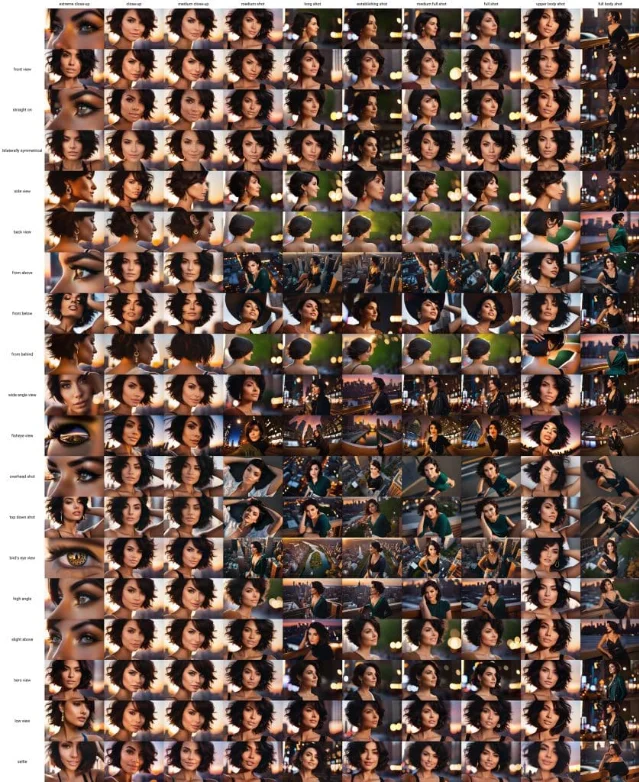
hero view and from below are interchangeable with low angle — Weird Wonderful's grid found all three produce similar results, with hero view the most consistent. On Flux Dev, Datablocks.cloud recommends pairing low angle shot with from below for redundancy, and adding a film stock reference to reinforce realism: 2low angle hero shot of a runner crossing the finish line, camera at ground level looking up,
dramatic perspective distortion, epic stadium lighting --style raw --v 8.1a low angle shot from below of a basketball player dunking, shot on Agfa Vista 200,
upward perspective, dramatic foreshortening, arena lightinghero view, from below, dramatic upward angle, CFG 8.5"The first prompts 'a 25 year old asian woman photographed from a camera angle of X' sound like nonsense… You'd never speak or write like this in English, because it's wrong. It would be 'a(n) x photograph of a 25 year old asian woman'."— u/afinalsin
an over-the-shoulder photograph of two people in conversation at a café,
shallow depth of field, the far person's face in focusover-the-shoulder shot of a detective examining a crime scene photo,
left shoulder dominates foreground, focus on the photo in hand --style rawback view and rear view are confirmed working. Over-the-shoulder hasn't been directly tested in SDXL-specific guides, but the directional axis (back/front) responds well — the term should land.low-angle shot, shot from below, camera at ground level looking directly upward,
extreme upward perspective, subjects tower overheadworm's eye view [in positive] | worm [in negative]Dutch angle generating a Dutch person — a literal word-association failure. The term doesn't have enough photographic captioning behind it in SDXL's training data to reliably outcompete the proper-noun association.Dutch angle shot of a detective interrogation room, camera tilted 25 degrees,
harsh overhead fluorescent light, noir atmosphere --style raw --v 8.1a canted angle photograph of a figure running through a narrow alley at night,
camera tilted 20 degrees, harsh shadow geometry, Cinestill 800T graintilted camera frame, oblique composition, camera roll, horizon at 25-degree angle| ❌ Mechanical (fails on Flux) | ✅ Natural English (works on Flux) |
|---|---|
photographed from a camera angle of bird's eye view | a bird's eye view photograph of... |
camera angle: Dutch tilt | a Dutch tilt photograph of... |
camera: over-the-shoulder shot | an over-the-shoulder photograph of... |
low angle hero, worm eye perspective | a low angle shot from below of... |
[angle adjective] photograph of) vs. the description-clause form (photographed from a [angle] angle). The first mirrors how training captions are written. The second doesn't match any real sentence a photographer would caption."From above, bird's eye view, high angle, selfie, isometric" in the negative prompt. The negative prompt is the silent hero of actual control.
from above, bird's eye view, high angle, selfie, isometric, overhead view--no flag):your prompt here --no overhead view, bird's eye, high angle, top downa [angle] photograph of [subject] — rather than any clause construction. If you're on SDXL and fighting an unwanted overhead angle, add bird's eye view, high angle, from above to your negative field. Both changes take under 10 seconds.weirdwonderfulai.art
weirdwonderfulai.art
This story was produced automatically by a channel. One sentence is all it takes for Neodrop to keep producing for you.
