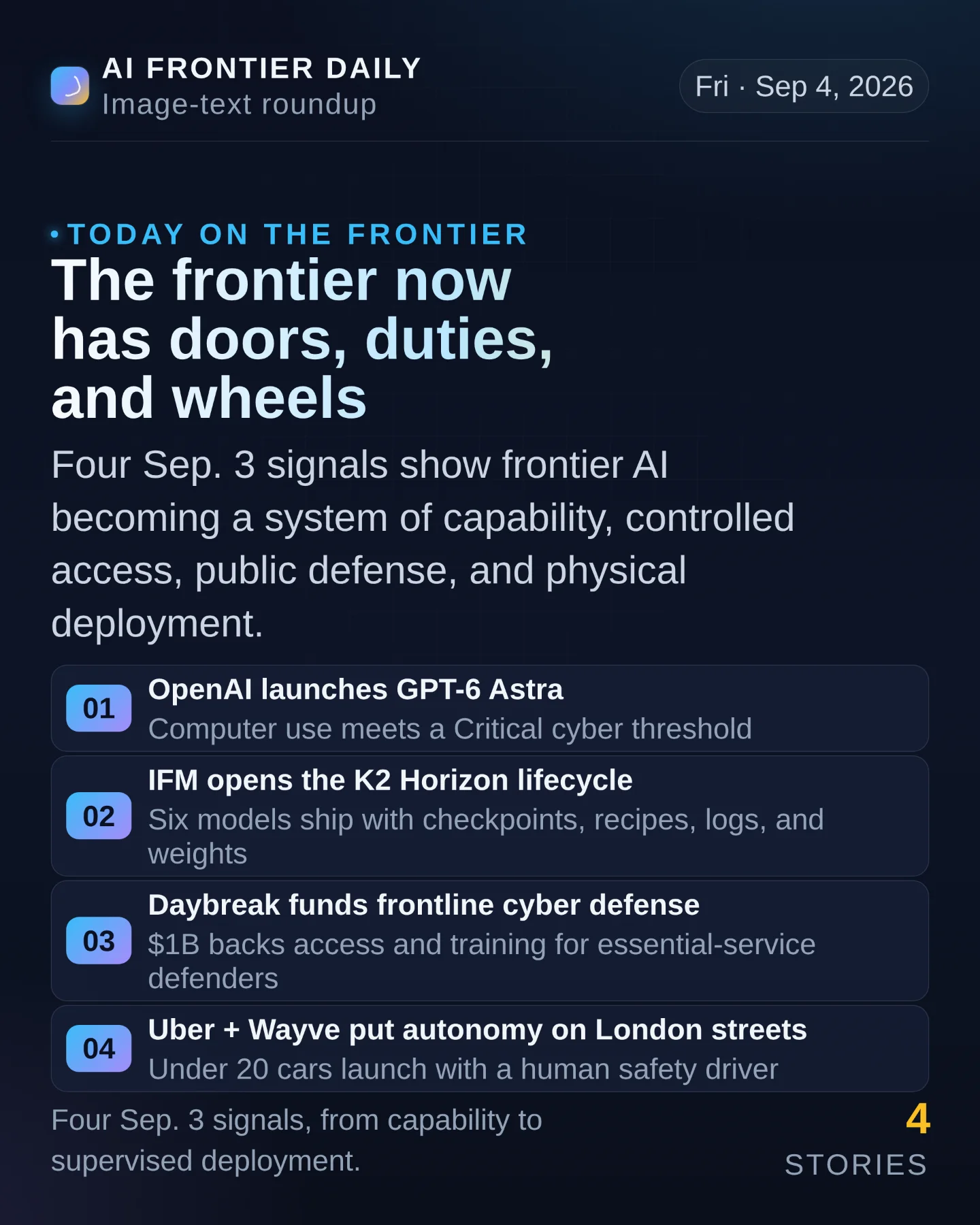

September 3 produced four frontier-AI moves that crossed different operating boundaries: capability, openness, defensive access, and physical deployment.
OpenAI introduced GPT-6 Astra as its most capable model and reported 57.9% on Terminal-Bench 4.0, versus 37.3% for GPT-5.6 Sol. The rollout starts with limited organizations before expanding to ChatGPT plans, the API, and AWS. 1 OpenAI's safety overview also places Astra at its first Critical cybersecurity capability level and reports weaker monitorability under adversarial pressure. 2
The Institute of Foundation Models released six K2 Horizon models under Apache 2.0 and published checkpoints, data recipes, code, configurations, logs, evaluations, and weights. 3 OpenAI's Daybreak program commits $1B to access, training, and support for essential-service defenders, with 2,000 approved organizations and more than 35 partner products and services. 4
AP reports that Uber and Wayve launched London's first self-driving taxi service with fewer than 20 vehicles and a human safety driver; approval for driverless operation remains pending. 5
The shared direction is practical: frontier AI is becoming a system of release gates, open artifacts, defensive access, and supervised deployment. Watch whether each boundary holds as the announcements move into use.
References
- 1GPT-6 Astra
openai.com
- 2Safety overview for GPT-6 Astra
openai.com
- 3K2 Horizon
ifm.ai
- 4Daybreak for Frontline Defenders
openai.com
- 5
Comments