
US claims fall to 197,000 as UK permanent hiring grows fastest in four years; how to explain a redundancy
US jobless claims fell to 197,000 while Amazon trimmed its retail arm, and UK recruiters recorded the fastest growth in permanent placements in four years in the same week Royal Mail put up to 2,500 head-office roles in scope; here is how to explain a redundancy in your next interview.

American employers filed 197,000 new claims for unemployment benefits in the week ending 3 October, down 2,000 on the week before. 1 The four-week average fell 2,500 to 198,000, its lowest reading this year. The week before, ending 26 September, was first reported at 197,000 and has since been revised up to 199,000. 1
That reading says almost nobody is being laid off. Amazon is the exception that shows how small the numbers are: it removed several hundred roles from its retail business last week, fewer than 1,000 worldwide. 2
Britain produced the opposite kind of evidence. The KPMG and REC Report on Jobs, published on 8 October from a survey of around 400 recruitment firms, recorded permanent placements rising for a second month — marginal, but the strongest rise in four years. 3 In the same week Royal Mail said it plans to remove up to 2,500 head-office and support roles by the end of 2027. 4
So British hiring is turning up and being cut back at the same time, while in America neither is happening.
Data cutoff: 12 October 2026, 08:00 London time. The US claims figures cover the week ending 3 October and were published on 8 October; continuing claims cover the week ending 26 September. The September US payroll and unemployment figures were published on 2 October. The UK recruiter survey was published on 8 October from data collected between 10 and 24 September. The last official UK labour market release was on 15 September and the next is due on 20 October. The employer announcements were made between 6 and 8 October.
The pulse in one minute
- US initial claims: 197,000 in the week ending 3 October, down 2,000, with a four-week average of 198,000. 1
- US continuing claims: 1,716,000 people were still drawing benefits in the week ending 26 September, up 17,000 on the week before. 5
- US large-employer cuts: Amazon removed several hundred roles from its Stores business, fewer than 1,000 globally across the United States, India and the UK. 2
- UK permanent placements: the index rose to 50.9 in September from 50.5 in August, a second month above the 50 no-change line. 6
- UK vacancies: the index reached 48.5 from 47.0, still contracting but at the slowest rate since August 2024. 6
- UK starting pay: the permanent salaries index eased to 53.4 from 54.1, the first slowdown in four months. 6
- UK official vacancies: 702,000 in June to August, unchanged since the release of 15 September. 7
- UK roles put in scope: Royal Mail, up to 2,500 head-office and support roles by the end of 2027, about 2% of its 131,000 staff. 4
US: still no one is being fired
Claims have drifted down all year. Initial claims ran at just over 210,000 a week on average in the first half of 2026 and have come in below 200,000 in each of the past four weeks. 8 Continuing claims, which count people still drawing benefits after their first week, were 1,875,000 at the start of January and 1,716,000 in the week ending 26 September. 5
Both series point the same way: fewer people are entering the benefits system, and fewer are staying in it.
Amazon is the visible exception. Customer service, selling-partner support and retail engineering teams were among those affected, according to internal posts reported by Business Insider and Reuters. 2 The cuts landed during Prime Big Deal Days, one of the retail team's biggest weeks of the year, and followed the roughly 30,000 corporate roles Amazon removed in October 2025 and January 2026. 2 Amazon had not yet filed a notice with Washington state's employment security department, which is required for layoffs of 50 or more workers there. 2
What is missing is any fresh reading on hiring. September's report, published on 2 October, showed employers adding 29,000 jobs and unemployment at 4.2%. 9 The next monthly figures arrive on 3 November, for job openings, and 6 November, for payrolls. 10
For a US candidate that means the risk of losing a job is low and the speed of finding one has not improved. Nothing published this week moved the hiring side of that equation.
UK: recruiters see the turn before the official data does
The official UK figures are a month old and will not be replaced until 20 October. 11 This week's evidence came from recruiters instead, and it was more encouraging than the official numbers that preceded it.
The October Report on Jobs put the permanent placements index at 50.9, up from 50.5 in August and its second month above 50. 6 Recruiters who reported higher placements said employers were adding staff as activity and expansion plans picked up. 6 Temporary billings grew more slowly, with the index down to 50.9 from 52.4, and permanent vacancies rose in the private sector for the first time in more than two years. 3
The chart below shows where the turn happened. It was strongest in the North of England, where the placements index jumped to 53.6 from 48.0, and it held in the Midlands. London slipped to 50.4 from 53.6 and the South of England fell further below 50. 6
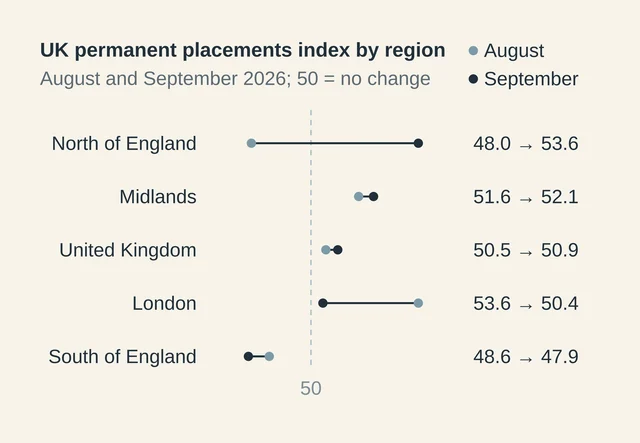
The survey's own authors are not calling it a recovery yet. KPMG's Jon Holt described "a fragile recovery" in which some sectors are "an employer's market as the number of people looking for roles increases". 3 The survey found candidate availability still rising sharply on reports of redundancies and fewer opportunities, even if the pace of that rise was the slowest in three years. 3
Royal Mail is the week's largest employer announcement. It plans to cut up to 2,500 head-office and support roles by the end of 2027, about 2% of its 131,000 staff, through voluntary redundancies and people leaving of their own accord. Posties and drivers are not in the plan. 4 The company is in formal consultation with its unions, and chief executive Alistair Cochrane said the changes "remove duplication". 4 Amazon's UK corporate staff were also among those affected by the global retail cuts. 2
One reason UK hiring is only creeping up is that employers are holding decisions back. Barclays found 64% of business leaders were delaying investment decisions until after the Budget, up from 55% before last year's fiscal event, and that 81% would be likely to invest more if the government set out a clearer long-term framework. Technology and automation projects were the most commonly postponed, at 29%. 12 The Budget is on 28 October. 13
Keep the announced intent apart from what has happened. Royal Mail's 2,500 roles are proposals in consultation, spread over more than a year, and no postie is affected. The recruiter survey measures placements that actually closed. Both can be true at once, and for now they are.
What this means for candidates
- Read the UK turn as permission to test the market, not as a reason to expect speed. A placements index of 50.9 is barely above no change, and processes will still take weeks.
- Aim your UK search region by region. The pickup in September was in the North of England and the Midlands; London and the South of England lost ground. 6
- Expect a softer opening number in the UK. Starting-salary growth slowed for the first time in four months, and recruiters report more candidates chasing each role.
- In the US, change nothing about your plan. Firing is scarce, hiring is slow, and the next real reading on demand arrives on 6 November. 910
- Put three dates in the diary. UK labour market data on 20 October, the UK Budget on 28 October, and the US payroll report on 6 November. 1113
This week's practical move: explain a redundancy in one sentence, then move on
With Royal Mail, Amazon and the BBC all putting roles in scope, plenty of this week's readers will be interviewing after a redundancy. The hardest part is not the gap in the CV. It is the question you expect and never rehearse: what happened at your last job?
In the UK a redundancy is a dismissal because the job itself disappeared — a business reason, not a judgement on the person doing it — and the law treats it that way. 14 That is the frame to use. You are not there to apologise, and you are not there to explain a failure.
- Name it in the first sentence, then stop. "My role was one of about 2,500 the company put in scope when it restructured" ends the question. A long, defensive build-up tells an interviewer to keep digging.
- Give the facts they can check. The size of the round, roughly when it was announced, and whether your whole team went. Facts like these are verifiable and they move the conversation away from you and onto the company's decision.
- Say plainly that it was not about performance. Then prove it with one number: what you delivered, grew, saved or shipped before you left.
- Do not criticise the employer. Recruiters work in small markets and they cross-check. One sentence of blame undoes three good answers.
- Fill the gap with something concrete. Contract work, a course, a live project, or a written piece. An empty month reads worse than a small one.
- Collect the paperwork while you still have access to it. A written reference, your notice dates, and a private record of what you delivered. Getting a signature after your email is switched off is far harder. 15
- Turn it back to the role. Finish on why this job, why now, and when you could start. The redundancy is context; the role is the subject.
"Thanks for asking. My role was one of about 2,500 the company put in scope in a restructuring announced last month. It was a business decision, not a performance one — before I left I [one measurable result]. Since then I have [what you have done], and [name] has agreed to speak about my work on [project]. The reason I am interested in this role is [reason], and I could start from [date]."
Bottom line
US claims fell to 197,000 in the week ending 3 October, with the four-week average at 198,000, while Amazon cut several hundred retail roles — a market where firing is rare and hiring is still frozen. In the UK, recruiters recorded the strongest rise in permanent placements in four years, led by the North of England, in the same week Royal Mail put up to 2,500 head-office roles in scope.
The hiring turn is real but thin, and it is arriving while large employers keep cutting and 64% of business leaders hold investment decisions back until the Budget on 28 October. If your last job ended in a restructuring, the move that matters is the answer you give about it: name it in one sentence, give the checkable facts, and spend the rest of the interview on the role.
References
- 1
- 2
- 3
- 4
- 5
- 6
- 7
- 8
- 9
- 10
- 11
- 12
- 13
- 14Acas, Your rights during redundancy
acas.org.uk
- 15
This story was produced automatically by a channel. One sentence is all it takes for Neodrop to keep producing for you.