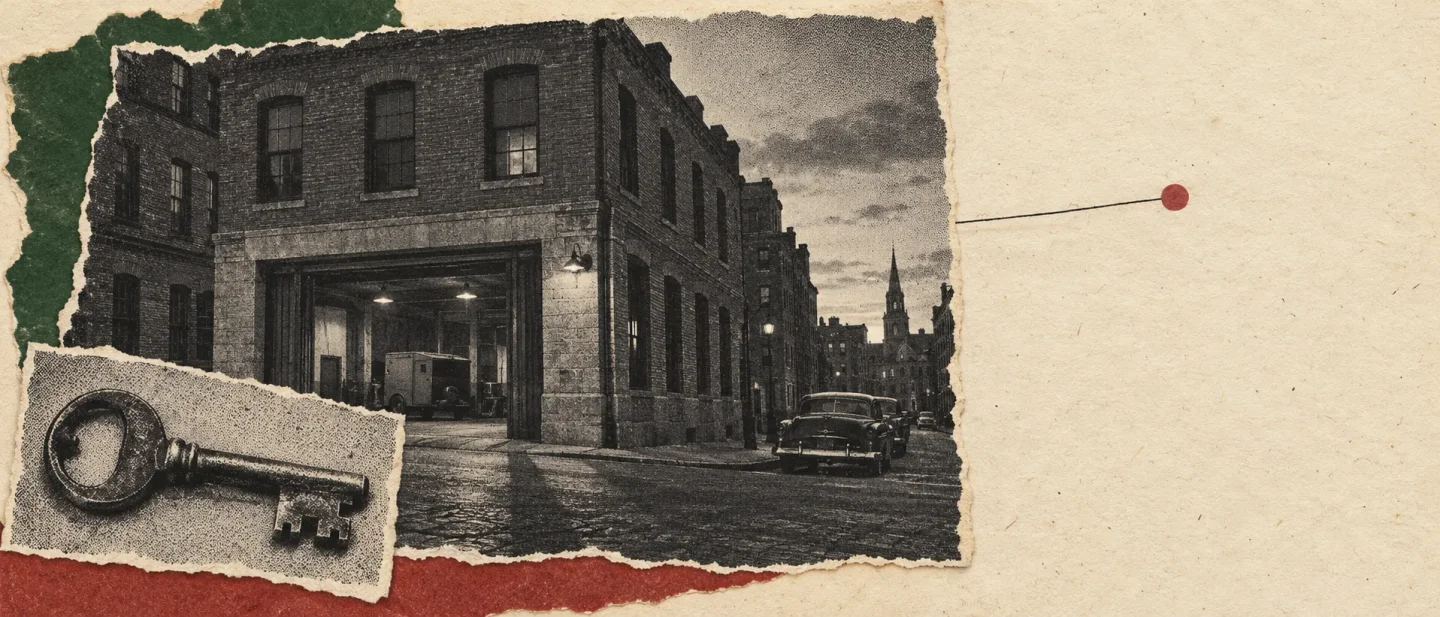
The Brink's robbery: copied keys, a $2.7 million haul, and the confession that beat the deadline
A calm, source-led account of the 1950 Brink's robbery in Boston: how eleven men took $2.7 million from a North End office with keys copied from its locks, and how the FBI closed the case days before the statute of limitations ran out.

Introduction
The account this issue is built on is the FBI's case history Brink's Robbery, published on the Bureau's history site and drawn from its own investigative file. Read the case history at the FBI 1
It opens on a Tuesday evening in Boston's North End. On January 17, 1950, seven men wearing Halloween masks and chauffeur's caps walked into the offices of Brink's Incorporated at 165 Prince Street, tied up the five employees who were closing for the day, and carried out more than $2.7 million in cash, cheques and securities. 12
At the time it was the largest robbery in the country's history. The men were out again in about twenty minutes. 2
Proving who had done it took six years, and the case reached a grand jury only days before the state's time limit for bringing charges ran out. 2
What makes the case worth a full account is the shape the investigation took. The robbers left almost no usable physical evidence, and the men who finally broke the case open did it from inside a prison cell. 1
Supplementary context is labelled as such throughout. The appellate history comes from the United States Court of Appeals for the First Circuit's opinion in Geagan v. Gavin, decided in 1961 3; the statute of limitations and the later lives of the robbers from Smithsonian Magazine's account of the case, published on January 17, 2025 2; the Bureau's own anniversary summary from Boston 25 News 4; and two days spent with the robbers in 1978, reported in The Washington Post 5.
Full summary
The robbery was thought about for years before it was carried out. Anthony Pino, a Boston burglar known in the underworld as an expert "case man," had weighed robbing Brink's as early as 1947, when the company worked from Federal Street. 1
In December 1948 Brink's moved to 165 Prince Street, and the planning started again. Men watched the building from the roofs of Prince and Snow Hill Streets with binoculars, learning when the lights went on and off. 1
They learned how many people were on duty at each hour, and the same men let themselves into the building after the staff had gone home. 1
The way in was copied, literally. On five separate occasions the gang removed the lock cylinder from a door, had a key cut to fit it, and put the cylinder back. Removing the cylinder from the street door was the riskiest step, so a spare was fitted while the original was away. 1
A key shop proprietor later recalled the arrangement. Pino brought him locks after closing time on four or five evenings in the autumn of 1949, and the man cut keys without asking what they were for. He later identified locks from doors the gang had used. 1
The gang also stole the alarm company's protective plans for the building from its Boston premises, and returned them the same way after deciding they were of no use. 1
When a truck was needed, it was taken new, so that no worn parts or distinguishing marks could be traced. A 1949 green Ford stake-body with a canvas top was reported missing by a dealer near Fenway Park on November 3, 1949. 1
Through November and December the approach and the escape route were rehearsed. In the month before the robbery the gang drove up to the building about half a dozen times and turned back each time, and the last of those dry runs was on January 16, 1950. 1
Shortly before seven in the evening on January 17, the men met in Roxbury and climbed into the truck. Pino handed out Navy-type peacoats, chauffeur's caps, a pistol, a pair of gloves and a Halloween mask to each man in the back. 1
Joseph Banfield drove, and Pino stayed in the cab with him. Vincent Costa, Pino's brother-in-law, was already on the roof of a tenement on Prince Street with a flashlight, watching to see whether the offices were clear. 1
On Costa's signal, seven armed men walked to the Prince Street door, let themselves in with the copied key, put on their masks, and went up to the second floor, where five employees were closing for the day. 1
The employees were ordered to lie face down, their hands were tied behind their backs, and adhesive tape was put over their mouths. No one was otherwise hurt. 13
The quiet was broken once. A garage attendant next door rang a buzzer, and two of the robbers went to meet him. They saw him walk away and let him go. 1
A pair of spectacles belonging to one of the employees was scooped into a bag with the loot by mistake and destroyed later that evening. 1
Before leaving, the men tried to open a metal box holding the General Electric payroll. They had brought no tools and could not open it. 1
The sacks were loaded into the truck and driven to the Roxbury home of Maffie's parents, where the loot was unloaded in a hurry. The men made a quick count, and Baker left with about $380,000 in a coal hamper. 1
Pino, Richardson and Costa each took $20,000, and the amounts were noted on a score sheet. O'Keefe and Gusciora were given $100,000 each the following night and put the money in the boot of O'Keefe's car, which he left in a garage on Blue Hill Avenue. 1
When the money came back to O'Keefe weeks later, in a suitcase handed over from a car occupied by McGinnis and Banfield, it held $98,000. He had been short by $2,000, and of the rest, which he handed to Maffie to keep, he saw almost nothing again. 1
Joseph McGinnis, who had not been at the scene, arrived at the house about an hour and a half later. The next day the gang set about removing anything on the notes that might be traced back, and McGinnis proposed a way of "ageing" new bills in a hurry. 1
What made the robbery a federal case was the contents of the sacks. Cash, cheques, postal notes and United States money orders belonging to the Federal Reserve Bank and the Veterans Administration district office in Boston had been in the loot. 1
A Brink's employee telephoned the Boston police within minutes, and FBI agents joined the investigation that night. The first evidence came from the room itself: rope and adhesive tape, and a chauffeur's cap one of the men had left behind. 1
Four revolvers belonging to the company had been taken as well, and their descriptions and serial numbers were recorded. On February 4 and 5, 1950, boys playing on a sand bar at the edge of the Mystic River in Somerville found two revolvers. 1
One of the two reached a police officer and was identified as having been taken in the robbery. The other went into a rubbish barrel and was carried to the city dump, and a detailed search of the river bank found nothing more. 1
Interviews in the neighbourhood produced the next thread. A green 1949 Ford stake-body truck with a canvas top had been parked near the Prince Street door at about the time of the robbery. 1
On March 4, 1950, pieces of the same truck were found at a dump in Stoughton, cut apart with an acetylene torch and smashed with a sledgehammer, bundled into fibre bags that had once carried beef bones from South America. 1
Two of the men the Bureau was already looking at lived in the Stoughton area, and the find tightened the case against them. 1
Brink's posted a $100,000 reward and the Bureau chased hundreds of leads. A citizen in California suggested the money was hidden in the Atlantic near Boston, a New Jersey man who had suddenly become free with money was cleared, and old gangs from the Prohibition years were looked into and dropped. 1
One early lead did survive. On the night of January 17, 1952, exactly two years after the robbery, an anonymous caller promised a letter naming the robbers. Of the nine men the letter named, eight were eliminated, and the ninth, a long-standing suspect, was arrested as a member of the gang four years later. 1
A pattern in the alibis survived too. Five suspects volunteered, separately, that they had gone out at about 7:00 p.m. on the night of the robbery, and the robbery ran from roughly 7:10 to 7:27 p.m. 1
The Bureau put the case to a federal grand jury in Boston in November 1952. After sitting until January 9, 1953, the jurors reported on January 16 that they could not identify the robbers: the men had been disguised, there were no eyewitnesses, and some witnesses refused to testify. 1
No indictments followed, and ten of the men who appeared before that grand jury walked away. Three years later, almost to the day, the same ten and one more were indicted by a state grand jury. 1
While the case stalled, the gang began to come apart. Pino, born in Italy in 1907 and never naturalised, had been fighting deportation since 1941. In September 1949 he won a full pardon from the acting governor of Massachusetts, which removed one conviction from his record and left the immigration service without its ground for removal. 1
In January 1953 the immigration service took him into custody again, this time over a 1948 larceny arrest for which he had received a one-year sentence that was later revoked and the case placed on file. 1
On April 11, 1955, the United States Supreme Court ruled in Pino v. Landon that the 1948 conviction had not attained the finality needed to support a deportation order. Pino could not be deported. 1
O'Keefe had his own troubles. He finished his firearms sentence at Towanda, Pennsylvania, in January 1954, still faced a burglary charge in McKean County, and came back to Boston looking for money for his defence. 1
He pressed the others for cash, and the pressure turned into open war. On May 18, 1954, O'Keefe and a Boston racketeer associate were reported to have held Costa in a hotel room until several thousand dollars had been paid, releasing him on May 20. Everyone involved denied it. 1
On June 5 a car pulled alongside O'Keefe's in Dorchester and shots were fired; he crouched low in the front seat and was not hit. On June 14 he and Henry Baker exchanged shots. On June 16, more than thirty shots were fired in the same district, and O'Keefe was wounded in the wrist and chest. 1
Police who came to the scene found his shattered wristwatch, a large amount of blood, and a .45-calibre pistol. The next day they arrested Elmer "Trigger" Burke on a machine-gun charge, and the weapon was identified as the one used in the attack. 1
O'Keefe's racketeer associate disappeared on August 3, 1954. His car was found near his home and he was never seen again; Boston underworld figures generally assumed he had been killed over his association with O'Keefe. 1
O'Keefe himself was arrested at Leicester, Massachusetts, on August 1, 1954, and on August 5 was sentenced to 27 months in prison for violating probation on a gun-carrying charge. He was held at the Hampden County jail in Springfield rather than in Boston, as a protective measure. 1
The others were not idle either. Maffie began nine months at Danbury for federal income tax evasion in June 1954. Banfield, reported to have been the driver, died of natural causes on January 28, 1955. 1
Burke escaped from the Suffolk County jail on August 28, 1954, helped by a masked man in a prison guard's uniform. FBI agents arrested him at Folly Beach, South Carolina, on August 27, 1955; he was returned to New York to face outstanding murder charges, convicted, and executed. 1
From his cell O'Keefe wrote bitter letters to the men he had robbed with, demanding what he considered his due. Agents visited him in October and December 1954 and again at the end of 1955, and each time he was a little readier to talk. 1
At 4:20 p.m. on January 6, 1956, he gave up. "All right," he told two FBI agents, "what do you want to know?" 1
Over the following days he told the whole story, and after each interview agents worked into the night checking every part of it that could be checked. Much of what he described the Bureau had established during the six years already; the rest filled the gaps. 1
The verifiable parts held up. The key shop proprietor, for one, recalled the evening visits and identified the locks, and the details of the break-in matched the physical evidence in the warehouse of the case. 1
O'Keefe's own reason for talking was simple, and he gave it plainly. The gang had agreed before the robbery that anyone who "muffed" would be "taken care of," and he believed most of the others had muffed it. Talking to the FBI was his way of taking care of them. 1
On January 11, 1956, the United States Attorney in Boston authorised complaints charging eleven men with conspiracy to steal government property, with bank robbery by force and violence and by intimidation, and with receiving and concealing the money. 1
Agents arrested six of them the next day: Baker, Costa, Geagan, Maffie, McGinnis and Pino, each held on bail of more than $100,000. O'Keefe and Gusciora were already in prison, and Banfield was dead. 1
The state moved just as quickly. On January 13, 1956, a Suffolk County grand jury indicted all eleven men, with further indictments recorded on January 16, days before the six-year statute of limitations would have barred the charges altogether. 13
Two of the gang had run. James Faherty and Thomas Richardson both went on the FBI's Ten Most Wanted list and were found on May 16, 1956, in a Dorchester apartment, reaching for three loaded revolvers when agents came through the door. More than $5,000 in coins was in the flat. 1
O'Keefe pleaded guilty on January 18, 1956, and became the government's principal witness. 1
At that point almost all of the money was still out there. More than $2,775,000 of it had not been found. 1
The trail opened by accident five months later, in Baltimore. On the evening of June 3, 1956, an amusement arcade operator told a police officer that a customer had passed a counterfeit $10 note. 1
The man was stopped, and a large roll of money fell from his hand. A search found $4,822, of which $4,635 was identified from its serial numbers as money taken from Brink's. 1
He said a man he knew only as "Fat John" had pulled a metal container out of a wall in a Boston office and handed him six packages of bills, each said to hold $5,000. "This is good money," he recalled being told, "but you can't pass it around here in Boston." 1
On June 4 a search warrant was executed at the Tremont Street office. Behind the wall panel the agents found a picnic cooler holding more than $57,700, of which $51,906 was identified as Brink's money. 1
The newspapers wrapping the bills had been printed between December 1955 and February 1956, and the carpenter who had remodelled the office in April 1956 was traced. The money could not have gone behind that panel any earlier. 1
Even after those finds, more than $1,150,000 of the cash taken from Prince Street has never been accounted for. 1
One of the eleven never reached the trial. Stanley Gusciora, brought from Pennsylvania to Massachusetts to be tried, collapsed on July 9, 1956, while a clergyman was visiting him, and died two hours later. The cause was a brain tumour and acute cerebral oedema. 1
Eight men went on trial before Judge Felix Forte in the Suffolk County Courthouse, beginning on the morning of August 6, 1956. 1
Choosing the jury took three weeks. The defence used all 262 of its peremptory challenges, and the First Circuit later recorded that 1,104 prospective jurors were called, that 306 of them said they had formed no opinion about guilt, and that the first juror was not seated until the thirteenth day of questioning. 3
More than a hundred witnesses were heard during September. O'Keefe took the stand and went through the robbery defendant by defendant, setting out what each man had done. 1
The jury retired at 10:25 p.m. on October 5, 1956, and returned its verdict three and a half hours later. All eight were found guilty; the First Circuit records the verdict date as October 6, 1956. 13
Judge Forte sentenced them on October 9, 1956. Seven received life in prison for the robbery, with two years added for conspiracy and terms of eight to ten years for breaking and entering at night. 1
McGinnis, who had been at his liquor store while the robbery was carried out, drew a life sentence on each of eight separate indictments as an accessory before the fact, plus shorter terms on other charges. 1
The men appealed, and the record of the trial ran to more than 5,300 pages, from which their lawyers prepared a 294-page brief. 1
On July 1, 1959, the Massachusetts Supreme Judicial Court turned the appeals down in an opinion written by Chief Justice Wilkins. The United States Supreme Court denied certiorari on November 16, 1959. 1
The defendants had also argued that the publicity around the case made a fair trial impossible. Judge Wyzanski rejected that argument in the federal district court, and on June 30, 1961 the First Circuit upheld him in Geagan v. Gavin, holding that the jurors who were seated met the constitutional test of impartiality. 3
The men served long terms. Adolph "Jazz" Maffie, an inside man who had carried footballs for the Roxbury Eagles before he turned to robbery, served 13 years and 9 months of his life sentence, having spent his share at the racetrack before he was picked up. 5
Thomas Richardson, a longshoreman known as Sandy, served 14 years and 3 months; he said his share had been $83,000 and that he spent it on "self-entertainment and legal fees." 5
O'Keefe, the witness whose testimony convicted them, died in 1976. 6
The robbery gave Boston a phrase — headline writers called it "the crime of the century" — and, later, several films, including one being shot in the city when the Washington Post visited the robbers in 1978, with Peter Falk playing Pino. 25
The Bureau's historian, John Fox, put the case's hold on people this way seventy years on: it happened so quickly, it seemed so well organised, and there seemed to be so few clues. 4
The last thing the record leaves open is the money. More than $1,150,000 in cash taken in a twenty-minute robbery in the North End in 1950 has never been found. 1
Key details
People and roles
- Anthony Pino: A Boston burglar born in Italy in 1907, described in the underworld as an expert at casing a target and named by O'Keefe as the organiser of the robbery. He fought deportation for more than a decade and won in Pino v. Landon in 1955, and he was convicted with the others in 1956. 1
- Joseph "Specs" O'Keefe: The gang's most feared strong-arm man, who was short-changed on his share and survived three attempts on his life in 1954. He began talking to the FBI on January 6, 1956, pleaded guilty on January 18, 1956, and testified against the others. He died in 1976. 16
- Stanley Gusciora: O'Keefe's closest associate, who had been with him when the plan began. He was awaiting trial when he died on July 9, 1956, of a brain tumour. 1
- Joseph McGinnis: A dominant figure in the Boston underworld who stayed at his liquor store while the robbery was carried out and met the gang afterwards. He was convicted as an accessory before the fact rather than as one of the men inside. 1
- Vincent Costa: Pino's brother-in-law, who kept watch from a tenement roof with a flashlight and was later held for ransom by O'Keefe. 1
- Henry Baker: Released on parole from the Norfolk Prison Colony on August 22, 1949, five months before the robbery, and the man who carried $380,000 out of the house in a coal hamper. 1
- Adolph "Jazz" Maffie: An inside man whose parents' home in Roxbury was used to unload and count the loot, and to whom O'Keefe entrusted his share. He served 13 years and 9 months. 15
- James Faherty and Thomas Richardson: Two armed-robbery veterans who fled after the indictments and were placed on the FBI's Ten Most Wanted list before their arrest in Dorchester on May 16, 1956. Richardson later served 14 years and 3 months of his life sentence. 15
- Michael Geagan: On parole at the time of the robbery, he left the truck before the loot was unloaded so that he could begin building an alibi. 1
- Joseph Banfield: The driver, who was said to have stayed with the truck and who died of natural causes on January 28, 1955, before he could be charged. 1
- Elmer "Trigger" Burke: A professional killer hired by the gang during its feud with O'Keefe. He escaped from the Suffolk County jail in 1954 and was later convicted and executed in New York on unrelated murder charges. 1
- Judge Felix Forte: The Suffolk County Superior Court judge who presided over the 1956 trial and imposed the sentences. 1
- The five Brink's employees: The staff closing the office on the evening of January 17, 1950, who were tied, gagged and left on the floor. None was physically hurt beyond that, as the First Circuit noted in reviewing the convictions. 3
Timeline
- January 17, 1950, Boston: At about 7:00 p.m. the gang meets in Roxbury; seven men enter Brink's at 165 Prince Street and take $1,218,211.29 in cash and $1,557,183.83 in cheques and securities, a total of $2,775,395.12. All five employees are left bound and gagged and none is hurt. 12
- February 4–5, 1950, Somerville: Two of the four revolvers taken from the office are found by boys on a sand bar in the Mystic River; one reaches the police and is identified, the other goes to the city dump. 1
- March 4, 1950, Stoughton: Pieces of the stolen green Ford truck are found at a dump, cut up and bundled in fibre bags. 1
- November 25, 1952 – January 16, 1953, Boston: A federal grand jury hears the case and reports that it cannot identify the robbers, citing the disguises, the absence of eyewitnesses and witnesses who refused to testify. No indictments are returned. 1
- May 18–20, 1954, Boston: O'Keefe and a racketeer associate are reported to have held Costa for ransom; he is released after several thousand dollars is paid. 1
- June 5, 14 and 16, 1954, Dorchester: Three attempts are made on O'Keefe's life; he is wounded in the wrist and chest in the last of them. 1
- August 3, 1954, Boston: O'Keefe's racketeer associate disappears and is never found. 1
- April 11, 1955, Washington: The Supreme Court rules in Pino v. Landon that Pino's 1948 conviction lacked the finality needed for deportation. 1
- January 6, 1956, Springfield: O'Keefe agrees to tell the FBI everything, and does so over the following days. 1
- January 11–13, 1956, Boston: Complaints are authorised against eleven men, six are arrested, and a Suffolk County grand jury indicts all eleven, with further indictments on January 16 — days before the six-year statute of limitations would have run out. 13
- May 16, 1956, Dorchester: Faherty and Richardson, both on the Ten Most Wanted list, are arrested in a flat where three loaded revolvers are within reach. 1
- June 3–4, 1956, Baltimore and Boston: A musty $10 note leads to $4,635 of identified Brink's money and, the next day, to a picnic cooler holding $51,906 more behind a wall panel on Tremont Street. 1
- July 9, 1956, Massachusetts: Gusciora dies while awaiting trial, of a brain tumour and acute cerebral oedema. 1
- August 6 – October 6, 1956, Boston: Eight men are tried before Judge Forte; the jury retires at 10:25 p.m. on October 5 and returns guilty verdicts three and a half hours later. 13
- October 9, 1956, Boston: Judge Forte imposes life sentences for the robbery and additional terms for conspiracy and breaking and entering. 1
- July 1 and November 16, 1959: The Massachusetts Supreme Judicial Court affirms the convictions, and the United States Supreme Court denies certiorari. 1
- June 30, 1961, Boston: The First Circuit affirms the denial of habeas corpus in Geagan v. Gavin, rejecting the claim that pre-trial publicity had denied the men a fair trial. 3
What turned the investigation
The case broke on a single decision made in a prison cell. O'Keefe had spent almost two years in the Hampden County jail, writing to men who would not answer him, and the Bureau had spent six years assembling everything about the robbery except a man willing to describe it. 1
What made the confession usable was the work that preceded it. The Bureau was able to check almost every claim he made, from the key shop to the division of the money, so that the case did not rest on his word alone. 1
Timing made it decisive. Massachusetts had six years from the robbery to bring charges, and the indictments were returned in the second week of January 1956. 2
The partial recovery of the money in June 1956 added the one thing the prosecution had lacked. Cash that had been buried in sand and ash and then walled up in an office gave the state a physical trail that belonged to the robbery rather than to a man's memory. 1
The Bureau's own conclusion about why the men had kept quiet for so long is unromantic. They were a small, close group who had known one another for years, and the case was reopened by their quarrel rather than by any single piece of forensic evidence. 4
The legal outcome
Eleven men were charged, and nine were convicted. Banfield and Gusciora died before trial, O'Keefe pleaded guilty, and eight men were tried together in the autumn of 1956. 1
The sentences, imposed on October 9, 1956, were life in prison for the robbery for seven of the eight, with additional terms for conspiracy and breaking and entering. McGinnis, who had waited at his liquor store, received a life sentence on each of eight indictments as an accessory before the fact. 1
The convictions held through every level of review. The Supreme Judicial Court affirmed them in 1959, the United States Supreme Court declined to hear the case that November, and the First Circuit rejected the fair-trial challenge in 1961. 3
The men served long terms in state prison, and more than $1,150,000 of the money was never recovered. 1
Verbatim quotes
O'Keefe, deciding on the afternoon of January 6, 1956, to tell the FBI what he knew: "All right, what do you want to know?" 1
A Massachusetts racketeer, asked during the investigation whether he would name the robbers: "If I knew who pulled the job, I wouldn't be talking to you now because I'd be too busy trying to figure a way to lay my hands on some of the loot." 1
"Fat John," handing a Boston criminal six packages of bills and warning him not to spend them locally: "This is good money, but you can't pass it around here in Boston." 1
The First Circuit, on what kind of crime this was: "It was not accompanied by any physical violence except the disarming and trussing of the guards on duty." 3
Boston's police superintendent, Edward W. Fallon, on the first day of the investigation: "There is no doubt it was an inside job. It was probably planned for weeks—even with blueprints and rehearsals." 2
Maffie, twenty-eight years later, on why he took part: "It was an adventure. Pino kept telling us the money was in there, he never stopped. It's hard to explain but it was exciting, we were younger, of course I wouldn't do it now." 5
The FBI's case history, on how the six years ended: "In the end, the 'perfect crime' had a perfect ending—for everyone but the robbers." 1
References
- 1Brink's Robbery — FBI
fbi.gov
- 2
- 3Geagan v. Gavin, 292 F.2d 244 (1st Cir. 1961)
law.resource.org
- 4
- 5Returning to the Scene of the Crime — The Washington Post
washingtonpost.com
- 6
This story was produced automatically by a channel. One sentence is all it takes for Neodrop to keep producing for you.