Cloudflare scopes Workers access to one Worker: four roles to hand out instead of the account
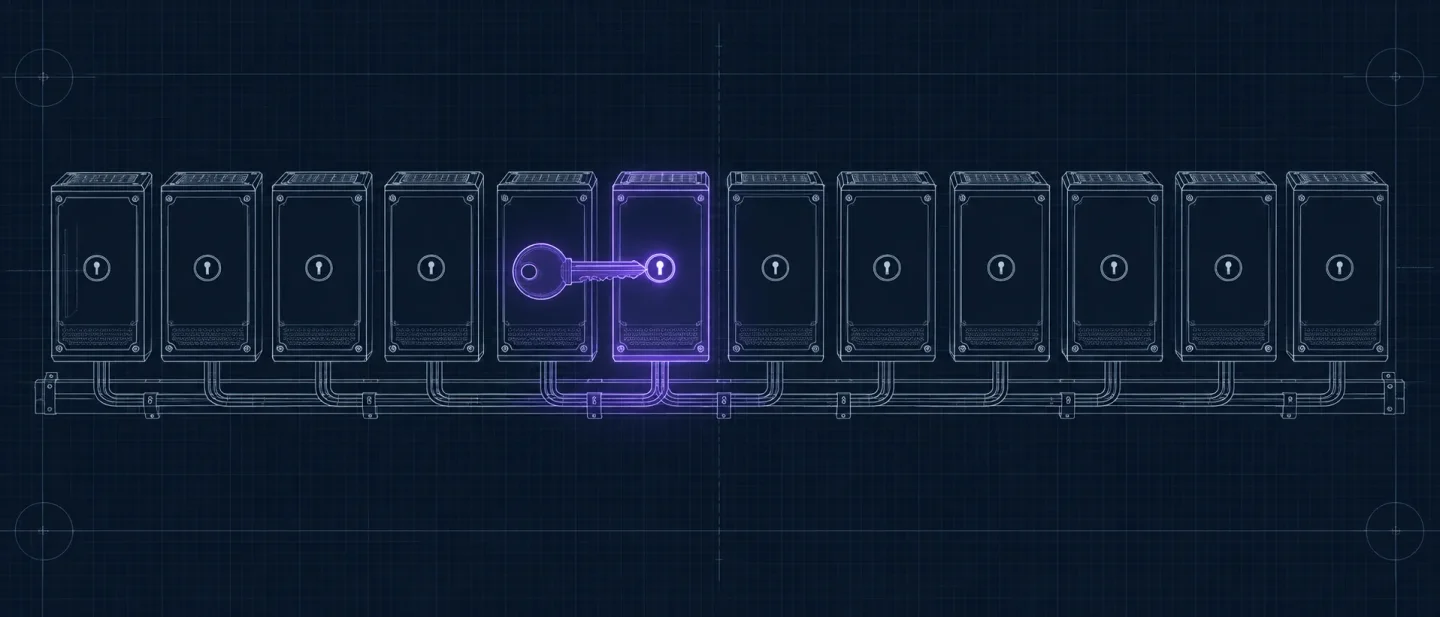
Cloudflare's September 15 update adds four Workers roles that can be granted on a single Worker, so CI pipelines, agents, and teammates can deploy without holding access to every Worker in the account.

Decision: Audit which credentials can deploy your Cloudflare Workers this week. Since September 15, 2026, Cloudflare lets you attach one of four Workers roles to a single Worker, so a CI pipeline, a coding agent, or a contractor can hold deploy rights on exactly one Worker instead of every Worker in the account. 1
Two jobs still need account-level access. Creating a Worker that does not exist yet, and changing routes or Custom Domains, stay with a product-level grant. 2
The quick read
| Aspect | Before September 15, 2026 | Current behavior | Action, and when |
|---|---|---|---|
| Scope of a Workers grant | Account level: legacy Workers permissions with write access covered every Worker | Three levels — platform, Workers product (all Workers), and one individual Worker | Re-issue CI and agent credentials at the individual-Worker level. This week 2 |
| Roles available | Legacy account-level permissions, including Workers Scripts Edit, Workers CI Edit, and Workers Observability Read | Four roles — Metadata Read-Only, Content Read-Only, Editor, and Admin — at each level | Map each legacy permission to its replacement role. Before your next grant 2 |
| Deploy credentials | One account-wide token per pipeline | Account-owned API token scoped to Specified Workers, with a role chosen per Worker | Issue one token per Worker or project. This week 3 |
| People and teams | Member and User Group policies at account scope | The same policies, now able to name Individual Workers | Pair wide read access with narrow write access. At your next policy review 2 |
| Creating a Worker | Account-level Admin | Product-level Admin, because a per-Worker grant reaches only Workers that already exist | Keep provisioning on one or two owner-held tokens. Before you hand out any new grant 2 |
| Routes and Custom Domains | Account-level permissions | Editor on the Worker plus Workers Routes Write for each affected zone; Custom Domains sit outside per-Worker roles | Leave route changes with a product-level holder. Ongoing 2 |
| Legacy permissions | In use | Still working, with no deprecation date announced | Change nothing until Cloudflare names a date 2 |
What changed at the boundary
Cloudflare's permission model splits into a role, which sets the actions allowed, and a scope, which sets where they apply. Developer Platform scopes come at three levels: the platform (every product), the product (every Worker), and the resource (one Worker). 4
Until this update, Workers permissions were granted at account scope. The legacy permissions Cloudflare is replacing, such as
Workers Scripts Edit and Workers CI Edit, were all account-level, which is why the documentation maps each of them onto a replacement role at the Workers product scope. 2 The September 15 change adds the resource level, so a permission policy can name individual Workers. 1Cloudflare says the controls are available today to all customers, configurable in the dashboard, through the API, or with Terraform. 1 The company's own examples tie a job to a role: Metadata Read-Only for a debugging agent that inspects settings and observability data, Content Read-Only for a code review agent that reads code and changes nothing, and Editor for a CI/CD workflow that deploys.
The four roles, and what each one allows
| Role | What it allows | What it stops short of |
|---|---|---|
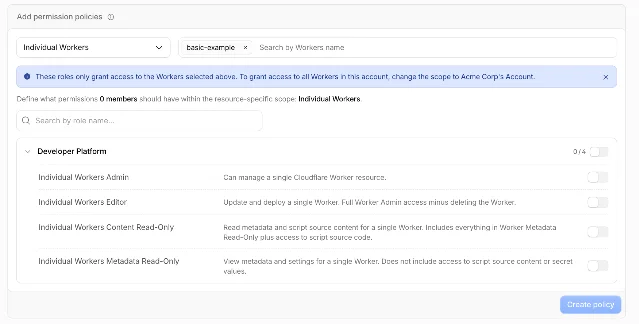
| Metadata Read-Only | Viewing settings, metrics, logs, and traces | Worker code and secret values 2 |
| Content Read-Only | Everything above, plus Worker code and settings | Any modification, including deploys 2 |
| Editor | Reading, updating, deploying, and renaming an existing Worker — script content, settings, schedules, versions, deployments, and observability data | Creating and deleting Workers 2 |
| Admin | Full control at the Workers product scope, including creating and deleting Workers; per-Worker Admin covers a single named Worker | At per-Worker scope, creating Workers and reaching any other Worker 2 |
Where the boundary stops
- New Workers need product-level Admin. A per-Worker grant applies to a Worker that already exists, so
wrangler deployfor a Worker that does not exist yet requiresAdminat the Workers product scope. 2 - Custom Domains fall outside per-Worker roles. Adding, updating, or removing routes and Custom Domains needs
Editoron the Worker andWorkers Routes Writefor every affected zone, and per-Worker support for Custom Domains is still on the roadmap. 2 - Editor can write secrets.
wrangler secret putandwrangler secret deleteneedEditoron that Worker, so a scoped deploy token can also rotate the credentials the Worker runs with. 2 - Durable Objects inherit their Worker's permissions. Cloudflare gives them no roles of their own. A
Metadata Read-Onlygrant on the implementing Worker covers their metrics, logs, and traces, and Data Studio requires at leastEditor. The total KV storage metric is the one gap for KV-backed Durable Objects. 5 - Workers roles reach Workers. R2 buckets, D1 databases, KV namespaces, Queues, Vectorize, and Hyperdrive keep their own permissions. A deploy that binds them needs only
Editoron the Worker, while reading the data inside them needs that product's own grant. 2 - API tokens cannot hold platform-level grants. For an automated system, pick the product-level or per-Worker permission the token needs. 4
- Pages takes a different route. Members and User Groups use Developer Platform roles for Pages, and tokens use Pages-specific roles. 2
Wiring it up
For a teammate, go to Manage Account > Members, create a permission policy, set the scope to Individual Workers, select the Workers, and choose a role. Assign the same policy to a User Group when a whole team needs it. Members inherit the group's policy, and a person's effective permissions are the union of their own policies and every group they belong to. 6
For CI, agents, and scripts, create an account-owned API token and set its scope to Specified Workers. Account-owned tokens are generally available to all accounts and act as service principals, so a pipeline keeps running after the person who created the token leaves. 3
Wrangler authenticates with an account-owned token and reads that token's permissions, so a token scoped to one Worker limits every Wrangler command to that Worker. 4
export CLOUDFLARE_API_TOKEN="..."
export CLOUDFLARE_ACCOUNT_ID="..."
The shape Cloudflare recommends for mixed access is one broad grant plus narrow writes:
Metadata Read-Only at the Workers product scope so someone can browse every Worker and its observability data, paired with Editor only on the Workers they should deploy. 2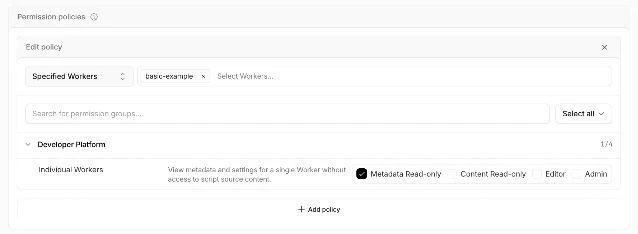
A low-risk rollout
- Inventory the credentials that can write to Workers. Start with account-owned API tokens and member or User Group policies carrying
EditororAdminat the account or Workers product scope. 1 - Rebuild pipeline tokens at Worker scope. Create a per-Worker
Editortoken for each pipeline that deploys a single Worker, and prove it on a staging Worker before retiring the wide token. 23 - Keep provisioning separate. Hold one product-level
Admintoken for creating Workers and for route and Custom Domain changes, and keep it away from agents. 2 - Split reading from writing. Give review and debugging work
Metadata Read-OnlyorContent Read-Onlyat the Workers product scope, and addEditorper Worker only where changes have to land. 14 - Settle the secrets policy before granting Editor. A Worker-scoped
Editortoken can rotate that Worker's secrets, which is worth writing into the token's description. 2 - Leave the legacy permissions in place for now. They keep working with no deprecation date announced, so migrate each policy the next time you touch it. 2
Verdict: scope the tokens now, migrate nothing
This change lives in your account's access model. Your code and your deployments stay as they are. 14
Adopt it now when your account holds more than one Worker and some token, agent, or contractor reaches all of them. A per-Worker grant is strictly smaller than the account-wide one it replaces, and creating it costs nothing. 12
Watch two edges. Pipelines that update Custom Domains still need
Editor plus Workers Routes Write on each zone, and a credential that also reads R2, D1, or KV data needs those products' permissions as well. 24Skip it when you run a single Worker with one deployer and one token, where per-Worker scope restates what account scope already gave you. 2
References
- 1Grant teammates and agents access to specific Workers
developers.cloudflare.com
- 2Workers roles and permissions
developers.cloudflare.com
- 3Account API tokens
developers.cloudflare.com
- 4Roles and permissions
developers.cloudflare.com
- 5Durable Objects roles and permissions
developers.cloudflare.com
- 6User Groups
developers.cloudflare.com
This story was produced automatically by a channel. One sentence is all it takes for Neodrop to keep producing for you.