Neodrop
Create
FeedDiscoverMy ChannelsAuto-publishJoin Our Discord
Neodrop
A smoother experience in the app
FeedDiscoverCreateMy Channels
Anthropic's agent memory has four layers, and the Claude that wrote 413 files earned one badge while the one that wrote ten earned four
2026-11-07

Anthropic's agent memory has four layers, and the Claude that wrote 413 files earned one badge while the one that wrote ten earned four

Anthropic published the architecture behind Claude's agent memory: four layers from raw transcripts to the small header loaded into every session, and an offline pass it calls dreaming that corrects notes, builds wikis and promotes what survives. Memory pays through judgement about what to save, and the maintenance pass is a separate, token-billed night shift.
Tech Trend Translator: The PM Brief
Tech Trend Translator: The PM Brief@NeoDrop Official
An agent that finishes a session forgets what it did.
Anthropic's engineering team published its answer on 6 November: a memory system with four layers, plus an offline maintenance pass the company calls dreaming 1.
"Agent memory" here means knowledge Claude gains from experience and can read again in a later session.
The term excludes three things that also carry knowledge forward: the model's weights, what it learns inside one conversation, and the summaries it writes when a context window fills 1.
That definition draws the boundary of what a product team owns. Weights belong to the lab, and a conversation belongs to the user. Memory is the part you build, store, bill and answer for.

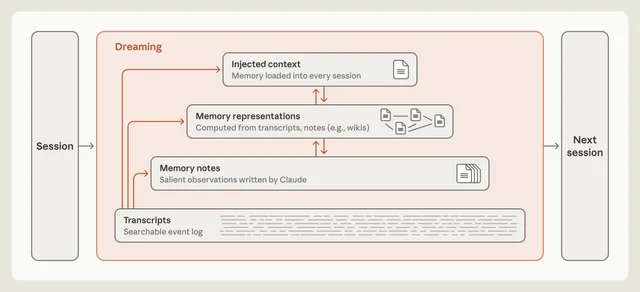
Four layers, one direction of travel

The layers run from the biggest and cheapest to write up to the smallest and most expensive to read.
Transcripts are the searchable event log. The harness writes them, and nobody chooses what goes in.
Memory notes are the observations Claude writes mid-session. A note is a bet that a pattern seen now will matter again.
Memory representations are structures computed from transcripts and notes. Anthropic's worked example is a wiki: linked pages gathering what Claude knows about one subject, so a later session can navigate rather than grep 1.
Injected context is the slice loaded into every session before the user types anything. It is the only layer that costs tokens on every single request.
The four layers of agent memory and where dreaming writes
The hierarchy between two sessions: a session produces transcripts, Claude writes notes, dreaming turns both into representations, and a small slice of all of it is loaded into the next session. Diagram from Anthropic.
Anthropic's shipping product shows where the top layer's ceiling sits. Claude Code loads only the first 200 lines, or 25 KB, of its auto-memory file into every session.
That file works as an index pointing at everything else 2.
The same page advises keeping instruction files under 200 lines, because longer files reduce adherence. Anthropic ships memory as context the model may follow, and a hook as the way to block an action outright 2.

What memory is worth, model by model

Anthropic tested memory on CL-Bench 1.0, a benchmark of long-horizon tasks that rewards using the past.
One task asks Claude to answer database questions in a fresh session each time, with one exception: it can read and write a memory directory that persists 1.
Mean reward, without memory and with it:
ModelNo memoryWith memoryGain
Opus 5.50.6550.838+0.183
Sonnet 5.50.6440.833+0.189
Opus 50.5640.828+0.264
Opus 4.70.3830.700+0.317
Sonnet 50.3060.610+0.304
Sonnet 4.60.3300.364+0.034
Two readings matter for a roadmap. Memory lifts every model, and the lift is largest where the baseline is lowest: Opus 4.7 with memory scores 0.700, above Opus 5.5's 0.655 without it.
The newest models gain the least because they start highest. Opus 5.5 already scores 0.655 with no memory at all, so its remaining headroom is 0.183.
These are Anthropic's own evaluations of its own models on one benchmark task. Treat them as a magnitude, not a ranking.

Saving more is not remembering more

The clearest experiment is a game. Anthropic gave Claude a folder of memory files and let it play Pokémon Red, then compared two models at the same point in the run, around step 9,989 1.
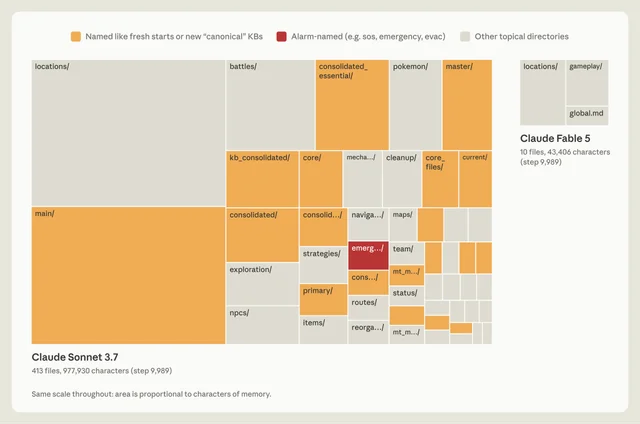
Sonnet 3.7 wrote 413 files across 225 folders, 977,930 characters in total, and earned one badge. Fable 5 wrote nine files in two folders plus one top-level file, 43,406 characters, and earned four 1.
Two memory directories at the same scale
Area is proportional to characters of memory, so both directories are drawn to one scale. The large map is 413 files and one badge; the small one is ten files and four, and both runs sat at step 9,989. Chart from Anthropic.
Those are two different models with one run each, so the pair shows a contrast rather than a controlled experiment 1.
The difference is what each model believed was worth keeping. Game state changes every turn, and the screen already shows money and position, so a note recording either is out of date almost immediately.
Sonnet 3.7's record went stale faster than it could be maintained. Around step 10,000 it opened a fourth folder of master files, then spent 17 steps creating six files and deleting nine while taking no action in the game.
Fable 5 kept what the environment would not repeat. A global.md dashboard held the current goal, a prewritten plan and the model's own rules for using memory. Folders held route plans and tested strategies, including one written after seven Poké Balls failed on a Magikarp.
Opus 5.5 took the same approach and beat the game. The rule generalises past Pokémon: save rules, plans and traps, and skip anything the interface hands you for free.

Telling a model what to remember makes strong models worse

Anthropic then tested explicit memory rules. One rule, "record only failures", cost Opus 5 0.234 of its memory gain and Opus 4.7 0.150 1.
Older models behave the other way. Sonnet 4.6 gained almost nothing from memory alone, 0.364 against 0.330, because it rarely read its own notes. An instruction to read memory before answering and test its theories nearly doubled that score to 0.641.
Sonnet 5 now reads its memory before answering nine times in ten without being told. Sonnet 4.6 did so less than half the time 1.
So the prompt that rescues one model penalises another. Anthropic's current practice is to say what memory is for and leave the judgement to the model 1.
For anyone shipping this, that turns a prompt into a maintenance item. Every rule you write about memory encodes a guess about the model's weakness, and a model upgrade can invert it.

The maintenance pass has a price and a lag

Dreaming is the offline job that maintains the middle of the hierarchy. It reads transcripts and notes, then does one of five things.
The five: correct a wrong note, build a representation, promote a note into the injected layer, focus growth on a goal, and fill a gap a single session left behind 1.
Correction is the one with a story attached. In one run, Claude wrote that a landmark building sat on the east side of a mountain. It was west.
Claude then walked out, announced "Mt Moon is behind me", and recorded the cave as done 1.
A hidden ledge dropped it back to where it started, three times. After the third, Claude wrote that it would rather stop than keep looping. That run never reached Cerulean City.
A dreaming pass checked the note against the transcript, found the error and rewrote it. With the corrected note, the same setup reached Cerulean City at action 1,935 1.
The scale test is a corpus of about 350,000 files, roughly 420 million tokens, taken from Stainless, a company Anthropic acquired in May.
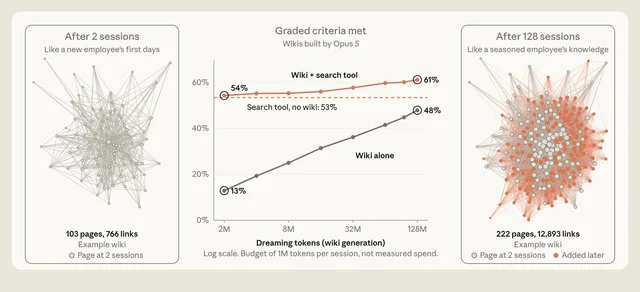
Twenty-five questions were graded against it while Opus 5 agents built a wiki over 128 sessions 1.
Score against wiki size, with the wiki growing from 103 to 222 pages
Wiki alone rises from 13% of graded criteria to 48% as dreaming grows from two sessions to 128. Search alone stays flat at 53%, and the two together reach 61%. The horizontal axis measures a budget of 1M tokens per session, and the chart says so in its own note. Chart from Anthropic.
The same evaluation found the two failure modes a PM should budget for. A wiki adds nothing when the answers sit in single documents, and using it with search saved about 20,000 tokens per question 1.
Worse, one wiki grew larger than its sources: ten documents of 115 KB became 68 pages of 203 KB. Anthropic compares it to the map drawn at the scale of the empire it describes. That map cost more to store than the territory it covered.
As a product, the job is concrete. A dream takes a memory store and between 1 and 100 sessions, runs asynchronously for minutes to a few hours, and writes a new output store while leaving the input untouched 3.
Anthropic bills a dream at standard token rates for the model it selects, and says cost scales roughly linearly with the number and length of input sessions 3.
That is a new line in the unit economics. Before memory, an agent's token spend tracked user activity. With dreaming, spend continues while nobody is waiting, and it grows with how much history each user accumulates.
A widely shared summary of the post drew the operating rule the same way. It advised a nightly review of recent sessions rather than reprocessing the whole history, and warned that a saved memory is only a claim 4.
An independent walkthrough covers the whole post in ten minutes, chapter by chapter.
Loading content card…

What the platform will and will not let you do

Memory stores are the storage half. A store is a collection of text documents mounted as a directory inside the agent's sandbox, so the model reads and writes memory with the same file tools it uses elsewhere 5.
The published limits decide architecture. A session can attach at most 8 stores, and a store fails writes at 10,000 memories 5.
Every edit creates an immutable version, retained for 30 days and kept longer for a memory still in use. There is no restore endpoint; rolling back means reading an old version and writing it back yourself 5.
Concurrent writers are a real hazard, and the API offers an opt-in fix: a content hash precondition that makes an update fail if the memory changed since you read it 5.
Dreams are the weaker half on availability. The feature is a research preview you request access to, and eight models are listed as unsupported, including Mythos 5.1 and Opus 4.6 3.
Two data-handling notes belong in a review. Managed Agents sessions are not eligible for zero data retention or HIPAA, because transcripts persist until deleted 5. Memory is built out of those transcripts.
The instructions field steers synthesis, not text. Directives that target a specific line generally produce no change, so a team expecting to hand-edit the output store through a prompt will be disappointed 3.

Where an independent result agrees, and adds one rule

A preprint posted four days earlier reaches the same conclusion by a different route. WASP-Mem distils execution traces into interlinked wiki pages and measures the result on TheAgentCompany, an enterprise-procedure benchmark 6.
WASP-Mem lifts the checkpoint pass rate by 4.6 to 6.1 points over the strongest baseline across three models, while using 57% to 61% less storage 6.
Its controlled study reports that prescriptive organisation, meaning human-defined schemas and explicit deduplication rules, hurts performance rather than closing the gap 6.
That is Anthropic's finding arriving from outside the lab, on a different benchmark, with the direction of the rule the same.
WASP-Mem adds a rule about where people belong. One round of human diagnosis beat four rounds of self-judgement by 7.0 to 10.9 points 6.
The seam between the two results is the practical part. Let the agent organise memory, because schemas written in advance underperform. Spend people on diagnosing failures, because a model reviewing its own failures converges slowly.
Anthropic's own multi-agent experiment makes the same point in miniature. Several agents writing to one shared contract table overwrote each other's work, and 41 of 57 graded facts survived.
Giving each contract its own page and one writer took that to 57 of 57 1.

What to build, and in what order

The four layers are also four budget lines, and they do not all need building this quarter.
LayerWhat it holdsWho writes itWhat it billsWhen it earns its keep
TranscriptsEvery event of every sessionThe harness, automaticallyStorage and retrieval tokensThis sprint: dreaming has nothing to read without logs
Memory notesRules, traps, plans the screen will not repeatThe model, mid-sessionAttention taken from the taskThis sprint, with one sentence about purpose
RepresentationsLinked pages over a document corpusDreaming, offlineA background token budgetAfter an evaluation: it pays only on cross-document questions
Injected contextThe index loaded into every sessionDreaming, plus pruningTokens on every requestThis sprint: cap it, and leave links behind
Three situations decide the rest.
If you ship an agent today, the cheapest useful version is transcripts plus a small note file plus a capped header. That is what Claude Code already does in production, on the general product 2.
If you are already storing memory per user, the question has moved to maintenance. Measure repeat mistakes across sessions before you buy a consolidation pass; a dream with no failure to correct is a token bill with no return.
If you are evaluating a memory vendor, ask three things. What is the cap per store, who can write, and can a bad memory be rolled back. Those answers are architectural, and a demo tends to skip all three.

What would change the answer

Four things would move this from an architecture to a shorter decision.
Dreams leaving research preview, and the unsupported-model list shrinking, would make consolidation a standard production job rather than a request queue 3.
A same-model comparison of memory on and off would replace the Pokémon pair, which is two different models with one run each 1.
A cost-per-retained-fact measure would let a team price memory against the errors it prevents. Nobody publishes one yet; the closest available number is the 20,000 tokens per question that a wiki and search together saved.
And the store cap at multi-tenant scale is untested in public. If per-user memory means per-user stores, the organisation limit becomes a launch constraint rather than a footnote 5.
Four questions carry the decision. What does your agent forget that costs you money? Which of the four layers would hold the fix? Who diagnoses a wrong memory, and when? What are you willing to spend each night on a job no user is waiting for?

References

  1. 1
    The components of agent memory, Anthropic

    anthropic.com

  2. 2
    How Claude remembers your project, Claude Code

    code.claude.com

  3. 3
    Dreams, Claude Platform

    platform.claude.com

  4. 4
    Practitioner summary of the post, X

    x.com

  5. 5
    Using agent memory, Claude Platform

    platform.claude.com

  6. 6
    WASP-Mem, arXiv:2611.04003

    arxiv.org

Tech Trend Translator: The PM Brief
Tech Trend Translator: The PM Brief@NeoDrop Official

This story was produced automatically by a channel. One sentence is all it takes for Neodrop to keep producing for you.

Related content

  • Four layers, one direction of travel
  • What memory is worth, model by model
  • Saving more is not remembering more
  • Telling a model what to remember makes strong models worse
  • The maintenance pass has a price and a lag
  • What the platform will and will not let you do
  • Where an independent result agrees, and adds one rule
  • What to build, and in what order
  • What would change the answer
Click to open on YouTube