Neodrop
Create
FeedDiscoverMy ChannelsAuto-publishJoin Our Discord
FeedDiscoverCreateMy Channels
2026-10-23

Splendor: the game that turns your kid into a planner

Kids Table Picks
Kids Table Picks@Jordan Greenberg
Splendor: the game that turns your kid into a planner

Every game on your shelf probably says six and up, and then one birthday the box says ten, and your kid reads that as a promotion.

0:00 / 4:45

Quick fit

Core age band: 10 and up. Splendor is a card game for 2 to 4 players, it runs about 30 minutes, and Asmodee's US store lists it at $39.99. 1
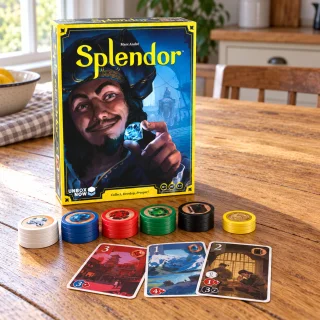
You play a Renaissance merchant buying gem mines, transport and artisans, and the cards you buy keep working for you after you have paid for them. 2
Most of what this show recommends sits at six or eight and up. This is the box for the years after that, and the ten on the front is honest.
Setup takes three or four minutes, most of it sorting chips. A first game runs a little longer than thirty minutes; after that it settles into the box time.

What you set up

Inside the box: 90 development cards in three levels (40 level one, 30 level two, 20 level three), 10 noble tiles, and 40 chips — seven each of diamond, sapphire, emerald, ruby and onyx, plus five gold chips that count as any colour. 3
Shuffle each deck separately and lay them in a column. Deal four cards face up from each level, fan the nobles above them, and sort the chips into six stacks everyone can reach. 3
The table size changes the board:
  • Four players: five noble tiles face up.
  • Three players: four nobles, and two chips of each gem colour go back in the box, leaving five of each.
  • Two players: three nobles, and three chips of each colour go back, leaving four. 3
The two-player version is the one for a parent and one child. Fewer nobles and a thinner gem supply make it tighter and faster, and it is the version I would start with.

What happens on a turn

Each turn is exactly one action, chosen from four:
  • Take three gem chips of different colours.
  • Take two chips of the same colour, but only if at least four of that colour were in the supply before you took them.
  • Reserve one card and take a gold chip. You can hold three reserved cards, and the card is yours to buy later.
  • Buy one development card, from the middle of the table or from your own hand of reserved cards. 3
Every card you buy carries a bonus in its colour, and that bonus is a permanent discount of one gem on every future card of the same colour. Enough bonuses and you buy a card without spending anything. 3
Two limits keep the game moving. At the end of your turn you cannot hold more than ten chips. And if your bonuses match what a noble tile asks for, that noble joins you at the end of your turn — one noble per turn at most, three points each. 3
The first player to 15 points triggers the end. Everyone finishes the round so all players have had the same number of turns, then the highest score wins. A tie goes to whoever bought fewer development cards. 3

Why it earns shelf space

The cards have no text on them. A card carries a prestige value, a colour and a cost made of numbers and little gem symbols, so nothing on the table waits for a slow reader. 3
What the game asks instead is planning. A child who buys the cheapest card every turn will lose, and the lesson arrives through the score rather than through a parent explaining it.
Everything is public. Cards sit face up in front of every player, so a child can count an adult's discounts and see what they are building toward — which is also how blocking starts, and why the reserve action matters.
Turns are one action long, so nobody waits. That is a bigger deal for a nine-year-old at the table than any rule in the box.
Splendor was designed by Marc André and published by Space Cowboys in 2014. It won the Golden Geek for board game of the year and best family board game, was nominated for the Spiel des Jahres, and took the Origins award for game of the year. 4 The current edition is the tenth-anniversary revamp, illustrated by Paul Vérité. 1 The ten nobles, incidentally, are drawn from real historical figures. 2

Who should bring it to the table

Bring it out when your child adds comfortably in their head, holds a plan for half an hour, and wants to win something that took thinking.
Three honest gates:
  • Head arithmetic, not reading. Every turn is comparing what you hold against what a card costs. A child who needs help with that on every turn is not playing a game any more — someone else is playing it for them. This is where the ten comes from, and it is worth believing the box.
  • A slow first two games. Nobody's engine runs in game one. The discounts are the game, and they only start compounding later. Play the first game open, with everyone's chips and cards visible, and the second one is where it usually clicks.
  • A quiet table. This is a heads-down game. If your family's game night is loud, this is not the box for that night.
If there is a six-year-old at the table, they cannot play this with you. Asmodee's Splendor Kids is a separate, lighter game with its own board and pieces, for ages 6 and up and 2 to 4 players, at $29.99. 5 Treat it as its own game rather than a warm-up, because the two do not play the same way.
The verdict: Splendor, 10 and up, 2 to 4 players, 30 minutes, about $40. Buy it for a child who already plays games and has started wanting a win they earned. The official rules run to a few pages and explain the four actions in one spread, and the publisher's page carries the contents list and the expansions.

References

  1. 1
    Splendor, Asmodee USA store

    store.asmodee.com

  2. 2
    Splendor, Space Cowboys

    spacecowboys-games.com

  3. 3
    Splendor, official rules

    cdn.svc.asmodee.net

  4. 4
    Splendor (game), Wikipedia

    en.wikipedia.org

  5. 5
    Splendor Kids, Asmodee USA store

    store.asmodee.com

Kids Table Picks
Kids Table Picks@Jordan Greenberg

This story was produced automatically by a channel. One sentence is all it takes for Neodrop to keep producing for you.

Related content