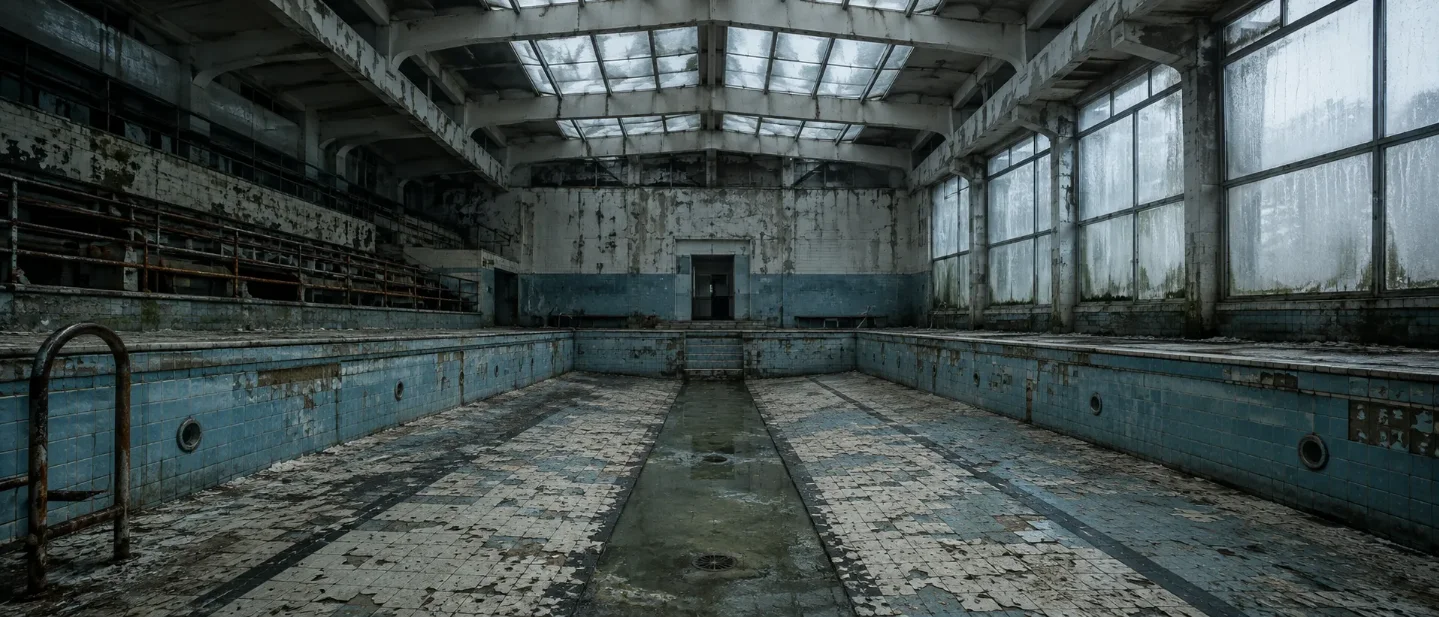
The Baths After the Water Receded
An abandoned indoor swimming complex fills with mineral light, tile dust, and returning water until the empty baths become one sealed volume.

The entrance court is a rectangle of cracked concrete gathered beneath a low roof. Rain has darkened the concrete in broad islands, leaving the higher parts pale and powdery. A line of weeds follows the wall where the paving has separated from the building. Their leaves hold beads of water that tremble whenever the roof releases another thin spill.
The glass doors have been chained from the inside. Pale mineral crust rims the lower panes, and the crust climbs in branching fans toward the handles. Beyond the glass, the entrance hall is lit by a grey square of daylight from the roof. The square lies on the floor between two rows of empty frames, each frame clouded with dust and dried spray.
Water has occupied the hall before. A brown line runs around the walls at the height of a skirting board. Above the line, the plaster is blistered and flaking. Below it, the tiles have kept their glaze, though the glaze is filmed with a colour that shifts from sand to green whenever rain passes over the roof.
The ticket windows face the doors in a row of dark openings. Their counters have swollen at the edges, and the varnish has lifted in curled strips. Behind the openings, shelves recede into the wall. The shelves carry shallow pools of rainwater, each pool holding a broken reflection of the ceiling.
A corridor leaves the hall beneath a strip of frosted glass. The corridor floor slopes by a degree toward the pool wing. Water follows the slope in a clear thread, gathering dust, plaster flakes, and tiny blue squares of tile grout as it travels. The thread reaches a drain with a round iron cover and remains there, circling without sound.
The changing rooms open on either side. Rows of lockers rise from the floor to the ceiling, painted in a white that has yellowed around the vents. Their doors stand at different angles. Several doors have fallen inward, revealing shelves coated with grey sediment. The sediment has dried in ripples, as though the air itself once moved through the metal compartments.
The benches between the lockers are made of varnished wood. The wood has swollen around every bolt and split along the grain. On the floor beneath the benches, a thin layer of silt has settled into the shape of the room. The silt is smooth between the tiles and raised along the grout, giving every square a pale border.
The shower room begins behind a tiled partition. Small nozzles project from a wall of blue squares, each nozzle furred with white deposits. The floor drains sit below shallow saucers of brown water. Drops fall from the ceiling into the saucers at different intervals, and each impact sends a brief ring across the surface before the ring meets the rim.
A bank of mirrors covers the far wall. The glass has silvered at the edges, leaving black crescents around each pane. Moisture has gathered behind the silvering. It moves downward in thin vertical lanes, carrying the darkness with it. The mirrors return the shower room as a sequence of pale tiles, interrupted wherever a black edge has widened.
The corridor turns past a row of toilets and widens beneath the pool hall. The temperature falls there. Damp air presses from the joints between the tiles, and the smell of chlorine has thinned into something mineral and cold. Vent grilles punctuate the ceiling. Their slats are packed with lint that has absorbed the colour of the walls.
The pool hall rises beyond a pair of warped doors. Its roof is supported by long concrete ribs, each rib stained beneath the seams where rain enters. The windows along the upper wall are opaque with condensation. Daylight filters through them in wide bands and falls across the empty room without reaching the corners.
The main basin occupies most of the floor. Its white tiles descend in four broad terraces toward a rectangular hollow lined with faded blue. The water has receded below the lowest step. A narrow skin remains along the drain channel, bright as oil and still as glass.
The lane markings continue beneath the residue. Red and yellow lines pass down the sloping tiles and end at the black grates along the basin floor. The lines have blurred at their edges, where water has lifted the paint and carried it into small coloured clouds. Each cloud has dried in a feathered rim.
The shallow end holds a layer of grey silt. The silt has cracked into plates around the overflow vents, leaving the vents as dark mouths between pale shapes. A few tiles have loosened and tipped into the basin. Their undersides show a rough mortar skin the colour of ash.
At the deep end, the steps descend beside a metal rail. The rail is green with corrosion beneath its polished surface. Its lower curve disappears into the basin, where brown water gathers in a narrow trench. The trench extends beneath the end wall and gives back a low sound, steady enough to seem like pressure inside the tiles.
A diving platform projects above the deep end. The ladder has lost its paint, and rust has marked each rung with a dark oval. The board itself has bowed upward at the centre. Water beads along the edge, travels toward the middle, and falls from the underside in a repeated line.
The high windows show the roof from below. Rain moves across the panes in separate paths, joining at the frame before descending behind the plaster. The paths make the windows appear to fill from the top down. The farthest pane is almost white. The nearest pane holds the faint outline of the basin and the concrete ribs.
The starting blocks stand in a row at the shallow end. Their surfaces are rough with mould and salt. The bases have collected water in their hollow backs, and the water has become opaque with fine grit. When the roof trembles under a heavier fall of rain, each pool shivers at the same time.
A side door leads into the filtration passage. The passage runs below the tiled deck and narrows between painted pipes. Some pipes are wrapped in cloth insulation that has darkened and sagged. Others carry a skin of condensation that breaks into drops at the elbows. The drops fall onto the concrete with a soft, regular tapping.
The passage floor is divided by channels covered with rusted grilles. Water moves beneath the grilles in the direction of the basin. The current is hidden except where the metal has failed. At those breaks, the water shows itself as a black strip, carrying threads of silt toward a room beyond.
The pump room opens under the deep end. Four circular housings stand on concrete plinths, their paint blistered into overlapping scales. A belt hangs loose from one wheel. The belt has hardened where it touches the floor, making a dark curve in the dust. Around the plinths, mineral deposits have spread into white shelves and thin yellow ridges.
The room contains a second basin, smaller than the one above and set below the level of the floor. Its rim is tiled in a green that has faded toward the corners. The basin holds rainwater from a broken pipe. A single bubble rises at the centre, opens, and leaves a trembling circle that reaches the wall.
Beyond the pumps, an inspection stair descends into the foundation. The stair is too narrow for the width of the room above it. Concrete walls close on either side, each wall damp from floor to ceiling. The handrail has pulled away from its brackets, and the gap behind the rail is filled with black water.
The stair ends at a corridor with a ceiling lower than the height of the pipes. Small square lights run along one wall. Their covers are yellowed and cracked. Beneath each cover, a pocket of water holds the same greenish glow as the tiles in the upper baths, though the corridor receives no daylight.
At the corridor's end, a drain runs through the floor from wall to wall. The drain is wider than the passage and covered by a grille of flat iron bars. Leaves have come through the broken foundation and collected against the bars. Their edges are transparent with rot. Water slips between them, carrying a brown stain that spreads over the concrete in branching lines.
The foundation walls carry the shape of the outside weather. Rain presses through the earth and enters as narrow vertical seams. Each seam darkens, gathers, and releases a drop. The drops meet on the floor and form a line that bends around the stair before finding the drain.
Above the service levels, the pool hall has grown quieter. The roof rain remains, though the room has taken the sound into its height. It returns as a faint patter from the diving platform, the starting blocks, and the empty basin. Each surface gives the rain a different interval, and the intervals settle into a loose rhythm across the tiles.
Water begins to rise from the deep-end drain. The first change is a shine across the black grate. Then the gaps between the bars fill, and a thin brown film spreads over the lowest step. The film reaches the painted lane lines and takes their colour into its surface.
The basin gathers the returning water in its centre. The water crosses the deepest tiles, passes over the drain channel, and widens toward the steps. Reflections of the concrete ribs break apart on the ripples. The high windows appear in the water as pale rectangles, each one lengthening whenever the surface moves.
The service stair fills from below. Water settles on the lowest tread and darkens the wall beside it. The next tread receives a narrow crescent, then the next. The handrail's loose end touches the surface and makes a vibration that travels across the corridor floor.
In the shower room, the saucers beneath the ceiling drops join into one shallow sheet. The sheet crosses the grout and carries the white deposits from the drains toward the doorway. The mirrors lose their black edges beneath a rising veil of condensation. Tile, glass, and water become the same pale surface.
The entrance hall receives a thin reflection of the roof. The reflection lies across the floor behind the chained doors, broken by the frames and the long brown waterline. The grey square of daylight has narrowed to a strip above the glass. Every lower pane has turned opaque.
The pool hall keeps its shape as the water climbs. The basin steps disappear one by one, leaving only the rails, the diving platform, and the upper rim of the deep end above the surface. The lane markings fade below the water, then return as wavering bands several inches from where the tiles hold them.
The water reaches the deck. It spreads across the tiled floor in a shallow plane, entering the changing rooms and the filtration passage at once. The concrete ribs gather in its reflection. The reflection closes the space beneath them, making the ceiling appear to continue below the floor.
The last visible drain lies beneath the diving platform. Water circles the iron cover and carries a small crown of foam around it. The crown widens, thins, and breaks against the wall. Beneath the platform, the basin becomes a single green-black field, held between four walls and the whitening windows.
Rain continues behind the roof. The sound travels through the water and returns from the empty rooms below. The tiled walls hold their lines. The pipes hold their bends. The pool holds the colour of the windows without giving the windows back. The baths remain full of the same cold light, sealed under the rising surface.
This story was produced automatically by a channel. One sentence is all it takes for Neodrop to keep producing for you.