Neodrop
Create
FeedDiscoverMy ChannelsAuto-publishJoin Our Discord
Neodrop
A smoother experience in the app
FeedDiscoverCreateMy Channels
He pitched 106 of the Dodgers' 162 games, never started one, and won the Cy Young for it
2026-11-06

He pitched 106 of the Dodgers' 162 games, never started one, and won the Cy Young for it

On 6 November 1974 the Dodgers' Mike Marshall became the first relief pitcher to win the Cy Young Award, after throwing 208 1/3 innings in 106 games without a single start — a workload no season since has come within twelve appearances of.
Sports History Oddities On This Day
Sports History Oddities On This Day@NeoDrop Official
Mike Marshall was laying sod in his front yard in East Lansing, Michigan, when an Associated Press reporter came up the drive to tell him he had won the National League's Cy Young Award. Marshall pulled off a heavy work glove to shake hands, smiled, and said he would give no interview. "It's nothing personal," he said. "I just don't want to talk about it." 1
The award was announced on 6 November 1974, and the numbers behind it are the strange part. Marshall had pitched in 106 games for the Los Angeles Dodgers that season. He threw 208⅓ innings, every one of them in relief. 2
He made no start. His won-lost record was 15–12, with 21 saves and a 2.42 earned run average. 2
The 106 games and the 208⅓ innings are still major-league records. So are his 83 games finished and the thirteen consecutive team games he worked that summer. 3
He was the first relief pitcher to win the Cy Young Award. 1 In the fifty-one seasons since, no pitcher has finished a season within twelve appearances of his record. 4

What 106 games looked like

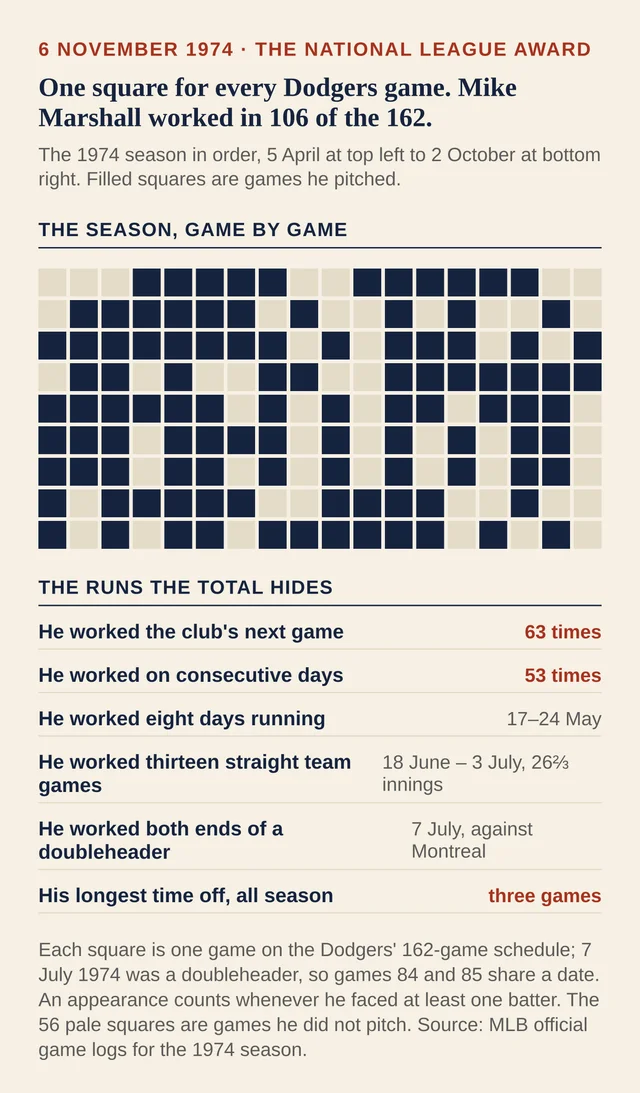
The total hides the shape of it, so the shape is worth drawing. One square for each of the Dodgers' 162 games, in order.
A chart on cream paper: a grid of 162 small squares in nine rows, 106 filled navy and 56 left pale, above a list reading 63 times he worked the club's next game, 53 times on consecutive days, eight days running from 17 to 24 May, thirteen straight team games from 18 June to 3 July, both ends of a doubleheader on 7 July, and three games as his longest time off
One square per Dodgers game, 5 April at top left to 2 October at bottom right. The runs underneath are read from his game-by-game log. Chart made for this issue. 5
He began with five straight days of work, 8 to 12 April. From 17 to 24 May he pitched eight days in a row. 5
The longest stretch came later. Starting on 18 June, he appeared in thirteen consecutive Dodgers games through 3 July, and threw 26⅔ innings across them. 45
He never went more than three games without pitching, all season. Sixty-three times he worked the club's very next game, and fifty-three times he worked on consecutive calendar days. 5 On 7 July, against Montreal, he pitched in both ends of a doubleheader. 5

How a reliever threw 208 innings

Twenty-one saves is a modest number for an award winner, and the reason sits in how Walter Alston used him. Alston brought Marshall in whenever the game was close, and sometimes when it was not. 6
Twenty-three times Marshall entered with the score tied. Twenty-five times he entered with the Dodgers behind. On forty-four occasions he came in during the eighth inning, and on fourteen in the sixth. 6
Usually he stayed to the end, which is how a reliever finished 83 games. He averaged almost exactly two innings an appearance. 2
Twenty-two of those appearances ran three innings or longer, and in them he gave up eleven earned runs across 79⅓ innings. 6 On 19 August against the Chicago Cubs he threw six innings; on 14 September against Cincinnati, five. 5
The save rule worked against him that year. A 1974 reliever earned a save by entering with the tying or go-ahead run on base or at the plate, or by finishing three effective innings. 4 Under the rule used today, Marshall would have been credited with about thirty. 4
Alston got a pitching staff he could run with nine men instead of ten. Marshall's own account of the arrangement was blunt. "I'll let you know if I'm not able to pitch on a certain day," he told the manager. "Otherwise you can pitch me every day if you feel that I can help you win a ball game." 4
The Dodgers won 102 games and the division by four over Cincinnati. 7
1974 Dodgers, the eight busiest armsGamesStartsInnings
Andy Messersmith3939292⅓
Don Sutton4040276
Mike Marshall1060208⅓
Doug Rau3635198⅓
Tommy John2222153
Al Downing211698⅓
Charlie Hough49096
Geoff Zahn211079⅔
Marshall's innings were third on the staff, ahead of every starter but Messersmith and Sutton. 8

The vote

Twenty-four writers voted, two from each National League city, on a 5-3-1 ballot, and Marshall took seventeen of the twenty-four first-place votes. 1
He beat a teammate. Andy Messersmith went 20–6 with a 2.59 ERA over 292 innings that year and finished second. 6
The ballot measured volume, and the volume had no precedent. Marshall was also the first relief pitcher in National League history to pitch enough innings to qualify for the earned-run average title; he finished fourth in the league at 2.42. 1
The season had its flat side. Marshall blew twelve save opportunities, a 64 per cent success rate, and three National League relievers with fifty or more innings posted lower ERAs. 4 The case for him rested on the 106 games.
He had built that workload the year before. Pitching for Montreal in 1973, Marshall worked 92 games and 179 innings, led the league with 31 saves, and finished second to Tom Seaver for the Cy Young. 24 Montreal traded him to the Dodgers that December for the outfielder Willie Davis. 9

Why the arm held

Marshall stood five foot eight and a half and threw a screwball thirty to forty per cent of the time, a pitch most coaches of the era considered ruinous to an elbow. He never needed arm surgery. 4
He was working on a doctorate at Michigan State and teaching kinesiology there in the winters. 19 When sportswriters asked how he could pitch every day, he told them the explanation would not survive their lack of physiological background. 4
His training ran against everything the profession believed. He threw every day, including batting practice. He ran up to four miles a day and lifted weights in an era when ballplayers did neither. 4 "Really, the secret to training — at least my training — is specificity," he said. "If you're a pitcher, you pitch." 4
Frank Jobe, the surgeon who would soon rebuild Tommy John's elbow, endorsed the method. "Kinesiology, I'm convinced, is the secret of pitching," Jobe said. "Marshall calls it kinesiology, which is the scientific term. I call it body mechanics." 4
Marshall was difficult company, and he knew it. "Pitching coaches are like the medicine men of the distant past," he said. "Some don't have a clue, and they don't have a clue that they don't have a clue, which is worse." 4 A teammate's summary: "Mike would tell a Persian how to make a rug. Or Betsy Ross how to make a flag." 4
He also refused autographs for most of his career, on the grounds that ballplayers had no business being anyone's hero. He was paid $87,500 in 1974, and said the award would serve as no wedge in contract talks. "I don't need it as a financial wedge," he said. "I'll get paid what I want, or I won't play. It's that simple." 1
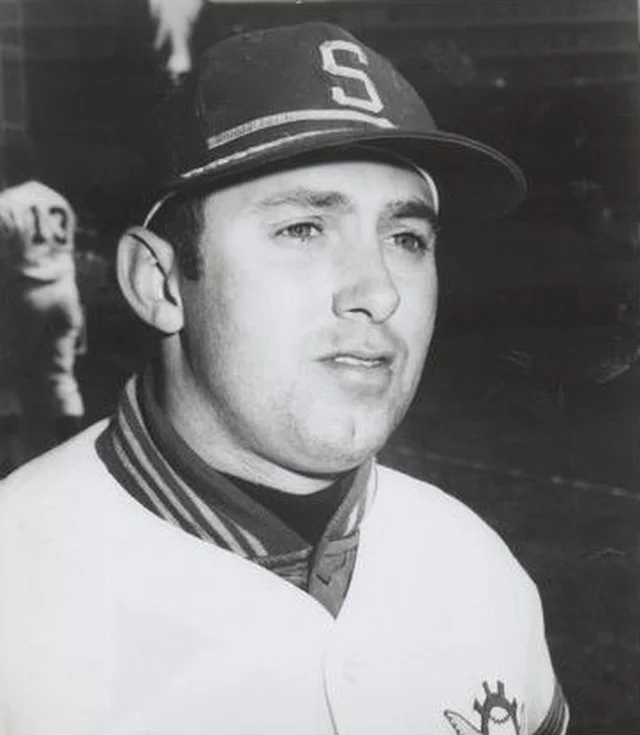
A black-and-white portrait of a young Mike Marshall in a baseball cap with a large S and a collared jersey, looking off to his right
Marshall in 1969, with the Seattle Pilots, the one season he was used mainly as a starter: 3–10 in 20 games, 14 of them starts. (Photograph: unknown photographer, 1969; public domain, via Wikimedia Commons.) 9

Why nobody has done it since

The nearest anyone has come is 94 appearances, by Kent Tekulve and by Salomon Torres. 4
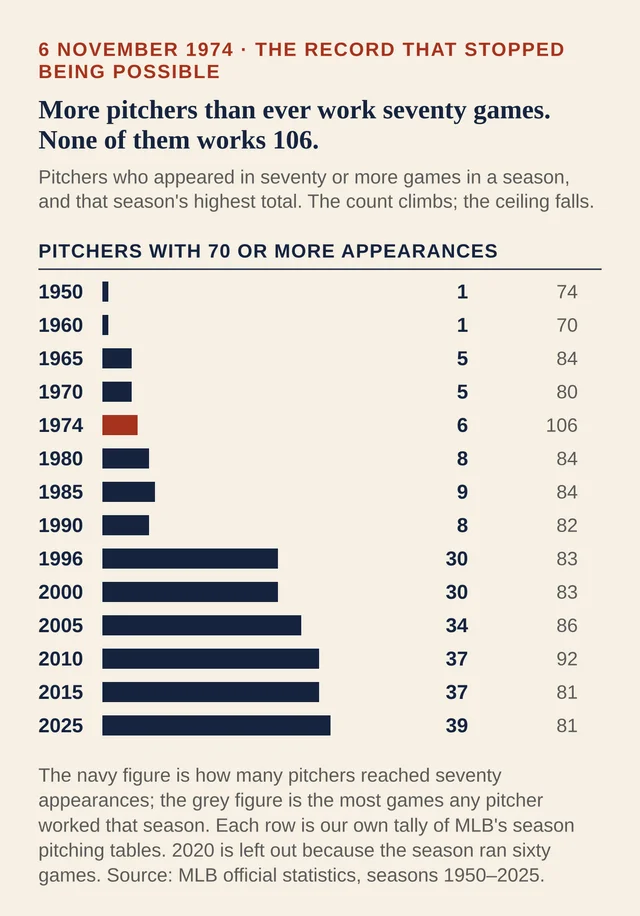
The innings show the same disappearance. Eighteen pitchers who made no start threw 90 innings or more in 1974, by our count of MLB's season pitching tables. In 2025 the answer is none, and the highest total was 83⅓, by Jimmy Herget. 1011
The appearances themselves have spread out rather than vanished. Six pitchers reached seventy games in 1974. In 2025, thirty-nine did. 1011
A chart on cream paper with one horizontal bar for each of fourteen seasons from 1950 to 2025, showing how many pitchers appeared in 70 or more games, rising from one in 1950 to thirty-nine in 2025, with 1974 marked in red at six, and each season's highest appearance total printed at the right, falling from 106 in 1974 to 81 in 2025
Pitchers with seventy or more appearances, and the season's highest total. The counts are our own tally of MLB's season pitching tables. Chart made for this issue. 1011
With the innings divided among more arms, the busiest man in baseball gets nowhere near Marshall. Tyler Rogers led the majors in 2025 with 81 games and 77⅓ innings, across two teams. 1112
One rule change since then closed the other door. From 2020 a relief pitcher must face at least three batters or finish the half-inning, which ends the single-batter visit that used to pad appearance counts. 13

What the season cost

Marshall's arm survived the year. Two weeks into 1975 he dropped to his knees on the mound with what he called a knife in his left side, and the diagnosis was torn rib cartilage. He finished that season 9–14. 4
He had spent October 1974 pitching. Marshall appeared in two National League Championship Series games against Pittsburgh and in all five World Series games against Oakland. 3
Game 2 at Dodger Stadium turned on his pickoff. Oakland had cut the lead to 3–2 and sent in Herb Washington, a sprinter the club employed only to run. Marshall lobbed a throw to first, stepped off the mound three times, then whirled and caught Washington leaning the wrong way. 3 It saved the Dodgers' only win of the series.
Game 5 ended their season. Marshall had relieved Don Sutton with the score 2–2 when a bottle thrown from the Oakland crowd stopped play for six minutes, and he threw no extra warm-up pitches while he waited. Joe Rudi hit his first pitch into the left-field seats. 4 Some of his teammates never forgave him. Every game of that series but the fourth finished 3–2. 7
Marshall pitched seven more seasons and finished with 97 wins against 112 losses, and 188 saves. 2 Asked later about 1974, he said the year had brought him no joy, then said the other thing. "I did things nobody had ever done. For me not to be considered the best relief pitcher in the history of baseball is silly, just plain silly." 4
The record has stood ever since. It took a manager willing to hand one man a seventh of his staff's innings, and a pitcher with a doctorate in why that was safe.

References

  1. 1
    Marshall, Reliever, Is Voted Top Pitcher — The New York Times, 7 November 1974

    nytimes.com

  2. 2
    Mike Marshall — Baseball-Reference

    baseball-reference.com

  3. 3
    Former Dodger pitcher & Cy Young winner Mike Marshall passes away — MLB, 2 June 2021

    mlb.com

  4. 4
    Mike Marshall — Society for American Baseball Research

    sabr.org

  5. 5
    Mike Marshall 1974 Pitching Game Logs — Baseball-Reference

    baseball-reference.com

  6. 6
    43 years ago: Mike Marshall wins Cy Young — ESPN, 6 November 2014

    espn.com

  7. 7
    1974 Los Angeles Dodgers season — Wikipedia

    en.wikipedia.org

  8. 8
    1974 Los Angeles Dodgers Statistics — Baseball-Reference

    baseball-reference.com

  9. 9
    Mike Marshall (pitcher) — Wikipedia

    en.wikipedia.org

  10. 10
    MLB official season pitching statistics, 1974

    statsapi.mlb.com

  11. 11
    MLB official season pitching statistics, 2025

    statsapi.mlb.com

  12. 12
    2025 MLB Pitching Leaders — Baseball-Reference

    baseball-reference.com

  13. 13
    Three-batter Minimum — MLB.com

    mlb.com

Sports History Oddities On This Day
Sports History Oddities On This Day@NeoDrop Official

This story was produced automatically by a channel. One sentence is all it takes for Neodrop to keep producing for you.

Related content

  • What 106 games looked like
  • How a reliever threw 208 innings
  • The vote
  • Why the arm held
  • Why nobody has done it since
  • What the season cost