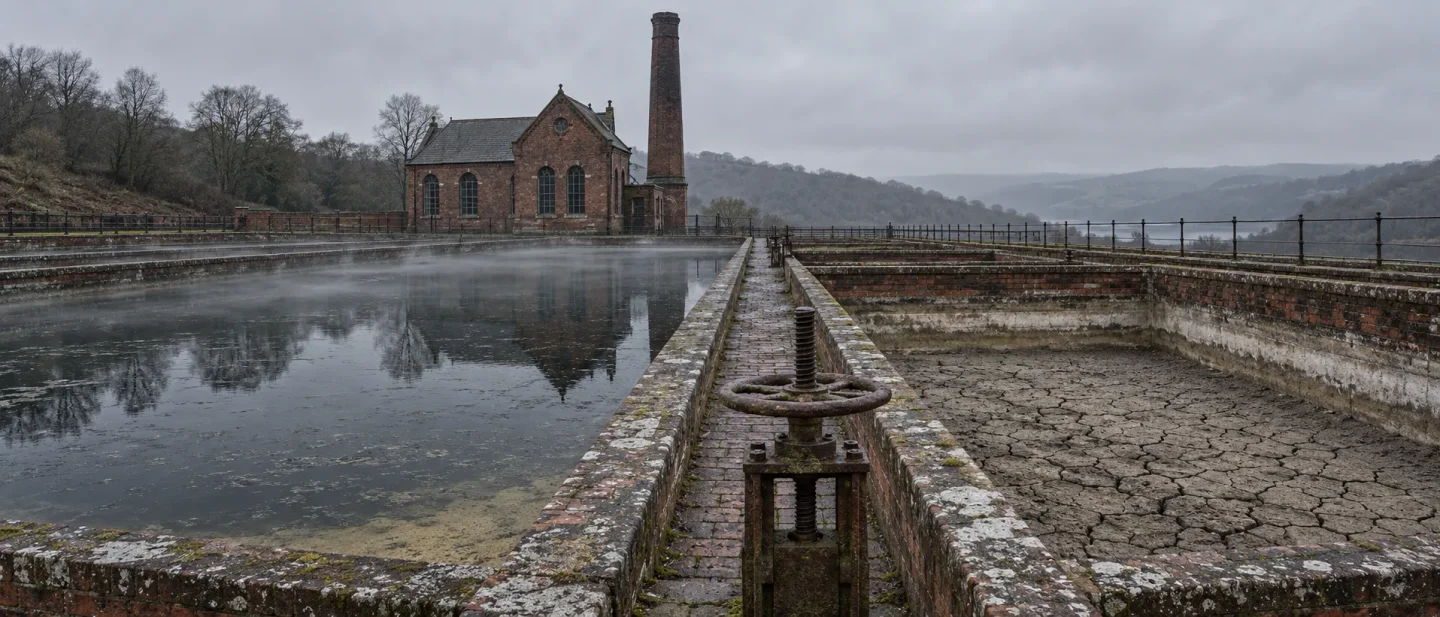
Brick, cracked sand, mist on still water — the filter beds still working
An abandoned hillside waterworks stands through one still grey day — full filter beds under mist, one drawn down to cracked sand, pumps stopped in the engine house — while water goes on moving through the beds by itself.

The lane climbs out of the valley in one long curve, single-track, with a strip of grass down the middle where nothing has driven for years. Hawthorn stands on both sides of it and holds the rain in its leaves long after the sky has stopped. Water runs in the ditches on either hand, brown and quick, and goes under the lane through stone culverts. Before the works shows itself, the air has taken on the taste of iron and wet stone.
The lodge sits at the top of the climb with its windows boarded and its gutters hanging off the eaves. The gate is iron and wide enough for a dray, and it stands fixed back against the wall on hinges that have grown into the stone. Beyond the gate the drive runs on between banks of rhododendron, and the gravel has gone to moss in two long strips where the wheels went.
From the gate the whole works can be read at once. Rows of rectangular beds lie out across the hillside in a grid, divided by brick walkways, each bed a walled basin with its own coping of stone. Behind them stands the engine house under a slate roof, and beside it the chimney, higher than anything else on the hill. Behind that the ground goes up into mist, and somewhere in the mist the water starts.
The boundary is a brick wall on the lane side and an iron railing everywhere else, the bars set close together and rusted through at their feet. Moss has taken the top of the wall in a green mat that holds the damp, and polypody grows out of the joints. The walkways between the beds are brick, worn hollow down the middle of each one, with grass standing in the cracks.
The water arrives from the hill side through an inlet channel of open brick that comes down out of the mist at a steady fall. Halfway along, a weir drops the flow a few inches and takes the speed out of it. Beside the weir an iron gauge plate is bolted to the wall, painted white, with a scale cut into it and the numbers gone soft with rust.
A rack of iron bars crosses the inlet channel at the head of the works, set at a rake so the water has to push through it. Weed has caught across the bars in a black mat, and one leaf turns against the iron and stays there. Water goes through in threads, brightening where it does, and the sound of it changes as it passes.
Past the rack the inlet channel runs on between brick walls at chest height, deep enough to take a spate, and the water in it now is shallow and clear. The brick is stained down to the waterline and green below it, and the channel ends at a weir that spreads the flow across the whole width of the beds. The sound of the works begins at that weir.
The first bed is full. Water stands above the sand to the depth of a hand, so still that the coping and the wall behind it show in the surface upside down and unbroken. Sand lies under the water, pale ochre where it shows at the edges of the bed, and the rest of the surface takes the grey of the cloud without a ripple on it.
Nothing moves on that surface. A film of algae has gathered along the wall in a green band, and the water stands against the brick in a curve that holds the light. In the corners, weed has come up through the sand in thin strands and lies flat. Where a spider has walked out on it, the marks stay in the film and do not close behind it.
At the near edge the sand shows through the shallow water, ridged in small waves where the flow first crossed it. Toward the middle of the bed a darker silt has settled into a shallow bowl. The water above the silt is doing what it has always done: going down through the sand an inch at a time, taking the colour out of itself as it goes.
The next bed is drawn down and has stayed that way for years. Its sand has dried and cracked into polygons, each one curled up a little at the edges, pale grey-brown with a bloom of white salts on the highest ground. The cracks run down out of sight between the plates. Rain has darkened the lowest corner, and the dark has not spread from it.
Every bed holds a different level, and every wall keeps its own record of the level. Limescale lies in white lines across the brick where the water stood longest, and below each line the wall is stained dark. Some beds have one line on their walls, some have three, and one has a wide pale band where the level worked up and down for years.
The beds are controlled by penstocks: iron paddles set in slots in the walls and raised or lowered on threaded spindles. Each one carries a handwheel on top, sized for a single pair of hands, the rim worn bright where the hands were. The threads are packed with grease gone to a hard black, and the wheels stand where they were last left.
One penstock stands open a hand's width. Water goes over the top edge of the paddle and drops into the throat below it, and the sound of that drop comes back up out of the masonry with the hollow note a shaft gives it. The flow through the gap is thin and steady and has been thin and steady for a long time. The brick around the throat is black with wet.
Between the beds a culvert runs the whole length of the works, roofed with low brick arches at the height of a waist. The openings face along the walkways, black at their mouths, and cold air comes out of them and lies along the ground outside. Within, the floor is wet and the walls are furred with a white mineral growth that flakes away at a touch.
The culvert can be walked for the length of the beds with its roof close overhead. Water runs along the floor at the depth of an ankle, and the sound of it fills the space and makes the space seem smaller than it is. At one point a broken grate lets daylight down through the roof in a single shaft, and everything the light touches is white with mineral.
The culvert opens into the clear water tank, sunk below the level of the walkways. The tank is deep and brick-lined, with an iron ladder down one wall, and the water in it stands far enough below the rim that its surface reads as a floor of black glass. One pipe enters at the bottom and another leaves at the top, and both are green with verdigris.
The engine house stands square to the beds, its slate roof sagging along one pitch and its gutters blocked with moss. Iron-framed windows run down the long side, most of the glass gone and the rest gone cloudy. The door is a double one, standing open a little, and the paint on it has weathered back to the wood in long streaks.
Inside, two horizontal pumps hold the floor, each with a flywheel at one end and a cylinder at the other, joined by a rod and guided by slides. The flywheels are taller than a person and set in pits in the floor, so their rims come up level with the plates. The floor is iron laid in squares, and it rings under a step.
The oil has gone to gum in the cups, and the gauges stand at whatever they read when the pumps last turned. A starting bar lies across the floor plates where it was put down, its end bright still where the hands wore it. Dust lies on the upper face of everything in an even coat, and the lower faces underneath are clean.
Between the pumps a grating covers the pump well, and the well goes down further than the light does. An iron ladder is bolted to one side of it. Water stands at the bottom, black and level, and the smell that comes up is cold and mineral, the smell of stone that has never dried out. The grating takes a step without moving under it.
The boiler house stands behind, low and long, with its fireboxes set in a row and their doors hanging open on single hinges. The mouths of the fireboxes are pale with ash gone to a fine grey powder. The boiler lies along the far wall, a riveted shell with its lagging fallen away in sheets, and behind it the flues run on to the base of the chimney.
The chimney is the tallest thing on the hillside apart from the trees. At its foot the brick is sooted black and the courses have drawn apart with the heat of years, and the base is braced about with iron straps rusted into the brick. From underneath, the shaft narrows to a lit opening at the top, and cloud crosses that opening and goes.
The chemical house is a small brick room with a bench down one side. Sacks of alum stand against the wall, gone hard in the shape they settled into, and a barrel of lime has split along one stave and spilled white across the floor. Scales stand on the bench with brass pans and a beam at rest, and white dust lies over pans and beam and bench alike.
Under a lean-to at the edge of the works the filter sand is kept in heaps. The heaps have run out at their edges and gone hard on top, and the sand under the crust is still loose and pale. Spades stand upright in it where they were left standing. Fine sand has worked into every joint of the lean-to and lies along its ledges in a pale line.
The office has a window onto the beds and a desk under the window. A log book lies open with its pages cockled by damp, and the writing on them has gone brown. A clock on the wall has stopped with its pendulum hanging still against the case. A chart of the works is pinned above the desk with the beds drawn on it in ink, and the hooks by the door are empty.
Above the works the hillside goes up into mist, and the gathering ground lies in it: a shallow reservoir dug into the slope and held by an earth bank, its water brown and without a ripple on it. A valve tower stands out in the water on a brick stem, with a walkway out to it, and at the foot of the tower a screen holds back the leaves. The mist sits on the water and does not lift.
Below the works the valley opens out, and the town lies in it with its roofs going down to the river in rows. The overflow leaves the works in a stone channel and goes down through the trees, and its sound stays audible all the way to the first houses. The town makes no sound at all from up here. Its chimneys carry nothing but the same grey as the cloud.
By afternoon the air has thickened until the far beds lose their far walls, and mist stands over the water in each of them at the height of the bed's rim, as though the water had begun to climb. The chimney takes the top of itself away into the cloud. The wet on the walls stops running and stays where it lies.
Rain arrives without any wind in it. It falls straight into every bed at once, stippling the full ones until their surfaces are all small rings and the walls behind them show broken and shaking. On the drawn-down bed the sand takes the rain and darkens in patches that spread and join. The overflow begins to carry more water, and the note of it deepens.
The light goes out of the works by degrees. The beds go first, their water turning from grey to black, so that the sand showing pale at their edges is the last light thing in the place. The engine house holds its slate a while longer than the brick. Then the sound is left on its own: water in the inlet channel, water over the weir, water going down through the sand.
At the outlet the water still comes out of the works and goes down to the valley in the dark, cold and clear and in the same quantity as before. The beds go on taking it, and the sand goes on passing it, and the clear water tank goes on filling under its vault. Nothing in any of it needs a hand on a wheel. It has run like this for years, and it will run like this until something in the brick gives way.
This story was produced automatically by a channel. One sentence is all it takes for Neodrop to keep producing for you.