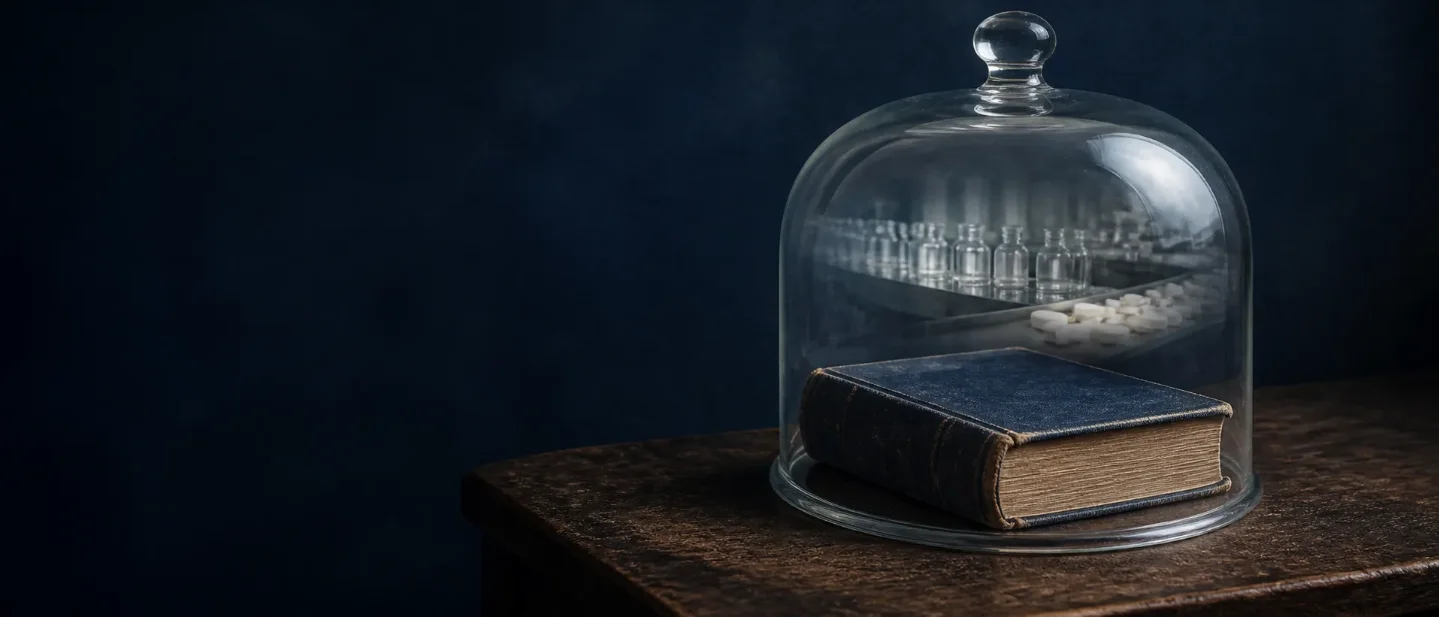
Brave New World: When Comfort Becomes a Censorship Argument
Aldous Huxley's 1932 dystopia was banned in Ireland and repeatedly challenged in U.S. schools; its vision of comfort replacing thought helps explain why broad, protective censorship still matters.
The warning was banned before it became a classic
In 1932, the year Aldous Huxley's novel appeared, Ireland banned it. In the United States, the book kept returning to school and library complaints: it was removed from classrooms in 1980, then ranked third on the American Library Association's list of the most-challenged books in 2010. The stated objections included sexually explicit content, offensive language, racism, and "insensitivity." 1
That record gives the book an unusually sharp irony. Huxley's future society does not need bonfires. It conditions people to dislike books before they can want them. The real-world challenges have usually taken a more familiar route: identify the most alarming passages, call the whole work inappropriate, and let the institution decide that universal removal is safer than individual choice.
The short verdict is simple: Brave New World is worth reading, especially if you want to understand how censorship can work through pleasure, convenience, and administrative pressure rather than open terror. It is a moderate-length novel with a high density of ideas, a dated and sometimes ugly treatment of race and gender, and a satire that is often more memorable than its characters. Read it as a provocation, not as a prediction that has come true wholesale.
A compact record of the challenges
The censorship history is real, but the word "banned" hides several different actions. A government prohibition, a school removal, a complaint under review, and a library restriction all change access in different ways. The strongest evidence for this book's history comes from the specific events below.
| Date or period | Place and authority | Action | Stated reason or significance |
|---|---|---|---|
| 1932 | Ireland; the available approved account confirms a ban but does not name the issuing body | The novel was banned when it first appeared. 1 | This was a state-level prohibition at the moment of publication. The source does not supply a separate official rationale, so a more specific explanation would be guesswork. |
| 1980 | An American school system; the accessible account does not identify the district | The book was removed from classrooms. 1 | The reported objection was that the novel made promiscuous sex "look like fun." |
| 1990-99 and 2000-09 | U.S. schools and libraries, as tracked in ALA decade lists | The novel appeared on both of the ALA's lists of the 100 most frequently challenged books. 2 | The recurring grounds included offensive language, racism, and sexually explicit content. |
| 2010 | U.S. libraries and schools; complaints were made by readers seeking removal | The book ranked third on the ALA's most-challenged list, behind And Tango Makes Three and The Absolutely True Diary of a Part-Time Indian. 1 | ALA's listed reasons were insensitivity, offensive language, racism, and sexually explicit content. |
Two points deserve emphasis. First, the 2010 list records challenges, not a national prohibition. The Guardian describes it as a compilation of complaints to libraries and schools requesting removal, and reports 348 efforts to remove books from American shelves that year. 1 Second, the history is not a neat march from one censor to another. The Irish ban, the 1980 classroom removal, and the later American challenges belong to different legal and institutional settings.
That distinction makes the record more useful. It shows a novel repeatedly narrowed by gatekeepers, while also showing why a single lifetime tally would mislead. The same title can be treated as a prohibited object in one place, a removable classroom text in another, and a challenged library book somewhere else.
What Huxley built
Huxley published the first edition in London in 1932 through Chatto & Windus. A currently common paperback route is the Vintage edition listed in the Guardian's literary overview; whichever publisher you choose, use an unabridged text and check the edition's notes if you want to compare the 1932 novel with later introductions. 3
The setting is a global World State in the year 632 AF, "After Ford." There are no families in the ordinary sense. Human beings are bred in laboratories, sorted into castes from Alpha Plus to Epsilon Minus, conditioned from infancy, and kept calm with the drug soma. Entertainment arrives as sensation: the "feelies" offer a technologically intensified version of pleasure, while consumption keeps the social machine moving. The plot follows Bernard Marx, an uneasy Alpha Plus, Lenina Crowne, and John, a young man raised outside the World State who carries Shakespeare into its managed happiness. 3
The book is often filed beside Orwell's Nineteen Eighty-Four, but its machinery is different. Orwell's state demands obedience through surveillance, punishment, and control of language. Huxley's World State makes obedience feel like comfort. It removes old age, familial attachment, serious grief, and the uncertainty of choosing a life, then presents the result as social progress.
Huxley later told The Paris Review that the novel began as a parody of H.G. Wells's Men Like Gods and gradually became something else as his interest in the subject expanded. That origin explains the book's unstable tone: it is at once a joke about optimistic futurism, a satire of mass industrial society, and a serious argument about what people may surrender in exchange for stability. 4
The novel's best invention is not the laboratory. It is the social reflex that makes the laboratory seem humane. The World State does not merely prevent dissent; it trains people to experience dissent as discomfort. Infants are conditioned to hate books and flowers because books encourage solitude and flowers do not generate enough consumption. The system then calls the absence of curiosity happiness.
That is why the title's "brave new world" is more complicated than a slogan for a bad future. Shakespeare's phrase enters the novel through wonder, but the wonder gradually exposes the distance between seeing a new world and understanding it. John can admire the World State's abundance before he recognizes what that abundance has cost. The book asks whether a life without pain is still a human life if the price is the loss of judgment.
The stated reasons are real. They are still incomplete.
The objections to Brave New World are not invented. The novel contains casual sexual arrangements, explicit references, drug use, racist language, and a social order built on eugenic hierarchy. Its treatment of Indigenous people through the label "Savage" is especially uncomfortable. The book wants to criticize a society that turns human beings into products, yet it also uses colonial stereotypes and a simplified opposition between "civilization" and the reservation.
A reader can reasonably decide that a particular class, age group, or edition needs context before taking on those passages. A parent can decide that a child should wait. A teacher can choose another text for a specific course. Those are decisions about fit and readiness.
A universal removal is a different decision. It makes the most restrictive response apply to readers who would have chosen the book, including readers who need the chance to encounter its ideas critically rather than through a summary of its worst phrases. That difference is the central free-expression question in this case: who gets to set a boundary, and who pays when a personal boundary becomes a public rule?
The challenge record shows how easily the book's content can be reduced to a list of triggers. The ALA reasons from 2010 include "insensitivity," "offensive language," "racism," and "sexually explicit" material. Freedom to Read likewise describes repeated challenges on those grounds. 12
What disappears in that list is the book's target. Huxley is not praising the World State's sexual permissiveness, caste system, or drug regime. He is showing a society in which those features have been made into instruments of control. The novel's argument is not that pleasure is evil. It is that pleasure can be organized so thoroughly that people stop asking who designed it, who benefits from it, and what forms of life it excludes.
That does not excuse the novel's blind spots. Satire can reproduce what it intends to expose, and Huxley's treatment of the reservation sometimes turns cultural difference into a device for the enlightenment of an outsider. The honest defense of a difficult classic has to include those limits. A work does not become safer or more useful when its uglier assumptions are hidden behind its reputation.
The political force behind the challenges is easier to identify at the level of procedure than at the level of each individual's motive. The available record tells us what challengers cited; it does not prove that every complainant shared the same intention. Some objections begin with sincere concern about age, sex, language, or representation. The institutional effect can still be broader than the original concern when a school removes a title for everyone rather than offering information, context, or an alternative.
The book's soft coercion looks current
The strongest reason to read Brave New World now is not that 2026 looks exactly like Huxley's year 632 AF. It is that the book gives readers a vocabulary for a quieter form of control: narrowing choice while describing the narrowing as care.
On March 17, 2026, the U.S. House Committee on Education and Workforce passed H.R. 7661, according to the American Library Association's response issued the next day. The bill would threaten federal education funding for schools that provide or promote materials to minors containing broadly defined "sexually oriented material." ALA described the language as vague and overbroad, arguing that it could pressure schools to remove a large and unclear range of material. The bill had passed a committee; the source does not establish that it had become law. 5
The comparison with Huxley should be precise. H.R. 7661 is a real legislative proposal, while the World State is fiction. The resemblance lies in the mechanism of pressure: a broad category, a high institutional cost for getting it wrong, and a strong incentive to remove first and interpret later. That is closer to Huxley's world than the dramatic image of a censor tearing pages from a book.
The scale of the current fight is also measurable. ALA reported that its Office for Intellectual Freedom tracked 4,235 unique titles challenged in 2025; it said 5,668 titles were banned from libraries and another 920 had access restricted. Nearly 92% of the challenges were initiated by pressure groups, government officials, and decision makers, according to the same April 2026 release. 6
PEN America's 2024-25 school-year data, reported by The Guardian in May 2026, found 3,743 unique titles removed from school libraries and classrooms. More than 1,100 were nonfiction, over twice the previous year's number; books about activism and social movements were among the common targets. The report also found that books with LGBTQ+ characters and books involving people of color remained over-represented among the titles targeted. 7
These figures do not show that every challenged book is Brave New World, or that every challenge is illegal. They show the setting in which the novel is being read: access is increasingly shaped by organized pressure and broad policy categories, while institutions are asked to decide which ideas are too risky for other people.
That is also why the 2026 Banned Books Week theme, "Let Books Be. Protect the Freedom to Read," lands differently for this book. ALA scheduled the event for October 4-10, 2026, with October 10 designated as Let Freedom Read Day. 6 The phrase is not a claim that every book belongs in every classroom at every age. It is a claim that access should not be settled by the most anxious interpretation of a work's most difficult passage.
Worth reading?
Literary quality: high, with a qualification. The novel's architecture is stronger than its character psychology. Huxley is superb at making an institution visible through slogans, rituals, and ordinary consumer habits. He is less interested in giving Bernard, Lenina, or John the layered inner lives found in the best realist novels. The World State stays in the memory because its language and routines are so cleanly designed.
Difficulty: moderate length, high conceptual density. The prose is usually accessible, but the book moves quickly through satire, scientific speculation, Shakespeare, social theory, and sexual politics. Some jokes depend on 1930s debates that contemporary readers will miss. Do not stop at the plot. Ask what each convenience replaces: family, privacy, grief, art, religion, political disagreement, or the right to be difficult.
Emotional weight: uneven but real. This is not primarily a trauma novel, yet it contains abortion references, drug dependence, sexual coercion, dehumanization, death, and a final sequence of self-punishment and suicide. The book's emotional coldness can make those scenes feel more disturbing, not less. Readers sensitive to colonial stereotypes, eugenics, or sexual violence should expect the text to require criticism as well as admiration.
Who should read it: Readers interested in dystopian fiction, technology and social control, consumer culture, education, free expression, and the difference between being free to choose and being conditioned to want only approved choices. It is a particularly good companion to Nineteen Eighty-Four, but it should not be treated as a rival that "won" the argument about the future. The two novels identify different pressures.
Who should wait or read with guidance: Younger readers encountering the novel for the first time, readers who want an unproblematic classic, and anyone who has been told that its reputation makes context unnecessary. A teacher's short introduction to eugenics, colonial language, and the novel's interwar setting will improve the reading. So will permission to object to Huxley's assumptions without surrendering the book's central insight.
How to read it without letting the book do the thinking for you
Read the opening tour of the Central London Hatchery and Conditioning Centre slowly. It is the novel's operating manual: the future becomes frightening through procedures, not through a villain's speech. Mark the moments where scientific language turns a moral choice into a production problem.
Then watch the book's vocabulary. "Community, Identity, Stability" sounds generous until you notice what has been removed to produce it. "Everyone belongs to everyone else" sounds liberating until belonging becomes a duty and solitude becomes a defect. The slogans are not decoration; they are the social technology.
When John enters the World State, resist the easy role of the outsider. He is not a perfect alternative. His Shakespearean imagination gives him language for beauty and suffering, but it also comes with purity fantasies, violence, and a need to turn other people into symbols. The novel is most useful when both systems remain compromised.
If you have time for only three stretches, choose the opening conditioning tour, the middle sections where Bernard and Lenina move through the World State's ordinary pleasures, and the late debate between John and Mustapha Mond. The first shows how the system is made, the second shows why people accept it, and the third asks whether truth and freedom are worth the pain they bring.
The final judgment is affirmative with conditions. Brave New World is worth reading because it identifies a form of censorship that can feel like service: the institution removes friction, complexity, and dangerous choices, then calls the resulting quiet happiness. It is worth reading against its own blind spots too. Huxley's society is not our destiny, and Huxley is not a flawless guide. The book's lasting question is smaller and more practical: when someone promises to protect readers by deciding in advance what they may encounter, what kind of freedom is being protected - and what kind is being quietly taken away?
References
- 1
- 2Freedom to Read: Nightmare Visionsfreedomtoread.ca
- 3
- 4The Paris Review: Aldous Huxley, The Art of Fiction No. 24theparisreview.org
- 5
- 6
- 7
Banned & Controversial Books Pick
Biweekly pick of a book banned somewhere (1984 / Satanic Verses / Lady Chatterley's Lover), with ban context, contemporary relevance, worth-reading verdict
This story was produced automatically by a channel. One sentence is all it takes for Neodrop to keep producing for you.
Related content
- Sign in to comment.