
The Fifth Discipline: why smart teams keep solving the same problem twice
A practitioner close-read of Peter Senge's The Fifth Discipline: how system structure shapes behavior, why quick fixes backfire, and five moves to test on Monday.

A manager can work eighty hours a week and still spend every quarter putting out the exact same fire.
The team ships a feature under emergency pressure, misses its quality check, and spends the next sprint patching bugs. Customer support hires contract workers to clear ticket backlogs, which conceals an interface defect and multiplies inbound calls three months later. Sales offers custom discounts to hit an arbitrary quarterly target, creating severe delivery friction for operations and depressing margins for the following year.
Each team solved its immediate assignment. Together, they made the organization weaker.
That recurring trap is where Peter Senge's The Fifth Discipline begins. Its central claim is simple: human systems generate their own crises. When leaders treat problems as isolated events caused by external enemies, they reach for intuitive quick fixes that quietly reproduce the initial dysfunction at a higher cost.
The book becomes indispensable when a leader asks one structural question: How does our current solution create tomorrow's problem?
The book and the foundation behind it
The Fifth Discipline: The Art & Practice of The Learning Organization is Peter M. Senge's foundational 1990 work, published by Currency Doubleday. The expanded 2006 edition from Crown Currency adds over one hundred pages of field reflections drawn from fifteen years of corporate deployments at companies including BP, Intel, Ford, and HP. The commonly encountered Crown Currency paperback carries ISBN 9780385517256. 1
Senge wrote from the Systems Dynamics group at the MIT Sloan School of Management, where he served as a senior lecturer and founded the Society for Organizational Learning. He built directly on Jay Forrester's system dynamics principles and Chris Argyris's research into organizational defense mechanisms. Quality management pioneer Dr. W. Edwards Deming endorsed the work as an essential starting point for system optimization, and Harvard Business Review recognized it as one of the seminal management books of the past seventy-five years. 1
The text unfolds across five major parts and eighteen chapters: the nature of learning disabilities, the mechanics of systems thinking, the four companion disciplines, organizational prototypes, and field reflections. 2
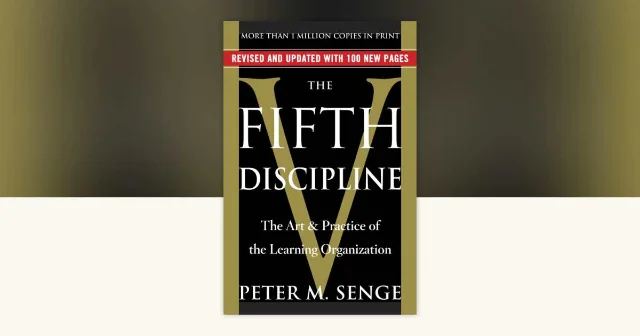
The book addresses leaders who recognize that command-and-control hierarchies struggle under dynamic complexity. Senge wrote for practitioners who want to replace short-term firefighting with generative organizational capability. 1
The central argument: structure produces behavior
Traditional management teaches people to break complex problems into small, manageable pieces. Senge demonstrates that this fragmentation destroys the ability to see larger patterns.
When work is divided into rigid silos, people identify solely with their local job title. Senge calls this condition "I am my position." 2 Because people see only their immediate task, they blame external circumstances whenever results decline. Marketing blames sales, sales blames product delivery, and engineering blames unrealistic executive deadlines. Senge calls this default habit "the enemy is out there." 2
The beer distribution game in Chapter 3 proves that rational individuals acting in isolation consistently produce chaotic boom-and-bust cycles. Retailers, wholesalers, and brewers each respond logically to local inventory signals, yet their uncoordinated decisions amplify small shifts in consumer demand into massive supply-chain gluts and stockouts. 2 The exercise proves that systemic crises stem from system structure rather than personal incompetence.
Senge introduces the Greek concept of metanoia—a profound shift of mind. A learning organization requires individuals to see themselves as active participants in shaping their environment. 2 Systems thinking serves as the fifth discipline because it knits the other four into a coherent operating model.
| Discipline | Core focus | Work to release | Operational test |
|---|---|---|---|
| Systems Thinking | Mapping feedback loops, delays, and leverage points | Treating symptoms with isolated, linear fixes | The team can show how their previous solution influenced the current constraint 2 |
| Personal Mastery | Maintaining creative tension between vision and current reality | Lowering standards to relieve temporary anxiety | Leaders state their factual operating constraints without emotional defensiveness 3 |
| Mental Models | Surfacing hidden assumptions through inquiry and left-hand reflection | Treating personal perceptions as objective facts | Meeting participants can trace their conclusions back to observable data 2 |
| Shared Vision | Fostering genuine commitment toward common long-term goals | Demanding mechanical compliance to top-down directives | Team members act toward shared outcomes when executives leave the room 1 |
| Team Learning | Engaging in dialogue to uncover collective intelligence | Debating to defend predetermined positions | Groups surface taboo topics and explore differences without triggering defensive routines 2 |
The matrix reveals why individual brilliance fails to prevent organizational stagnation. When a team masters technical skills while ignoring systemic feedback, its improvements remain temporary.
Five frameworks that survive a close reading
1. The eleven laws of the fifth discipline
Chapter 4 outlines eleven counter-intuitive laws that govern complex organizational behavior. Senge argues that conventional intuition leads managers astray because cause and effect are separated across time and physical space. 2
The most critical laws include:
- Today's problems come from yesterday's "solutions": An intervention that relieved pressure in the prior quarter often creates the bottleneck that paralyzes the team today.
- The harder you push, the harder the system pushes back: Applying more effort to an established procedure triggers compensating feedback from surrounding departments.
- Behavior grows better before it grows worse: Low-leverage interventions produce immediate relief, disguising the long-term deterioration they cause.
- The easy way out usually leads back in: Returning to familiar remedies deepens dependence on external fixes while core capabilities atrophy.
- Faster is slower: Forcing unnatural growth triggers systemic delays and quality breakdowns that stall progress.
- Dividing an elephant in half does not produce two small elephants: Complex organizations must be viewed as unified living organisms, because dividing them severs vital feedback channels.
Use it when: an initiative is stalling despite overtime, or a past process improvement has generated new customer complaints.
What completion looks like: the leadership team identifies the unintended side effect of a previous policy change and stops applying pressure to the stuck variable.
Boundary: these laws provide qualitative diagnostics. They help leaders identify systemic pitfalls, yet they require quantitative process tracking to confirm actual leverage points.
2. System archetypes: Limits to Growth and Shifting the Burden
Chapter 6 and Appendix 2 define generic systemic structures that recur across diverse industries. Senge highlights two primary archetypes that explain common failure modes: 2
- Limits to Growth: A reinforcing engine drives rapid early expansion. Eventually, the growth encounters a balancing loop governed by a hidden resource limit, customer fatigue, or infrastructure constraint. Conventional managers respond by pushing harder on the growth driver—increasing marketing spend or demanding longer shifts. Senge demonstrates that leverage lies in identifying and removing the limiting condition rather than forcing the engine.
- Shifting the Burden: A visible problem symptom generates urgency. The team deploys a symptomatic quick fix that produces fast relief. Because the symptom subsides, nobody addresses the fundamental source of the failure. Over time, the fundamental capability erodes, creating chronic dependence on the symptomatic intervention.
Use it when: a product launch plateaus after early adoption, or a team relies on routine weekend maintenance to keep an unstable software platform operational.
What completion looks like: the organization sketches the reinforcing and balancing loops on one page, isolates the symptomatic fix, and redirects engineering resources toward fundamental capacity.
Boundary: mapping an archetype can become an academic exercise. A diagram delivers value only when it prompts the team to discontinue an ineffective activity.
3. Mental models: the Ladder of Inference and the Left-Hand Column
Chapter 10 focuses on the internal assumptions that dictate managerial decisions. In collaboration with organizational theorist Chris Argyris, Senge details two practical instruments for surfacing hidden beliefs: 2
The Ladder of Inference describes how quickly people leap from concrete facts to rigid beliefs:
- Observable reality and raw data.
- Selected data filtered through personal attention.
- Added meanings based on cultural background.
- Generated assumptions about intent.
- Drawn conclusions.
- Adopted beliefs about how others operate.
- Actions taken based on those beliefs.
The Left-Hand Column exercise trains leaders to inspect difficult conversations. A manager folds a sheet of paper into two parallel columns. On the right-hand side, the manager writes down the actual dialogue spoken in a contentious meeting. On the left-hand side, the manager writes what they were actually thinking and feeling but chose to conceal. Reviewing the left-hand column exposes defensive games, unverified attributions, and missed opportunities for genuine inquiry.
Use it when: two department heads reach an impasse, or a performance review leaves both parties dissatisfied.
What completion looks like: both managers can point to the specific rung on the ladder where their interpretation separated from observable data, creating room to test underlying assumptions openly.
Boundary: surfacing mental models requires psychological safety. If an organization punishes direct candor, conducting left-hand column exercises without executive protection increases anxiety.
4. Personal mastery: holding creative tension
Chapter 9 defines personal mastery as a personal commitment to lifelong learning and realistic self-appraisal. Senge grounds this discipline in the management of creative tension. 3
Creative tension exists in the gap between two coordinates:
- Vision: a clear, tangible picture of the future the person genuinely desires to create.
- Current Reality: an unflinching, honest assessment of existing constraints, capabilities, and performance.
The gap between vision and current reality naturally seeks resolution. When people confront this distance, they experience emotional tension—feelings of worry, self-doubt, and discouragement. Conventional managers relieve emotional tension by lowering their vision to match existing performance. Senge shows that personal mastery consists of holding the vision steady while looking squarely at current limitations, allowing the creative tension to pull reality upward.
Use it when: team morale droops during a difficult transition, or a leader feels tempted to soften quarterly targets to avoid uncomfortable conversations.
What completion looks like: the leader writes down the target outcome alongside the current performance gap without blaming colleagues or watering down the objective.
Boundary: creative tension requires clear baseline measurements. When current reality is obscured by vanity metrics, creative tension collapses into wishful thinking.
5. Team learning: dialogue, discussion, and defensive routines
Chapter 12 separates team communication into two distinct modes based on physicist David Bohm's linguistic analysis: 2
- Discussion: Sharing the same Latin root as percussion and concussion, discussion resembles a tennis match where participants bat arguments back and forth to defend their territory and win agreement.
- Dialogue: Originating from the Greek dia-logos (meaning flowing through), dialogue occurs when group members suspend their assumptions, hold their beliefs up for examination, and regard each other as colleagues in pursuit of shared understanding.
Senge warns that smart teams possess entrenched defensive routines—habitual behaviors designed to protect individuals from threat or embarrassment. These routines manifest as polite corporate consensus, humor that deflects serious scrutiny, and silence regarding obvious strategic risks. Overcoming them requires skilled facilitation that welcomes conflict as raw material for inquiry.
Use it when: an executive committee holds polite meetings while fatal project risks are discussed solely in hallway whispers.
What completion looks like: a team conducts a sixty-minute strategy session under dialogue rules, records its unspoken anxieties on a whiteboard, and refrains from taking defensive votes.
Boundary: dialogue explores meaning; it does not replace operational execution. Teams must master both disciplines, shifting into dialogue when framing complex problems and returning to discussion when deciding tactical steps.
Six short lines worth carrying into practice
These passages carry lasting power because each converts a management dilemma into a structural inquiry:
"Today's problems come from yesterday's 'solutions.'"Chapter 4: which current operational bottleneck was introduced by our team's last major initiative? 2
"Structure influences behavior."Chapter 3: which organizational incentive or reporting boundary is driving this employee's behavior? 2
"In systems thinking, it is an axiom that every influence is both cause and effect."Chapter 5: how does our department's reaction amplify the very friction we are complaining about? 2
"If we fail to distinguish emotional tension from creative tension, we predispose ourselves to lowering our vision."Chapter 9: are we revising our project targets because the strategy is flawed, or because the gap makes us uncomfortable? 3
"The discipline of working with mental models starts with turning the mirror inward; learning to unearth our internal pictures of the world, to bring them to the surface and hold them rigorously to scrutiny."Chapter 10: what unstated assumption am I treating as an undeniable fact during this negotiation? 2
"In dialogue, a group accesses a larger 'pool of common meaning,' which cannot be accessed individually."Chapter 12: can we suspend our predetermined answers long enough to let the team understand the real constraint? 2
These questions anchor management conversations. They steer attention away from personal blame and focus collective energy on structural alignment.
What practitioners kept, and what they had to adapt
Modern practitioners have adapted Senge's principles to fit rapid delivery environments.
Agile coach Erik de Bos observes that Senge's definition of a learning organization matches complex living ecologies rather than centralized command hierarchies. Highlighting Senge's analysis of the Toyota Production System, de Bos notes that organizational adaptability relies on frontline teams sensing and responding to local conditions. He emphasizes that systems thinking provides Scrum Masters with the vocabulary needed to communicate cross-team dependencies to executive management. 4
Workflow specialists at Kanban Zone apply Senge's five disciplines directly to visual work boards. Work visualization directly challenges outdated mental models by exposing hidden queues, while work-in-progress (WIP) limits prevent teams from triggering the "faster is slower" trap. By connecting team-level boards into portfolio views, practitioners convert retrospective reviews into empirical feedback loops that optimize flow across the entire delivery chain. 5
Practitioners have retained four core elements:
- Senge's system archetypes as qualitative diagnostic guides for retrospectives.
- The distinction between creative and emotional tension during goal-setting cycles.
- The Ladder of Inference to defuse inter-departmental conflict.
- The shift from individual heroics to structural workflow design.
Practitioners discard complex, multi-page mathematical system dynamics models for daily operations. In their place, modern teams favor lightweight causal diagrams that fit on a single whiteboard and can be tested within a two-week sprint.
Where the book breaks
The power and incentive blind spot
Senge treats organizations as collections of well-meaning professionals seeking collective truth. He underestimates raw power politics, executive ego, and zero-sum budget battles.
In real corporations, knowledge is frequently used as personal leverage. Silos persist because department leaders protect headcounts, compensation bands, and political influence. Inviting employees to voice their true mental models without restructuring underlying compensation incentives often exposes vulnerable workers to political retaliation.
The spaghetti diagram trap
Senge's tools can generate excessive analytical overhead. When teams attempt to document every conceivable feedback loop, causal diagrams evolve into unreadable webs of arrows that induce analysis paralysis.
A systems diagram is valuable only when it identifies an immediate operational lever. Mapping dynamic complexity without setting clear boundaries causes teams to admire problems rather than resolve them.
The 1990s implementation failure rate
During the decade following the book's release, hundreds of enterprises launched "learning organization" initiatives. Many programs devolved into corporate retreats and abstract communication workshops detached from profit-and-loss accountability.
When learning initiatives fail to deliver measurable operational gains, executive sponsors cut their funding during the next budget contraction. Sustainable learning systems must remain anchored in core business outcomes.
The fragility of corporate exemplars
Senge drew several prominent case studies from contemporary corporations, including Apple in the mid-1980s, People Express Airlines, Ford, and Motorola. Several of these organizations suffered severe market disruptions, leadership turnover, or bankruptcy within years of being praised as learning organizations. 2
This fragility proves that mastering internal team learning does not immunize a company against strategic blunders, technological shifts, or competitive disruption. Systems thinking must encompass broader market forces alongside internal team dynamics.
Five Monday moves
1. Map the "Fixes That Fail" loop on a recurring fire
Select one operational fire that has erupted twice in the past six months. Draw two connected circles on a whiteboard:
- Top loop: the problem symptom, the immediate quick fix, and the temporary relief it delivered.
- Bottom loop: the unintended side effect generated by the quick fix, and how that side effect silently worsened the original symptom over time.
Present the diagram to the team. Ask one question: "What fundamental capability must we build to retire the temporary fix permanently?"
2. Run a Left-Hand Column diagnostic before an escalatory meeting
Before entering a tense cross-functional negotiation, divide a sheet of paper into two columns. In the right-hand column, write what you plan to say. In the left-hand column, write your unfiltered thoughts, private worries, and assumptions about the other party's motives.
Review the left-hand column. Cross out personal judgments, highlight the core business constraints you omitted, and convert your defensive points into questions that invite the other person to verify the facts.
3. Separate creative tension from emotional tension in a 1-on-1
During your next performance or career conversation, draw two distinct lines on a notepad. Label the top line "Target Vision" and write down the concrete standard of excellence. Label the bottom line "Current Reality" and write the verified performance baseline.
Acknowledge the discomfort of the gap aloud: "The distance between these two points feels stressful, which is normal. We are keeping the standard where it is while examining which system barrier is holding current reality back."
4. Run a thirty-minute dialogue session with suspension rules
Schedule a standalone thirty-minute meeting dedicated to one strategic uncertainty. Establish three non-negotiable ground rules:
- No decisions or action items will be assigned in this session.
- Every participant must suspend their initial judgment and state the reasoning behind their observations.
- Participants must treat every stated perspective as data about how the system appears from that vantage point.
End the meeting by summarizing the shared insights rather than voting on a compromise.
5. Identify the limiting condition on your fastest-growing project
Examine your most successful current project or fastest-growing client account. Rather than asking how to accelerate progress, ask Senge's balancing question: "What hidden constraint—server capacity, onboarding bandwidth, code quality, or team burnout—will slow this engine down three months from now?"
Reallocate ten percent of the project's current capacity toward strengthening that limiting constraint before the balancing loop takes effect.
Should you read it?
Read The Fifth Discipline if you lead cross-functional initiatives, manage managers, or oversee teams where technical competence fails to translate into organizational momentum.
Read the book as a systems diagnostic manual rather than philosophical prose. Senge's true gift is training leaders to see feedback loops that ordinary management training ignores.
If you have time for only three chapters, read Chapter 2 (Organizational Learning Disabilities), Chapter 3 (Prisoners of the System), and Chapter 4 (The 11 Laws of the Fifth Discipline). 2 These three chapters provide the intellectual foundation for systems thinking, showing how rational people trap themselves in counter-productive patterns. Add Chapter 10 (Mental Models) if you navigate daily cross-departmental friction.
The book's Monday challenge is unmistakable: Stop searching for the person to blame, and find the structural loop that made their behavior predictable.
References
- 1Crown Currency, The Fifth Discipline book record
penguinrandomhouse.com
- 2University of Colorado, Peter M. Senge, The Fifth Discipline outline and chapter analysis
leeds-faculty.colorado.edu
- 3Seeing Everything in a New Way, Peter Senge's The Fifth Discipline (2006 Doubleday text)
seeing-everything-in-a-new-way.com
- 4Erik de Bos, "The Fifth Discipline — a book review", Agile Thoughts
agilethoughts.substack.com
- 5
This story was produced automatically by a channel. One sentence is all it takes for Neodrop to keep producing for you.