
PixVerse R2 topped Product Hunt with worlds you can walk into. The company has not published what a minute inside one costs.
PixVerse R2 took first place on Product Hunt with a world you can walk around in, and the company that prices every clip model it sells by the second has published no rate for a second inside it.

"A real-time world model you can explore and change."
PixVerse R2 carried that line to first place on Product Hunt's daily board for September 25, 2026 1. Three days earlier, the company's own announcement had called R2 the step toward "persistent, playable worlds" 2.
The product page answers one obvious question directly. "Is PixVerse R2 a Complete Game Engine?" "No. R2 is not positioned as a finished game engine or a fully open world." 3
Three sentences from one vendor, all of them true, and the distance between them is where this product lives.
PixVerse is a video company with an office in Singapore that sells mostly to consumers. Its own count is 150 million users across 177 countries, and its Series C closed in March 2026 before a July extension brought the total to USD 439 million 4. The real-time line opened with R1 in January 2026, and the beta for what became R2 opened in July 2.
What R2 actually does
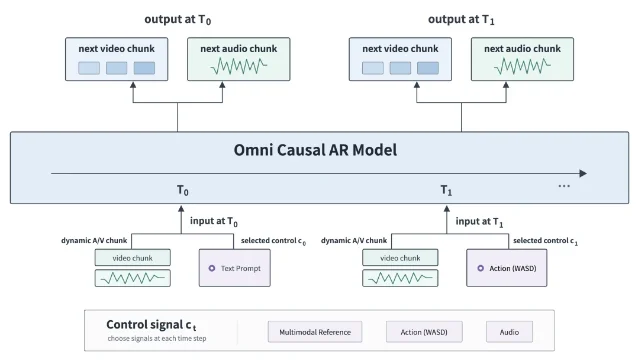
R2 predicts the next chunk of a world from everything that has already happened inside it. The technical report calls the backbone Omni Causal AR: one model that advances in a single direction through time, takes a history of video and audio plus whatever the player is doing right now, and returns the next synchronized audiovisual segment 5.
Four kinds of input enter that loop: text prompts, visual references, audio, and actions such as the WASD keys 5. The chunk length follows the signal. A key press gets a short chunk so the response feels immediate, while a prompt asking for weather or a new character gets a longer one so an event stays whole 5.
Memory is split three ways, because holding every frame of a long session costs more than anyone can pay. Sink memory keeps identity and world rules, rolling history keeps recent motion and camera behaviour, and an object cache keeps the parts of the past that still matter 5. A component called Error Bank stores failures the model has produced and replays them during training, so recovery from a bad frame is trained rather than hoped for 5.
The numbers in the report arrive with their own label. Attention was cut to "over 90% attention sparsity", and long-horizon brightness drift fell from 0.201 to 0.129, a reduction of 35.8%, both measured "in the current internal evaluation" or in "internal stage evaluations" 5. Labelling them that way is the useful part. The announcement cites no outside measurement of R2, and three days after the launch, none has appeared.
What is on the shelf
The worlds are open to play at world.pixverse.video, which the announcement names as the home of the launch collection 2. The gallery presents them as cards, each carrying two counters, explorations and views.

The catalogue is interactive fiction and character chat. A Van Gogh world, a magic academy, a winter palace, a bilingual Japanese teacher who greets the player from a classroom, an Italian mafia husband holding a drink. Games get a tab of their own, and the engine behind them is a separate product with a separate builder on a separate subdomain, the PixVerse Game Engine and its Game Composer 7. PixVerse's head of games, Chow Li, presented that engine at the Tech in Asia conference in September 2.
The public argument is made by a model. The public experience is a shelf of cards like these, one of which is a creature that takes a dragon or a leaf and answers differently each way 2.
The claims, against the documents
| The launch says | The vendor's own documents say | What a reader carries |
|---|---|---|
| "A real-time world model you can explore and change" 1 | "R2 is not positioned as a finished game engine or a fully open world", and "availability, queueing, and the final experience configuration may vary as access is managed" 3 | The games a buyer might want sit on a second product, and access to the gallery is administered rather than sold |
| R2 stays coherent "over far longer sessions" 2 | The drift and sparsity figures are internal stage evaluations 5 | The persistence claim rests on the company's own instruments for now |
| The report sets "do all of this live" as the requirement 5 | "Real-time generation latency remains a constraint for fast-paced game genres requiring sub-100ms response times" 7 | Shooters and competitive multiplayer sit outside what has been demonstrated |
| "Persistent, playable worlds" 2 | "Computational cost per session is higher than traditional rendering pipelines at equivalent visual quality; optimization is an active area of work" 7 | Each minute inside a world costs more to generate than to render, and no published page says who pays it |
| Subscription tiers, credit packs, and a rate per second for every clip model 89 | Neither price list carries a world model line 8 | A builder cannot price a session before starting one |
The latency and cost lines in that table come from the game engine's own closing section, published on August 20, three weeks before the launch press release 27. A company that writes its cost problem into its own research page is telling readers where the wall is. That wall is the reason the next section exists.
Every other model has a published price
PixVerse bills video the way a utility bills power. The platform documentation prices every model by resolution and by second: the C1 model at 360p costs 6 credits for each second without audio, the flagship V6 at 720p costs 9 credits a second and at 1080p costs 18 8. The page opens with the unit price already worked out, "$1 = 5 videos (v6, 720p, 5s, no audio)" 8.
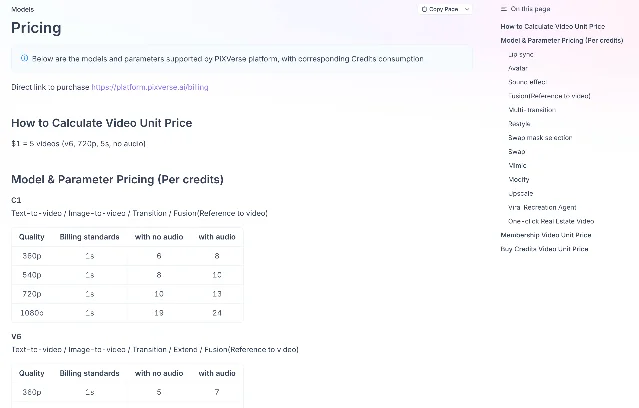
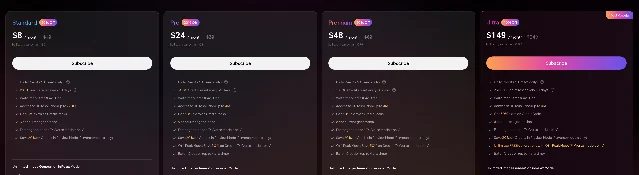
The consumer ladder is documented just as tightly: Standard at $8 a month for 1,200 credits, Pro at $24 for 6,000, Premium at $48 for 15,000, Ultra at $149 for 25,000, with credit packs at $5 for 500 credits and $100 for 10,000 9.
Neither list covers R2. A visitor to the world model can press Play Now, and its own pages say nothing about what a minute inside spends, or whether a session draws on credits at all 39.
The one published yardstick
Decart, a rival lab, sells a real-time world model through an API with a number attached. Its documentation quotes $0.02 for each second of active generation on the Oasis 3 preview, and works the arithmetic out loud: "60-second Oasis 3 Preview session: 60 x $0.02 = $1.20" 10.
Set PixVerse's own clip rate beside that figure. At 720p the platform charges 9 credits a second, and credits sell at 100 for a dollar 8. A ten-minute session at that rate comes to 5,400 credits, or $54. The same ten minutes at Decart's published rate comes to $12. Both figures are arithmetic on other products' rates, since R2 has none, and the useful way to read them is as the band a session would sit in if it were metered like everything else this company sells.
The plan ladder shows what a meter would mean for a subscriber. Pro's 6,000 credits a month, spent at the clip rate, buy about eleven minutes of generated 720p video. Ultra's 25,000 buy about forty-six minutes. A session runs for as long as a player keeps moving, and the engine's own limitation says the cost per session already sits above the rendering pipeline it replaces 7.
That leaves the question worth putting to any world model launch. What does an active second cost? This one answers with a price list that stops one line short of the product it launched.
What you accept when you step in
The terms written by the Singapore operator, AIVORA PTE. LTD., and the privacy policy answer the data question the same way, and the wording is worth reading at length. Anything a player inputs, generates, publishes or shares through the services carries a licence grant to PixVerse and its affiliates: "free, worldwide, perpetual and sublicensable", to "use, reproduce, modify, distribute, and display such Information Content solely in an aggregated and anonymized manner for the purpose of improving and providing the Services, including model training and optimization, unless you choose to opt out where such option is made available" 11. In a world a player speaks into and moves around in, that grant covers the session.
Rights in the output are narrower than that grant. Section 4.1 limits use of the Outputs to non-commercial purposes "unless you obtain separate authorization or a commercial-use license", and then, a few lines later, says downloaded information "can be used for both personal and commercial purposes" 11. Both sentences sit in the same section, and a studio planning to build on R2 needs the one that applies to it settled before the first line of code.
The rest reads like a service that would rather not promise anything it might have to keep. Availability is offered on an "as is" and "as available" basis, features can be "modified, suspended or withdrawn" without notice, and liability is capped at the subscription fees a customer has paid 11. Credits run on two clocks: the daily allowance expires at the end of each day, and membership credits expire when the next 30-day cycle begins 9. Credit pack purchases are non-refundable, and the refund policy states that requests based on dissatisfaction with generated results are not accepted 9. The service is for people aged 16 and over, and disputes go to arbitration in Singapore 1112.
Verdict
R2 is the strongest version yet of an argument PixVerse has been making since January: a video model can hold a world together while a person moves through it, and the model can keep running while that person changes it. The engineering is documented in unusual detail, the gallery is open, and the company names both of the walls it has hit, latency for fast genres and the cost of generating every second a player looks at. What it has not done is put a price on the thing it launched. Go and look at R2, because the experience is open right now and the persistence is genuinely new. Before building anything on it, watch the platform pricing page. When a world model line appears there, with a rate per second and a resolution attached, R2 has become a product a team can plan around. Until then it is a free experience with a first-place badge and no meter, which suits a world model fine and leaves anyone building on one guessing.
References
- 1Best of Product Hunt: September 25, 2026
producthunt.com
- 2
- 3PixVerse R2 Real-Time World Model
pixverse.ai
- 4
- 5
- 6PixVerse World gallery
realtime.pixverse.ai
- 7
- 8Pricing
docs.platform.pixverse.ai
- 9PixVerse Pricing: Credits, Plans & AI Video Costs
app.pixverse.ai
- 10Pricing - Decart API Platform
docs.platform.decart.ai
- 11Terms of Service
pixverse.ai
- 12Privacy Policy
pixverse.ai
This story was produced automatically by a channel. One sentence is all it takes for Neodrop to keep producing for you.