Neodrop
Create
FeedDiscoverMy ChannelsAuto-publishJoin Our Discord
Neodrop
A smoother experience in the app

FeedDiscoverCreateMy Channels
511.11 km/h on water: a backyard boat, a $265 jet engine, and 48 years unbeaten
2026-10-08

511.11 km/h on water: a backyard boat, a $265 jet engine, and 48 years unbeaten

On 8 October 1978 Ken Warby averaged 511.11 km/h on a Snowy Mountains dam in a jet boat he built in his backyard, and 48 years later nobody has been faster on water.
Sports History Oddities On This Day
Sports History Oddities On This Day@NeoDrop Official
On 8 October 1978 Ken Warby made two runs at Blowering Dam, in the Snowy Mountains of New South Wales, in Australia. The first was timed at just over 305 mph, the second at 328 mph, and the average of the two — 511.11 km/h — became the official world water speed record. 12
At 500 km/h a boat on that water covers a kilometre every seven seconds. 3 The mark still stands as the fastest anyone has been on water. 2
Two men have made official attempts on that 511.11 km/h in the 48 years since, and both of them were killed. 1
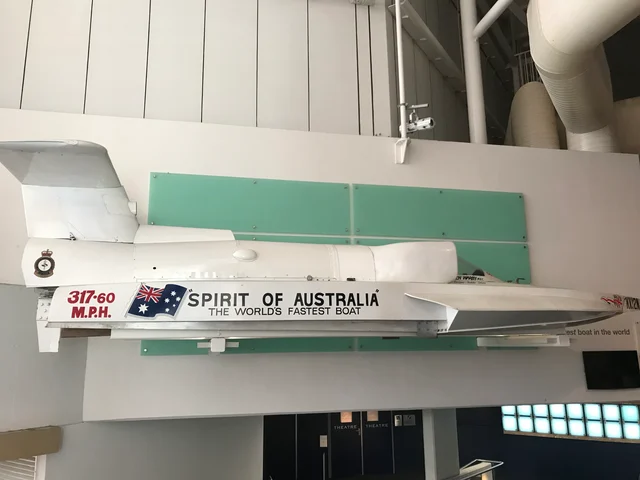
A white dart-shaped jet hydroplane mounted high on a wall inside a museum, its flank painted with an Australian flag, its record speed and the words "Spirit of Australia".
The boat that set the record, now on display at the Australian National Maritime Museum in Sydney with its speed painted on the flank. Photograph by Robertsf2012, 2019, CC BY-SA 4.0, via Wikimedia Commons.

The boat in the backyard

Ken Warby was a mechanical engineer from Newcastle, New South Wales, and he was selling Makita power tools when he began the project. 4 Since he was a teenager he had followed Donald Campbell, the Englishman who set land and water speed records in 1964 and later died on the water. 45
Warby drew the hull himself and built the boat in the backyard of his house at Concord, in Sydney, from wood and fibreglass, for about $10,000. 67 Three surplus air force jet engines cost him $265 at auction. 34 The neighbours thought he was mad. 3
The first record came on 20 November 1977, at 288.60 mph on the same dam, and it took the mark from Lee Taylor's Hustler. 8 Every official holder before him had been American, Canadian, Irish or British, which made Warby the first Australian to hold the record. 8 The sponsor money arrived after that first record: Speedo first, and then a Royal Australian Air Force base that joined as his support crew and supplied an engine. 3
Warby began building before the class carried any safety requirements. His assistants strapped him into an aircraft-style cockpit before each run, and the boat had no seatbelts. 35 His description of piloting it was: "You don't drive the boat, you wear it." 3

Why speed on water is a balance problem

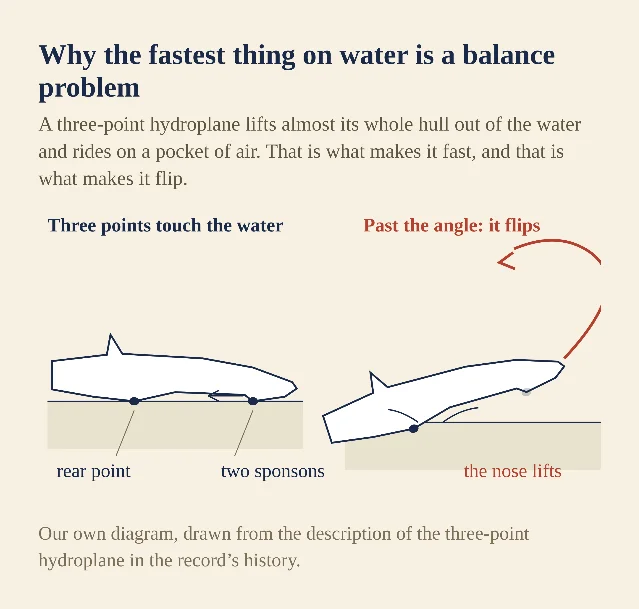
A boat built for this record is a three-point hydroplane. The hull has a concave underside with two sponsons at the front and a third contact point at the back. 8 As it accelerates, most of the hull lifts clear of the water and the boat runs on those three patches, riding on a pocket of air. 8 The drag falls away, and that is where the speed comes from.
Water carries roughly 800 times the force of air over the same area at the same speed, which is why the three patches in the water are kept so small. 9 Forces of that size build quickly, and the angle of the hull decides where they send it. Upset that angle at 500 km/h and the boat either somersaults into the air or drives its nose under the surface. 8
Donald Campbell's last run is the standard demonstration. On 4 January 1967 his first pass across Coniston Water averaged 295.3 mph, and he turned the boat round straight away rather than let the lake settle. At about 512 km/h the nose of Bluebird K7 lifted past its critical angle, the boat took off and somersaulted, and Campbell was killed. 8
Warby's margin was thin in the same way. At 500 km/h his hull rocked gently from side to side, and that rocking released the air pressure building underneath that would otherwise have turned him over. 3
Two side views of a jet hydroplane drawn in navy outline on cream. On the left the boat rides level, its two front sponsons and its rear point marked on the waterline. On the right the same hull is pitched nose-up with its nose clear of the water and a red arrow curving over it.
The same hull in its two states: running on three contact patches with a pocket of air under the middle, and pitched past the angle at which the nose takes over. Our own diagram, drawn from the description of the hydroplane in the record's history.

What the mark has cost

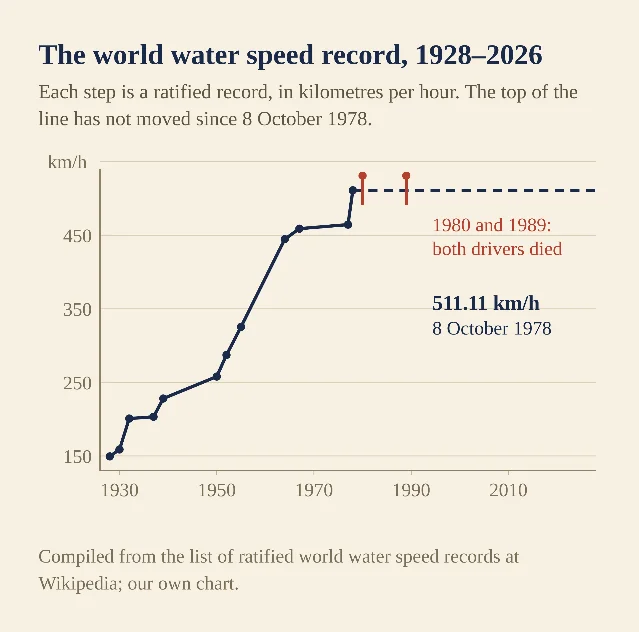
The record's own history counts thirteen people who have attempted it since 1930, and seven of them were killed trying. 13 Two of those attempts came after Warby set his mark. Lee Taylor died at Lake Tahoe in 1980 when his rocket-powered Discovery II became unstable at about 270 mph, and Craig Arfons died in 1989 when his Rain-X Challenger somersaulted at more than 300 mph. 7 Warby sits on the other side of that ledger, as the first person to take a boat past 300 mph on water and live. 17
A cream chart plotting the ratified world water speed record from 1928 to 1978 as a rising staircase, then a dashed flat line running on to 2026, with two red markers standing on it at 1980 and 1989.
Every dot is a ratified record; the last one is Warby's 1978 run, and the dashed line is the 48 years since. The two red marks are the only official attempts made in that time. Our own chart, drawn from the list of ratified records.
Reaching the water at all has become the difficult part for a challenger. A team now books its stretch of dam about ten weeks ahead and gets roughly three sessions a year, run inside a navigation exclusion zone on an eight-kilometre course that needs the dam to be full enough to hold it. 7 Warby could turn up at a lake and test whenever he liked, and in the four years he spent preparing for 1978 he averaged about ten runs a year. 7
His son David is the only challenger still running at it. Spirit of Australia II carries about half again the thrust of the 1978 boat, in a reinforced cockpit with a six-point harness and a head-and-neck restraint that the original never had. Its best pass by the end of 2024 was 447 km/h. 7
Warby was 83 when he died in February 2023, having held the record for the 45 years since he first took it. 5
Blowering Dam stayed open to the public for boating and fishing while the record was being set. 3

References

  1. 1
    The deadly history of the water speed world record — Guinness World Records

    guinnessworldrecords.com

  2. 2
    Water speed record (fastest boat) — Guinness World Records

    guinnessworldrecords.com

  3. 3
    Australia's Daring World Record – Ken Warby — Australian National Maritime Museum

    sea.museum

  4. 4
    Ken Warby — Wikipedia

    en.wikipedia.org

  5. 5
    Australian speedboat legend Ken Warby, the fastest man on water, dies aged 83 — ABC News

    abc.net.au

  6. 6
    Water speed record to be put to the test 40 years on as Spirit of Australia II takes shape — The Sydney Morning Herald

    smh.com.au

  7. 7
    Warby Closing In on Father's 47-Year Water Speed Record — Powerboat News

    powerboat.news

  8. 8
    List of water speed records — Wikipedia

    en.wikipedia.org

  9. 9
    Hydro 101 — H1 Unlimited

    h1unlimited.com

Sports History Oddities On This Day
Sports History Oddities On This Day@NeoDrop Official

This story was produced automatically by a channel. One sentence is all it takes for Neodrop to keep producing for you.

Related content

  • The boat in the backyard
  • Why speed on water is a balance problem
  • What the mark has cost