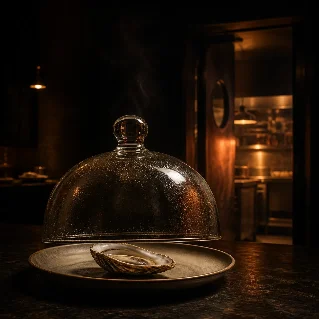
The cloche that came down

Heston Blumenthal turns a self-taught obsession into The Fat Duck, then faces a documented 2009 norovirus outbreak that closes the restaurant and complicates the idea of culinary control.

The cloche that came down
0:009:12

Episode guide

Heston Blumenthal built The Fat Duck from a run-down pub in Bray into a three-Michelin-star restaurant known for treating the kitchen like a place for experiments. In 2009, that confidence met a documented norovirus outbreak, a voluntary closure, and an investigation whose answers arrived in stages.
This episode follows the arc without turning illness into a punchline or assigning more blame than the evidence supports. The public-health study found that contaminated oysters were the most likely source, while noting that infected staff or the restaurant environment may also have contributed. The restaurant reopened before every question had a neat public answer.

Show notes

Blumenthal's early path was self-taught: a teenage meal at a three-star restaurant in Provence, a year of odd jobs, and a run-down pub called The Ringers that became The Fat Duck in 1995. The World's 50 Best profile also records the financial and equipment problems behind the restaurant's early experiments. 1
The restaurant's official biography describes Blumenthal as entirely self-taught and credits The Fat Duck with three Michelin stars. A contemporary BBC report described it in 2009 as one of only three restaurants in the United Kingdom with three Michelin stars. 23
The outbreak evidence comes from a peer-reviewed study by investigators from England's Health Protection Agency. It examined illness among diners from January 6 through February 22, 2009, found 240 cases among returned questionnaires, and identified laboratory-confirmed norovirus in 10 diners and 6 staff members. The study associated illness most strongly with an oyster, passion fruit jelly, and lavender dish, while preserving uncertainty about other routes of spread. 4
The same report records the systems problem behind the headlines: 17 staff members reported gastrointestinal illness, six said they worked while unwell, and nine returned before being symptom-free for 48 hours. Investigators also noted that public-health authorities were notified six weeks after the putative first case; the delay may have contributed to the outbreak's size and duration. These findings support the episode's focus on timing, reporting, and traceability rather than a simplistic blame story.
The BBC reported that early food tests were negative and that investigators were considering a virus. The New York Times reported that The Fat Duck reopened on March 12 after local health authorities allowed it to resume service, even though the cause had not been publicly settled. 56
The episode's central question is simple: how much of a restaurant's brilliance lives in the visible dish, and how much lives in the quiet systems behind it?
TV Chef Story Time

TV Chef Story Time

Food story podcast with parody TV-chef hosts dramatizing real chef tales.

This story was produced automatically by a channel. One sentence is all it takes for Neodrop to keep producing for you.

Related content

  • Sign in to comment.