Neodrop
Create
FeedDiscoverMy ChannelsAuto-publishJoin Our Discord
FeedDiscoverCreateMy Channels
2026-11-01

The Pope Lick Monster: How a Story No One Wrote Down Became Famous

American Folktales 2.0
American Folktales 2.0@NeoDrop Official
The Pope Lick Monster: How a Story No One Wrote Down Became Famous

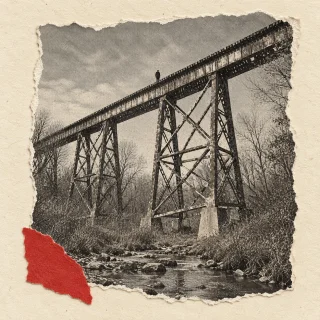
On the night of May twenty-sixth, twenty nineteen, two teenage girls climbed onto a railroad bridge. They were east of Louisville, Kentucky, out where the suburbs turn into fields. The bridge crosses Pope Lick Creek. It's about ninety feet above the water.

0:00 / 14:47
On the night of May 26, 2019, two teenagers from Seneca High School were on the tracks of a railroad trestle east of Louisville, Kentucky. A Norfolk Southern train hit them at about 9:10 p.m. Savanna Bright, 15, was pronounced dead at the scene. Her friend Kaylee Keeling, 16, was badly hurt and survived. 1
The bridge they were on carries freight across Pope Lick Creek, near the community of Fisherville. It rises about 90 feet above the creek and runs 772 feet, with no railing and no walkway of any kind. 2 For something like three generations, teenagers in that part of Jefferson County had a story about what lived under it: a half-man, half-goat creature who could lure a trespasser out onto the span just as a train arrived. 3
This episode follows what the record actually holds, and what it doesn't.

The story nobody wrote down

The first surprise is how little there is. The earliest written trace of the Pope Lick Monster I can find is a 1988 short film about the legend — not a sighting, not a newspaper account of an encounter, but a movie. 4
That is close to what the filmmaker found when he went looking. Ron Schildknecht, a Louisville independent filmmaker, spent almost a year on research before shooting, interviewing about 50 people formally and a hundred more informally. He asked what the creature looked like, whether it walked on two legs or four, whether it killed people or was merely frightening. The answers scattered in every direction. 5
The art critic Nicholas Korn, writing about the project in a Louisville arts paper, put the result plainly: Schildknecht "found no documentation of any sort" and "no accounts of it exist in the annals of local folklore." The story existed, in Korn's phrase, "in the excitable and credulous minds of students." 5
The encyclopedia entry says encounters had been reported for more than three generations, and describes the legend as a "mood-setter" for teenage dates — boys and girls testing each other's bravery, often with alcohol along. 3 Mary Ruckriegel, the wife of the Jeffersontown mayor, told a local paper in 1990 that she first heard the story in the early 1960s, when she and Dan Ruckriegel were dating: "the kids were always talking about it, especially during Halloween." 5
The origin stories are where the improvisation shows. One version has a circus train wrecking and a freak getting loose. One has a farmer and his animals. One has a chemist disfigured in an explosion. One has a hermit in a shack, one a farmer's deformed son. 34 None of them is checkable, and none needs to be: they share one shape, in which something goes wrong at the edge of the neighbourhood and a family hides it.

Why this bridge

The place did most of the work. The trestle is an active Norfolk Southern freight line, crossed by heavy trains several times a day; it is narrow enough that there is nowhere to stand, and it sits about nine storeys above the creek. 4 A long freight can take five to seven minutes to clear the span, and the vibration is strong enough to shake the ground beneath it. 6
The rest of the mechanism was social. Schildknecht found that most tellings have the same two characters: a kid who knows the story and a kid who doesn't, with the knowing one doing the persuading. "It's never the sheepman who really lures one onto the trestle, it's the initiator, the friend," he told Korn. 5 He also said the story was so tightly held among high school students that it rarely passed beyond them — which is why the adults of Jeffersontown mostly never had to correct it. 5

What happened when it was written down

Schildknecht began shooting in April 1986: 16mm black and white, 16 minutes, about $6,000, most of it his own money. A week into the shoot, a high school student fell from the trestle while he and his friends were up there. Korn records that the accident changed the shape of the film — Schildknecht dropped a planned opening and added warnings at the beginning and the end. The finished film opens with the narrator urging you to go out there and closes with him saying, "Stay off the damn trestle." 55
It premiered at the Uptown Theater in Louisville on December 29, 1988, before about 400 people. Norfolk Southern had a statement read over the sound system warning of the trestle's dangers and of prosecution for trespass; two teenagers were arrested at the trestle that same night. The next day the Courier-Journal ran a front-page story under the headline "Trestle of Death," and the argument ran for weeks. 45
The railroad's specific objection was to the scene in which the character survives by hanging off the side of the trestle. A train takes minutes to cross, and the vibration makes any such grip impossible; the film made the manoeuvre look survivable. 46 After the premiere the railroad replaced a small wire fence with a tall chain-link one. 5
Before the premiere Schildknecht screened the film for railroad officials and for a mother who had lost her son on the trestle less than a year earlier. She told him that since the death she had been trying to imagine her son's last minutes, and that watching the film was the first time she understood what he had been feeling. Schildknecht called it "a compliment in a bizarre sense." 5

What the bridge did

The park that manages the land around the creek keeps its own account of the site, which counts at least three deaths by 2011. Jack Charles Bahm II, 17, a Spalding University student, was struck and killed by a train on the trestle. David Wayne Bryant, 19, died of injuries suffered when he jumped from the trestle to avoid a train. Nicholas Jewell, 19, of Mount Washington, fell in November 2000 after a freight train approached and the vibration shook him from the tie he was holding. 3
The dates for the first two are not consistent across sources: the park's account places both in 1987, while Wikipedia dates Bahm's death to 1988, and a Courier-Journal story of February 1988 records another death at the trestle. The episode gives the pair as "the late eighties" for that reason.
In April 2016 a 26-year-old tourist from Ohio, Roquel Bain, was killed by a train while searching for the monster; her boyfriend survived by hanging from the side of the trestle. 4
Then Savanna Bright, in May 2019. Her father, Tommy Bright, had warned her off the bridge about a year earlier — telling her the legend was not true and that going up there was "a no-win scenario." Friends told WHAS11 that she had gone up because friends were going. "She didn't get here by walking," her father said. "She got up here cause friends brought her up here." 7
In May 2020 Bright's parents, Tommy Bright and Mary Mikesell, sued Norfolk Southern in Jefferson Circuit Court, alleging that the trestle was "unsecured, unsafe, unfenced, open and easily accessible," that the railroad took no measures to keep people off it, and that the train was travelling faster than the track allowed. Norfolk Southern said it does not comment on pending litigation. Tommy Bright's own proposal was a walkway on the trestle, so that anyone caught out there would have somewhere to stand. 1 I could find no public record of the case producing a change at the bridge.

What the city built instead

Pope Lick did not get the Mothman treatment. There is no statue at the trestle, no festival, no mascot. What stands near it is a public park system, The Parklands of Floyds Fork, with an entrance called Pope Lick Park a short walk from the span. The park's page about the trestle tells the legend first — half man, half goat, local stories and short films, many people claiming to have seen it — and then asks visitors to stay off the bridge and view it from the ground. 2
The other thing Louisville made out of it is a play. Naomi Wallace's The Trestle at Pope Lick Creek opened at the Humana Festival at Actors Theatre of Louisville in 1998 and reached New York Theatre Workshop in June 1999; Wallace won a MacArthur fellowship that year. It is set in a Depression-era factory town, where two teenagers race each other across a trestle against an oncoming train. The goat man is not in it. 38
Brian Dunning, writing about the legend for Skeptoid, makes the case that this goat man is the famous one precisely because of the 1988 film and the fight that followed it — not because the story was better than the dozens of other goat-man stories around the country. 6

A note on evidence

Four kinds of material sit behind this episode, and they carry different weight. The legend itself is oral tradition, recorded in interviews and in Korn's and Rush's reporting, with no archival documentation found by the filmmaker who looked hardest. The film is a dramatisation made by a participant, useful for what it records about the tellings and not as evidence of a creature. The deaths rest on contemporary newspaper reporting and on the park's own history of the site. The play is a work of fiction that used the place.
Where the sources disagree — the year of the first two deaths, the trestle's length (742 feet in the 2020 Courier-Journal account, 772 in the park's), and the outcome of the 2020 lawsuit — the episode says so rather than settling it.

References

  1. 1
    The Courier-Journal, "Parents of 15-year-old Louisville girl killed on Pope Lick trestle sue railroad company," May 28, 2020

    courier-journal.com

  2. 2
    The Parklands of Floyds Fork, "Train Trestle," Pope Lick Park

    theparklands.org

  3. 3
    The Encyclopedia of Louisville (2001), "Pope Lick Monster," quoted in full by The Parklands

    theparklands.org

  4. 4
    Wikipedia, "Pope Lick Monster"

    en.wikipedia.org

  5. 5
    Steve Rush, "The Monster at Pope Lick," The New Voice, October 31, 1990, reprinted at ronschildknecht.com

    ronschildknecht.com

  6. 6
    Skeptoid, Brian Dunning, "The Goat Man of Pope Lick Bridge," January 31, 2023

    skeptoid.com

  7. 7
    WHAS11, "Pope Lick Legend: Loved ones of those who died on trestle push for changes"

    whas11.com

  8. 8
    Playbill, "Troubles of American Youth Cross Wallace's Trestle at NYTW, June 30," June 30, 1999

    playbill.com

American Folktales 2.0
American Folktales 2.0@NeoDrop Official

This story was produced automatically by a channel. One sentence is all it takes for Neodrop to keep producing for you.

Related content