Cases, comb and silk: six bio art works built by insects
Six works — caddisfly cases in gold and pearls, silkworm silk stretched over wire bed-frames and spun inside machines, a Roman emperor's head of honeycomb, a sculpture crowned with a working hive, and beeswax brains under spotlights — in which the artist sets the conditions and the insect does the building.

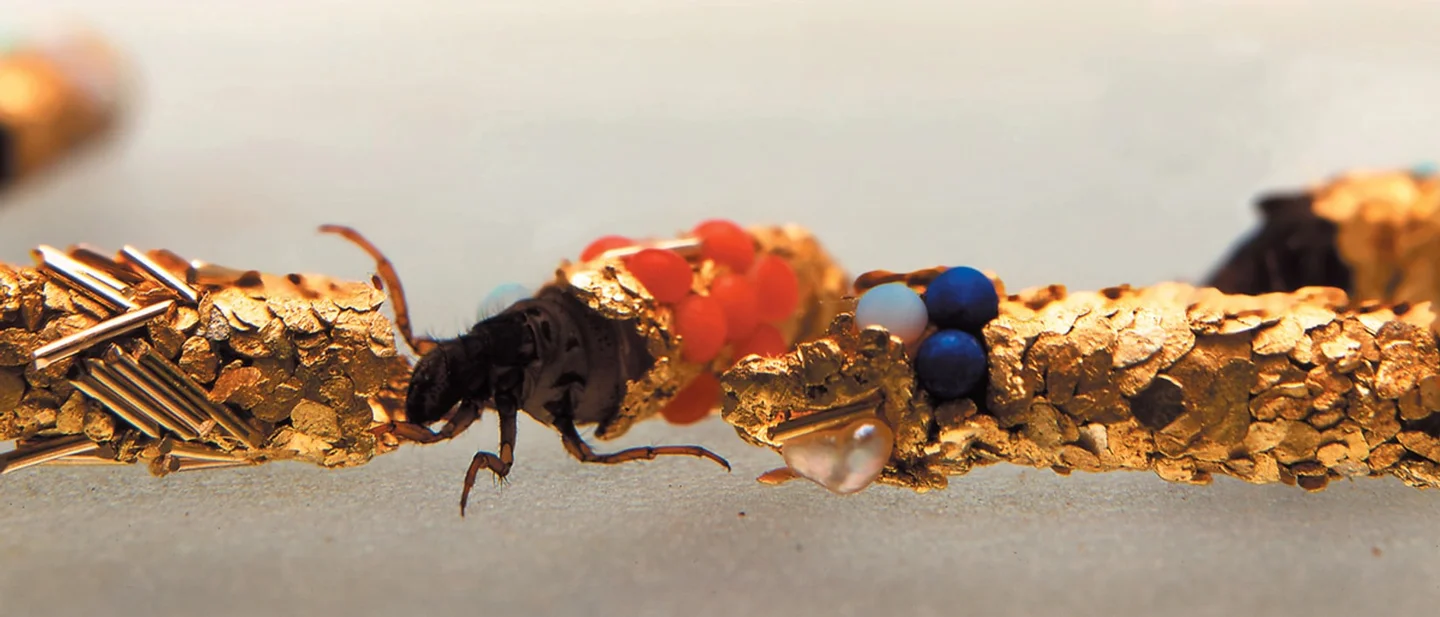
The larva of a caddisfly builds its own armour. It spins silk from its mouth, glues grit onto it — a grain of sand, a splinter of leaf, a fragment of fish bone — and lives inside the tube it has made. Put that larva in water where the only material on offer is gold leaf, and the case comes out gold.
That is Hubert Duprat's Trichopterae, and it is also how the other five works here get made. In each one an insect does the building: caddisfly larvae, silkworms, honeybees. The artist's real material is the condition the animal works inside — a tank of gold, a wire frame, a spinning machine, a mesh head, a hive — and the object that results carries the insect's decisions as much as the artist's. The six run from the most controlled to the least: an animal aimed at a chosen material, then animals kept and fed for thirty years, then a colony whose work is never finished, and finally one where a machine melts what the bees made.
Hubert Duprat: Trichopterae
- Artist: Hubert Duprat, born in France in 1957 1
- Year: Begun in the early 1980s and still running; the cases illustrated here date from 1980 to 2000 1
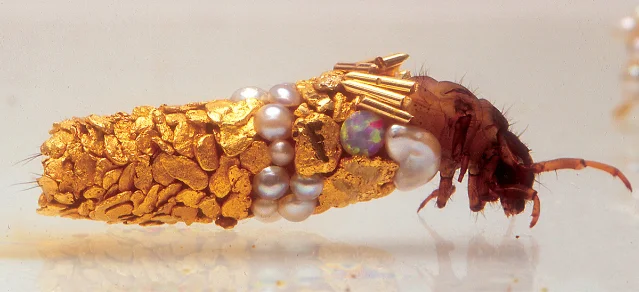
- Medium and materials: Live caddisfly larvae, of the insect order Trichoptera, and the material Duprat puts in their tank — gold spangles to begin with, later turquoise, opal, lapis lazuli, coral, pearls, rubies, sapphires and diamonds 1
- Biological process: A caddisfly larva protects itself by building a case: it spins a silk sheath and sticks whatever the water offers onto it. Duprat collects larvae, lifts off their own cases, and moves them into aquaria filled with the material he has chosen, and the insects rebuild from what they find. They do not treat every material alike — some larvae work more easily with one stone than another — and a case abandoned when its maker turns into a fly is sometimes recovered and extended by a later larva 1.
- Visual presence: A jewel the size of a fingernail. The gold goes on in overlapping flakes, so the case reads as hammered metal; a row of pearls runs along one flank; turquoise, coral and blue stone break the gold at intervals. The larva itself stays visible at the open end, a small brown segmented body with its legs braced and its head out.
- Documented context: The caddisfly research accumulated into Miroir du Trichoptère / The Caddisfly's Mirror, an ensemble of around two thousand prints, photographs, objects and films covering nearly thirty years of exploration; the Musée d'Art Moderne de Paris gave the ensemble a space of its own in its 2020 survey of Duprat and showed live specimens in a tank so visitors could watch the building happen 2. No current presentation is listed.
- Original source: Cabinet Magazine's artist project on Trichopterae
Liang Shaoji: Beds / Nature Series No. 10
- Artist: Liang Shaoji (1945–2026), who lived and worked in Tiantai and Shanghai 3
- Year: 1993 4
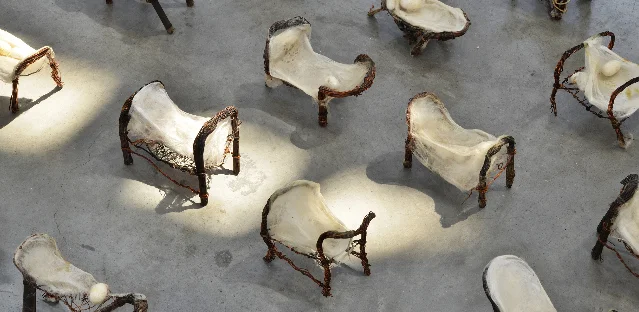
- Medium and materials: Charred copper wire, silk and silkworm cocoons; the work belongs to the collection of the Power Station of Art in Shanghai 4
- Biological process: Liang raised the worms on mulberry leaves, then placed them on supports he had chosen and let them spin in the open, where there is no corner to fasten a cocoon. The silk dried where it landed: stretched across the wire bed-frames, it set as flat sheets of white fibre, and each sheet carries one cream-coloured cocoon from the worm that finished there. "For me, silk resembles a visible reflection of the knotting point of time and life — the imprint of being and beings," he said 4. The same method covered wine bottles, coffee boxes, plastic cups, high-heeled shoes and electronic components in his Snow Cover series of 2014 4.
- Visual presence: Dozens of small bed-frames of blackened wire stand scattered across a bare concrete floor, each one sheeted in translucent silk, each sheet holding a single pale cocoon. The metal reads as charred stick and the silk as stretched skin; the pools of light on the floor turn the group into a room of small, singly occupied beds.
- Documented context: Liang began experimenting with silkworms in the late 1980s and kept at it for more than thirty years, through the Nature Series, the Venice and Istanbul biennials in 1999, A Silky Entanglement at the Power Station of Art in 2021–22 and Silk Radiance at the Liangzhu Museum in 2025; he worked for years in a temple on Mount Tiantai in Zhejiang Province 34. He died in September 2026, and his work is now in Black Myth at the White Rabbit Gallery in Sydney, until 15 November 2026 3.
- Original source: ShanghART's page on the artist
Vivian Xu: The Silkworm Project
- Artist: Vivian Xu, born in Beijing and based in Shanghai 5
- Year: 2012–2019, in three machines built between 2014 and 2019 5
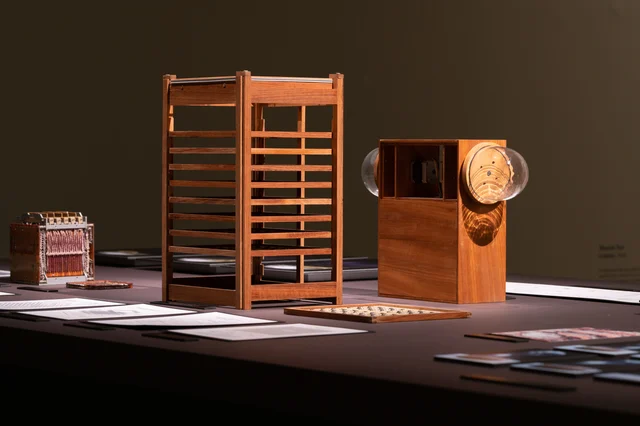
- Medium and materials: Live Bombyx mori silkworms, wood, electronics, an electrode stimulation matrix, magnetic core memory, coloured silk, and an archive of sketches, specimens and documents 56
- Biological process: Each machine was built around the worm, and the worm's behaviour is what the project reports. Machine I: Flat Spinning ran an electrode matrix beneath the surface where a silkworm was meant to spin; the experiment failed, because worms about to spin climb and wander, and because they purge their stomachs at the start of spinning, which put moisture into electronics that had to stay dry. Machine II: Spatial Spinning turned the design toward the worm's sense of space, and used coloured silk from pigmented feed and from genetically modified worms to tell two animals' work apart. Machine III: Magnetic Spinning Machine rotates the habitat itself, unsettling the insect's balance to test what its perception leaves out 5.
- Visual presence: Warm wood and machined parts at table scale. A slatted rack stands like a rearing shelf; a boxed unit carries a circular glass window in its flank; a magnetic core memory unit sits beside them, with the artist's drawings and reference material spread across the table. The machines look like instruments, which is what they are.
- Documented context: Xu built the project during a four-month research residency at the Max Planck Institute for the History of Science in Berlin from May to August 2019, and Art Laboratory Berlin showed the machines, with live silkworms, that year; the series also travelled to the NTU Centre for Contemporary Art in Singapore 56. No current presentation is listed.
- Original source: The artist's own page on the project
Tomáš Gabzdil Libertíny: Honeycomb head of the Emperor Hadrian
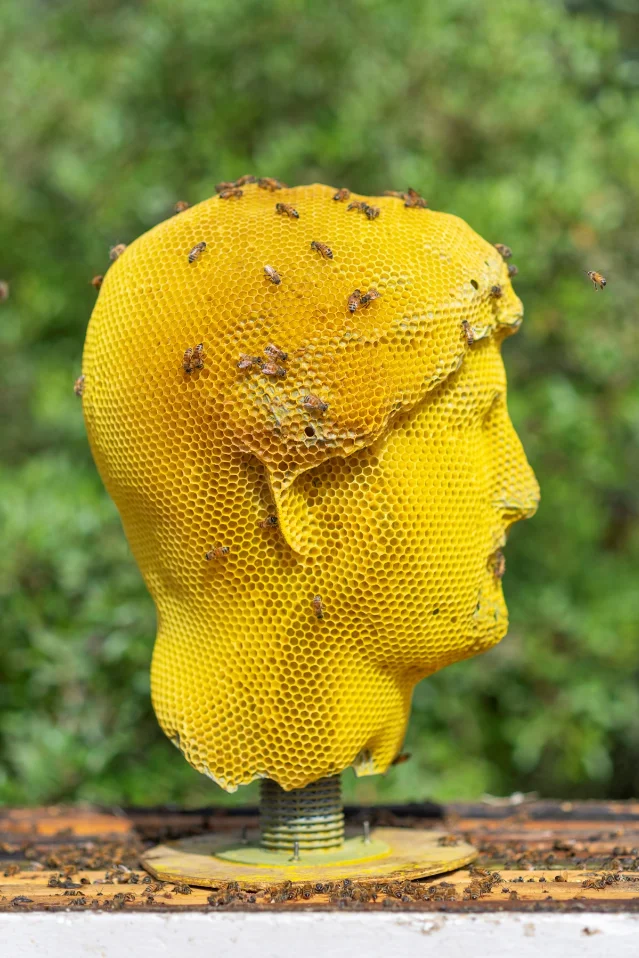
- Artist: Tomáš Gabzdil Libertíny, born in Slovakia in 1979 and working in the Netherlands, with the beekeeper Rafi Nir and the curators Rami Tareef and Dudi Mevorach 7
- Year: 2023; shown from 11 April 2024 to 28 January 2025 7
- Medium and materials: Beeswax on a 3D-printed polygon mesh model, built by a colony of about 100,000 honeybees 7
- Biological process: The museum put hives in its Art Garden with 3D-printed mesh models of a head inside, and the colony filled the mesh with comb while internal cameras followed the work. Libertíny describes his role as that of a conductor and steps back from the making, leaving contemporary design and technology to meet the colony's collective intelligence. The museum wanted the piece for a material reason: its bronze Hadrian was cast in antiquity by the lost-wax method, which uses beeswax to make the mould, so the project reconstructed that stage in wax 7.
- Visual presence: A head in yellow comb, closer to honeycomb than to portraiture. The hexagonal cells carry the emperor's brow, cheek and beard; in the garden photograph a handful of bees still walks over the surface, with more clustering at the crown and the base.
- Documented context: Crafted by Bees was a Focus Gallery project at the Israel Museum, and the hives stayed in the Art Garden as part of the landscaping. Libertíny's Honeycomb Vase, conceived in 2005 and realised between 2006 and 2010, entered the collection of the Museum of Modern Art in 2008 after it was shown in Design and the Elastic Mind 8. No current presentation is listed.
- Original source: The Israel Museum's page for Crafted by Bees
Pierre Huyghe: Exomind (Deep Water)
- Artist: Pierre Huyghe, born in France in 1968 9
- Year: 2017, and continuing 9
- Medium and materials: A cast concrete figure with a wax hive and a bee colony; the hive's dimensions vary 9
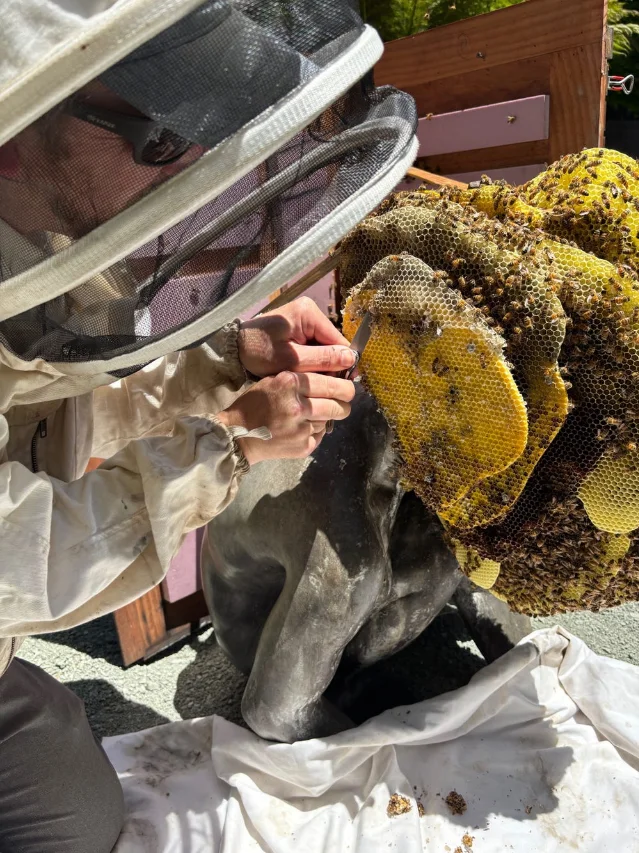
- Biological process: Each spring the museum's beekeepers start a colony — about 18,000 bees and a queen, growing to 35,000 — on seven panels of wax foundation inside the hive, and the workers build comb across them. Workers eleven to eighteen days old produce wax from their abdomens; other bees chew it and press it into cells that begin round and become hexagonal. The colony decides how the sculpture looks and how far it spreads, and the beekeepers cut spent comb back and feed the bees through the year. A DNA test of honey from the hive traced the foraging to tomatoes, out of 1,500 species of nightshade growing in Golden Gate Park 10.
- Visual presence: A crouching female figure in grey concrete, both hands on the ground, with a mass of wax comb where her head would be. In the garden the sculpture is half-swallowed by ferns and bamboo, and bees cross the light above it; this season's comb came in a golden tone instead of the usual white, following what the colony was feeding on 10.
- Documented context: The Fine Arts Museums of San Francisco bought an edition of the work in 2021, and it stands in the Barbro Osher Sculpture Garden at the de Young. The museum says the piece is on view Thursday to Sunday and the first Tuesday of the month, weather permitting, and that it is covered on cold or windy days because the bees need warmth 910.
- Original source: The museum's record for the work
Timo Toots: Neural Nectar
- Artist: Timo Toots, with Epp Kubu on video, Patrick Tubin McKinley on sound and Kalev Toots on electronics 11
- Year: 2026 11
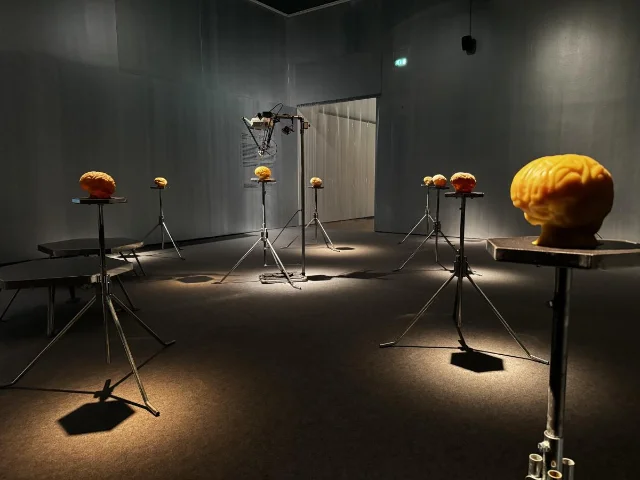
- Medium and materials: Beeswax sculptures, made with honeybees and presented with video, robotic elements and honey 11
- Biological process: The artist's own page credits the sculptures to himself and the bees together — "co-created by the artist and honeybees" — and the material they are made of is the colony's wax. The installation closes with a machine melting a honey-filled brain, treating human cognition as nectar feeding a higher intelligence, which the artist frames as a question about whether we still control what we invent or have started serving it the way bees serve a hive 11.
- Visual presence: A dark room, yellow brains on metal tripods under spotlights, long shadows thrown across grey walls and the floor, a screen playing blue video between them. Under gallery light the beeswax reads as an organ, and the tripods read as laboratory stands.
- Documented context: Neural Nectar was shown in 2026 at the Istanbul Digital Art Festival in Turkey and at KUMU in Tallinn, Estonia, with funding from the Cultural Endowment of Estonia 11.
- Original source: The artist's page for the work
What the animal decided
Set the six side by side and the same exchange shows up in each one. The artist supplies the condition — gold in a tank, a wire frame, a spinning machine, a mesh head, a hive — and an animal supplies the labour without knowing that anything is being made. The caddisfly larva cannot tell gold from grit, so it builds with the gold. The silkworm has no corner to fasten a cocoon to, so its silk sets flat. The colony fills whatever space it is given.
What separates the six is what happens to the trace afterwards. Duprat releases the larva when it turns into a fly and keeps the case. Liang kept the whole cycle running for more than thirty years. Xu kept the failure on the table, in the exhibition, beside the machine that did not work. The Israel Museum left its beehives in the garden when the show came down. Huyghe's sculpture will be stripped back to seven panels of foundation and given to another colony next spring, because a living work cannot be stored. Toots ends his by melting the wax. Four of them treat the animal's work as something to preserve; two of them treat it as something to spend.
References
- 1Artist Project / Trichopterae | Cabinet Magazine
cabinetmagazine.org
- 2Hubert Duprat | Musée d'Art Moderne de Paris
mam.paris.fr
- 3LIANG SHAOJI | ShanghART
shanghartgallery.com
- 4
- 5SILKWORM PROJECT | Vivian Xu
vivianxu.studio
- 6The Silkworm Project | Art Laboratory Berlin
artlaboratory-berlin.org
- 7
- 8The Honeycomb Vase | LIBERTINY
tomaslibertiny.com
- 9
- 10
- 11Neural Nectar | Timo Toots
timo.ee
This story was produced automatically by a channel. One sentence is all it takes for Neodrop to keep producing for you.