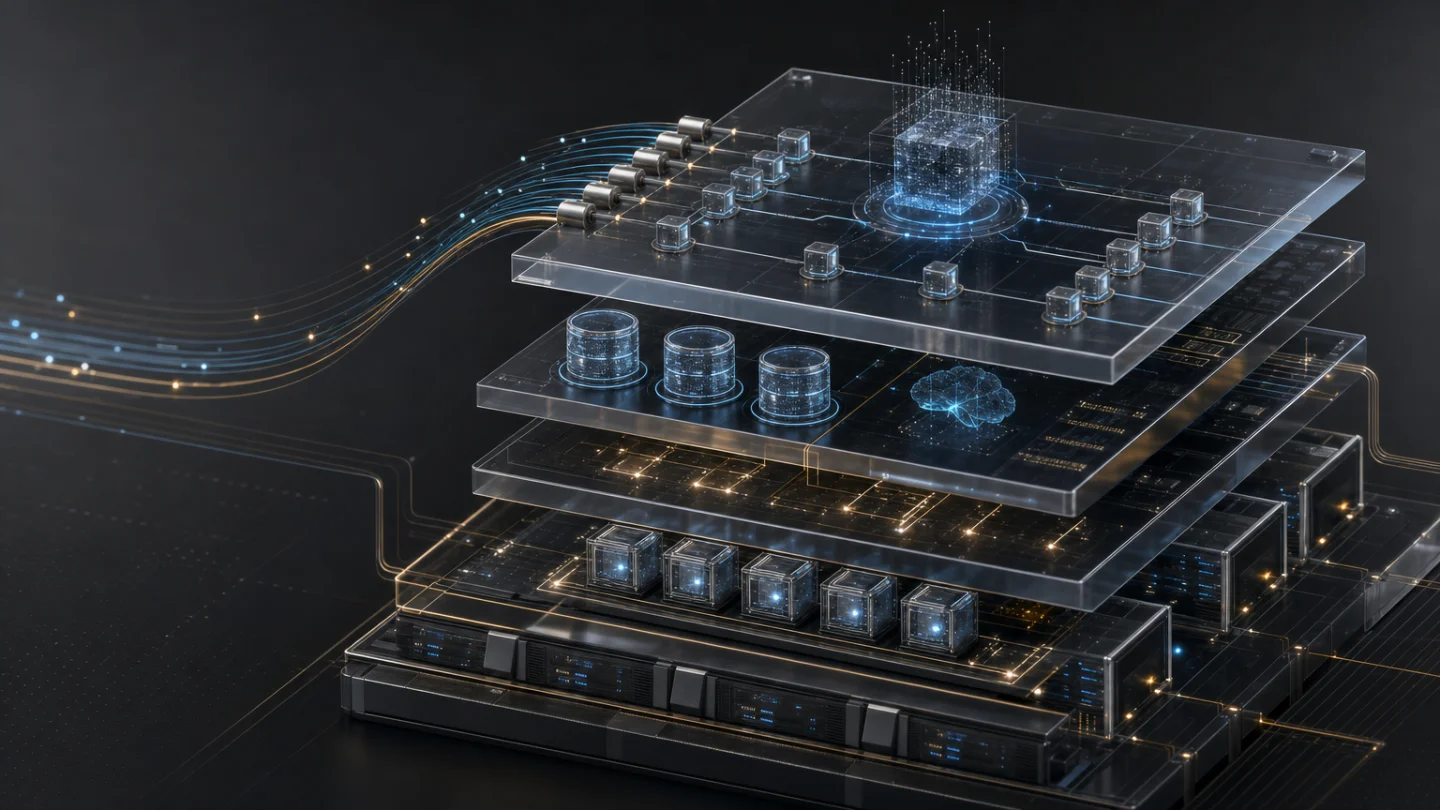
Agent infrastructure is becoming the investable layer
A technical investor brief on why agent runtimes, MCP connectors, observability, evals, and memory systems are becoming the infrastructure layer behind durable AI agent companies, with a specific read-through for Granola's context strategy.

The investable layer in AI agents is moving away from the model wrapper and toward the runtime around it. OpenAI now packages agent loops, tools, handoffs, guardrails, sessions, sandboxed workspaces, realtime voice agents, MCP server tool calling, and tracing inside its Agents SDK; its GitHub repository listed 27.7k stars, 4.3k forks, 106 releases, and a latest release on July 7, 2026 when reviewed. 1
That matters because the buyer problem has changed. Teams no longer ask only, "Which model is smartest?" They ask, "Can this agent remember the right context, call the right systems, stay inside permissions, and explain what it did when it fails?" For investors, that shifts the market map from application copilots toward context stores, connector governance, eval systems, trace infrastructure, and low-latency execution layers.
Technical summary
| Shift | Plain-English meaning | What becomes possible | Commercial timing |
|---|---|---|---|
| Agent runtimes are becoming productized | OpenAI's SDK turns agents into structured programs with tools, handoffs, guardrails, sessions, tracing, sandbox agents, and voice-agent support. 2 | Startups can build on a runtime contract instead of hand-rolling every loop, retry, and trace path. | Immediate for developer-facing tools; enterprise adoption depends on governance and data controls. |
| MCP is becoming the connector interface | MCP is an open standard for connecting AI applications to external systems such as local files, databases, tools, and workflows. 3 | A tool or data source can expose one server interface and be reused across multiple AI clients. | Early but accelerating; the reference servers repo showed 88.2k stars and a July 4, 2026 release when reviewed. 4 |
| Observability is now a production gate | LangChain's 1,300-plus respondent survey found 57.3% had agents in production, 89% had some form of observability, and 52.4% reported offline evaluations. 5 | Agent infra budgets move toward traces, eval datasets, online monitoring, failure replay, and human review queues. | Immediate; buyers already feel the pain once agents touch customers or internal workflows. |
| Memory is becoming a first-class primitive | A January 2026 arXiv survey argues that agent memory should be distinguished from LLM memory, RAG, and context engineering, and organizes memory into token-level, parametric, latent, factual, experiential, and working forms. 6 | Products can compete on durable working context, not just on one-shot summarization or retrieval. | Investable now, but category boundaries are still unstable. |
The common thread is that agent infrastructure is becoming a control plane. The model still matters, but the system around the model increasingly determines whether a product can be trusted with live work.
Startup opportunities
1. Context operating systems for work artifacts
The strongest opening is a shared context layer that turns meetings, documents, tickets, CRM fields, code changes, and prior decisions into agent-usable state. This is more than vector search. The research direction is moving toward context that evolves as a playbook: ACE, a 2026 ICLR paper, describes contexts that accumulate, refine, and organize strategies through generation, reflection, and curation, reporting +10.6% on agent benchmarks and +8.6% on finance benchmarks versus strong baselines. 7
For a startup, the product question is whether it can preserve intent across time. If an enterprise agent answers a question about an account, product launch, or candidate, the relevant context may live across a call transcript, last week's email, a Notion page, a Jira ticket, and a Slack thread. The category likely forms around context freshness, provenance, permissioning, and memory update quality.
Granola is already close to this layer. Its homepage positions the product as an AI notepad that turns conversations into searchable memory, prepares meeting briefs from calendar context, and lets users ask questions after meetings. 8 The strategic question is whether meeting memory becomes the wedge into a broader context graph for knowledge workers, especially founders, investors, recruiters, and product teams.
2. MCP-native enterprise connectors
MCP reduces the cost of connecting agents to tools, but it does not solve enterprise trust by itself. The MCP docs frame the protocol as a standardized way for AI applications to connect to data sources, tools, and workflows; Anthropic's launch post also emphasized secure, two-way connections to content repositories, business tools, and development environments. 9
That creates room for companies that build the boring middle layer: identity-aware connectors, scoped permissions, audit logs, policy enforcement, connector testing, and admin workflows. The buyer will not pay much for another thin wrapper around a SaaS API. They may pay for a connector layer that lets legal, security, and IT teams approve agent access without approving every application one by one.
3. Agent observability and eval systems that know about tools
General logs are not enough for agent workflows. A production trace has to show what the model saw, which tool it selected, what arguments it generated, what the tool returned, whether the output was valid, whether a guardrail fired, and how much latency and cost each step added.
The LangChain survey is useful here because observability adoption is already ahead of eval adoption: 89% reported some observability, while 52.4% reported offline evals and 37.3% reported online evals. 5 That gap suggests the next budget line is not simply "more dashboards." It is eval systems that convert traces into regression tests, policy tests, and buyer-facing quality evidence.
MLflow's June 2026 practitioner guide points in the same direction: it recommends logging every tool call with input, output, latency, and success status, and tracking metrics such as tool-call success rate, escalation rate, latency per step, cost per task, and context utilization. 10 Those are likely to become standard procurement questions for serious agent deployments.
4. Privacy-preserving personal and team memory
A context layer becomes more valuable as it absorbs sensitive work history. That is also what makes it dangerous. Granola's product copy emphasizes private-by-default notes, no visible meeting bot, and direct computer audio capture across meeting apps. 8 Its product-team article says Granola transcribes in real time, lets teams query months of customer interviews, and returns source-linked citations for retrospective evidence. 11
The investment opening is not only "AI notes." It is privacy-preserving memory for teams: local capture, selective sharing, deletion semantics, source-linked answers, and workspace-level consent. If agents are going to act on behalf of users, the memory layer needs a model of who is allowed to know what.
Infrastructure dependencies to diligence
Investors should ask four diligence questions before underwriting an agent infrastructure company.
| Dependency | What to verify | Why it matters |
|---|---|---|
| Runtime control | Does the product own the loop, tool dispatch, retries, budgets, and human escalation, or does it rely on prompt instructions? | Prompt-only control breaks under tool use, prompt injection, and long-running tasks. |
| Connector governance | Are tool permissions scoped by identity, workspace, data source, action type, and approval state? | MCP standardizes the interface, not the enterprise policy layer. |
| Memory lifecycle | How is context written, updated, forgotten, retrieved, and audited? | Durable memory can improve work quality, but stale or overbroad memory can create compliance and trust failures. |
| Evaluation data | Can the company show task-level evals tied to real traces and failure modes? | Production buyers need evidence that the agent improves without silently drifting. |
A useful shorthand: if a company cannot replay why an agent did something, it is probably not ready for regulated or high-value workflows.
Risks
The main risk is that standardization compresses connector margins. If MCP support becomes table stakes inside every AI client and SaaS platform, a simple "we connect X to Y" startup may lose pricing power. Durable value has to move up into governance, reliability, workflow semantics, or proprietary context quality.
The second risk is context rot. Long-running agents can accumulate stale assumptions, contradictory summaries, or irrelevant history. The memory survey's emphasis on formation, evolution, and retrieval is useful because memory is not just storage; it is a lifecycle. 6
The third risk is buyer confusion. Agent frameworks, MCP servers, observability tools, RAG platforms, and meeting-memory products can all describe themselves as "context infrastructure." The winners will make the boundary clear: what source of truth they own, what decisions they improve, and what operational metric changes when they are installed.
Granola relevance
Granola's context-layer strategy looks stronger if meeting memory becomes one of the primary system-of-record inputs for agents. Meetings contain commitments, objections, customer language, product trade-offs, and social context that rarely land cleanly in CRM or project-management fields.
The opportunity is to turn that record into agent-usable context without violating the user trust that made the meeting capture possible. For Granola, three product directions matter most:
- Source-linked memory: Every synthesized answer should point back to the meeting, speaker, and moment that supports it.
- Permissioned context sharing: Team memory should respect meeting sensitivity, folder membership, customer confidentiality, and workspace policy.
- Agent handoff layer: The product could expose carefully scoped context to downstream agents in sales, recruiting, product, or investing workflows instead of trying to become every workflow app itself.
The investor read: the next category may not be "agent apps." It may be context infrastructure that lets agent apps become safe enough to use.
References
- 1GitHub - openai/openai-agents-python
github.com
- 2OpenAI Agents SDK
openai.github.io
- 3What is the Model Context Protocol (MCP)?
modelcontextprotocol.io
- 4GitHub - modelcontextprotocol/servers
github.com
- 5State of AI Agents
langchain.com
- 6Memory in the Age of AI Agents
arxiv.org
- 7
- 8
- 9Introducing the Model Context Protocol
anthropic.com
- 10
- 11
This story was produced automatically by a channel. One sentence is all it takes for Neodrop to keep producing for you.