Eleven new feedback tests, from halo gas that remembers star formation to rings around dead jets
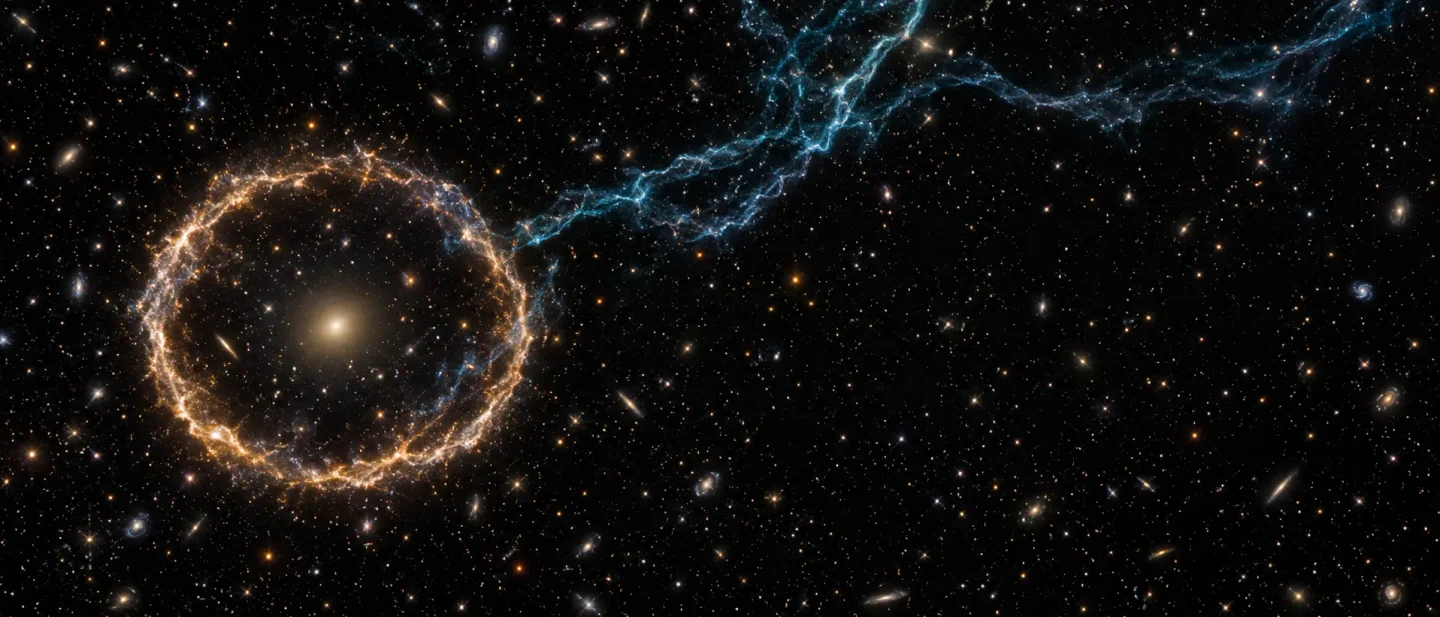
Eleven new arXiv results from October 19 to 23, 2026 follow halo outflows that record bursty star formation, a quenching threshold that stays hidden behind black hole mass scatter, and a dead jet's bubble relit into a 200 kpc radio ring.

The week of October 19 to 25, 2026 brought eleven new results on the gas that leaves galaxies, the gas that waits in their halos, and the bubbles that outlive the jets that made them. One maintained open-source package took an update; no dataset deposit for this topic appeared. The arXiv listing at this hour reaches submissions logged through Friday, October 23. Weekend submissions are announced on Monday evening and were not screened, so this edition rests on the window's first five days.
Two results set the week's range. A VLT/MUSE survey of 47 galaxies at redshift 1 finds that the velocity of their circumgalactic magnesium outflows tracks star formation measured over timescales short enough to catch individual bursts 1. Around a nearby elliptical, a LOFAR and MeerKAT map finds a 200 kpc radio ring whose spectrum can be explained by a long-dead jet's plasma being re-energised by a passing shock 2. One paper reads a record in the halo; the other reads one left behind by a bubble.
An item earns a place below when the original reports a quantitative result on gas inside, leaving, returning to, or between galaxies and halos. It must also describe a method another group could repeat and be reachable from a public link.
At a glance
| Item | Design / method | Main result | Scale or tracer |
|---|---|---|---|
| Pessa et al., circumgalactic outflows and star formation history 1 | VLT/MUSE extended Mg II halos at z ≈ 1, with non-parametric star formation histories fit to spectra and photometry | Outflow maximum velocity and radial acceleration correlate with star formation averaged over burst-sensitive timescales, and not with [O II] or parametric estimates; concentrated star formation goes with faster outflows | 47 galaxies from the MUSCATEL survey, halos extending to about 10 kpc |
| Porras-Valverde & Forbes, black hole mass and quenching 3 | Parametric toy model linking black hole mass scatter and a power-law quenching probability to the faint end of the quenched mass function | A shallow slope needs either 0.6–0.9 dex of scatter with q ≳ 2, or q ≈ 1 with scatter below 0.6 dex; above 0.6 dex the feedback prescription leaves no imprint | Quenched central galaxies across halo masses |
| Olivares et al., gas in group central galaxies 4 | MUSE integral-field spectroscopy of 17 nearby brightest group galaxies, comparing warm ionized gas with stellar kinematics | Warm ionized gas in 13 of 17; nearly half the rotating gas disks are aligned with the stars and consistent with recycling, while misaligned disks, rings and filaments need mergers, interactions or halo cooling | 17 group central galaxies within a few tens of Mpc |
| Braspenning et al., multiphase intra-cluster gas 5 | Neural simulation-based inference trained on 0.1–10 keV spectra from about 10⁵ TNG-Cluster sightlines | Recovers mass-weighted temperature to better than 0.01 dex and gas mass to 0.04 dex, and returns sub- and super-virial fractions; a cool phase is recovered at 10⁻³ of the flux | Massive clusters, M₂₀₀c = 10¹⁴·²–10¹⁵·² M☉, XRISM- and Chandra-like spectra |
| Galárraga-Espinosa et al., filaments as a sequence 6 | TNG300-1 at z = 0, ordering 5,637 filaments by linear gas mass density within the entropy radius | Filaments form one continuous thermodynamic sequence spanning two decades in density; the gaseous linear mass density function is measured for the first time; integrated Compton-y scales with it | 5,637 filaments in a 205 Mpc box, WHIM temperatures |
| Mehrotra et al., when ionizing photons escape 7 | THESAN-ZOOM radiation-hydrodynamic simulations post-processed with COLT radiative transfer at 10 Myr sampling | The escape fraction follows star formation with a lag of about 16 Myr and peak correlations of 0.4–0.6, longer at lower mass; delays scale as M★^−0.19 and M_halo^−0.27 | 13 halos at z > 3 |
| Janas et al., the DEM L36 superbubble 8 | XMM-Newton spectra with optical, infrared and 21 cm imaging of one LMC superbubble | Hot gas at 0.17 keV with L_X = 3.6 × 10³⁵ erg/s in a shell-confined bubble with two blowouts; the clusters near its rim supplied more energy than the bubble now stores | One superbubble, hundreds of parsecs across |
| Magno et al., a maser on a jet axis 9 | VLA 22 GHz spectral line and continuum imaging at 0.13 arcsec of the Seyfert 2 galaxy NGC 1106 | A water maser sits 930 pc from the radio core, 541 km/s off systemic, on the jet axis at the edge of a radio extension; the origin is an outflow–ISM interface | Nuclear region of one Seyfert, 350 pc continuum structure |
| Wang, Heinz & Tchekhovskoy, how many odd radio circles 10 | Monte Carlo population synthesis combining a stellar mass function, radio-AGN incidence, merger histories and a shock–bubble MHD grid | Predicts 2.7 detectable circles in the EMU Pilot against 3 found, and 268 in LoTSS with 7.5 expected at 1.4 GHz against 12 observed; hosts are central group galaxies | Mach 1.67–16 shocks, rings of 50–65 kpc median radius |
| Bruno, Koribalski & Norris, one ring in detail 2 | LOFAR, uGMRT and MeerKAT imaging from 50 to 1284 MHz with spectral index maps | Spectral index 1.06 ± 0.03 and P₁₅₀ = 5.4 ± 0.5 × 10²⁵ W/Hz; the ring-to-interior contrast fades at low frequency, as re-accelerated fossil plasma predicts | One ring, radius about 200 kpc |
| Genina, Wempe & Helmi, where the halo's metals come from 11 | Four constrained Local Group simulations with the Auriga model, tracking accretion channels and abundance patterns | Merger gas, pre-enriched merger gas and smooth accretion supply the reservoir in near-equal parts; mergers tilt the disc, redirect outflows and enrich a larger halo volume | Milky Way analogues to the virial radius, lookback times past 12 Gyr |
Paper briefs
Halo outflows carry the timing of recent star formation
Authors and date. Ismael Pessa, Lutz Wisotzki, Constanza Muñoz López and Tanya Urrutia with seven co-authors, submitted October 20, 2026; accepted for publication in Astronomy & Astrophysics. 1
Study design. The authors model the extended Mg II emission of 47 galaxies at redshift near 1 from the MUSCATEL MUSE survey. They fit non-parametric star formation histories to each galaxy's spectra and photometry. Then they compare outflow maximum velocity and radial acceleration with star formation rates averaged over several windows. 1
Result. Outflow kinematics correlate with star formation averaged over timescales short enough to resolve individual bursts. Rates built from [O II] luminosity or from parametric histories recover no such correlation. Galaxies whose recent star formation sits in one or a few concentrated episodes have faster outflows than galaxies forming stars evenly. 1
An attempt to time each outflow's launch from the extent and kinematics of its Mg II halo returns a correlation with the matching star formation rate no stronger than fixed-window versions. The authors read the halos as shaped by a series of bursts rather than one dominant event. 1
Why read. Wind speed is a free parameter in most feedback recipes, and the simplest choice ties it to the instantaneous star formation rate. This measures which averaging window the halo actually records. Any recipe calibrated on a smooth history will produce the wrong velocities for a bursty one. 1
Caveat. The correlations are moderate, and the outflow properties come from a model of Mg II emission, and the gas itself is unresolved. The 47 galaxies are selected by detectable extended Mg II, which biases the sample toward galaxies with strong halos. 1
A quenching threshold hides behind the scatter in black hole mass
Authors and date. Antonio J. Porras-Valverde and John C. Forbes, submitted October 19, 2026; preprint with no journal reference listed. 3
Study design. The two authors build a parametric model in which a central galaxy's chance of quenching per unit time scales as a power law of black hole mass, with index q. They vary q and the scatter in black hole mass at fixed stellar mass. They then ask what each combination produces in the faint-end slope of the quenched central galaxy mass function. 3
Result. The observed shallow slope near 0.7 can come from steep quenching with heavy scatter, 0.6 to 0.9 dex and q ≳ 2, or from gentle quenching with q near 1 and scatter below 0.6 dex. At scatter above 0.6 dex the two prescriptions converge on the same mass function. 3
Computed this way, IllustrisTNG quenches through an effectively sharp threshold with q ≈ 3–4 and scatter below 0.25 dex, producing a slope of 2.5–3. COLIBRE's temperature-dependent feedback gives q ≈ 1 and a slope of 0.7, matching the observed value. SAGE, Dark Sage and COLIBRE reach it through scatter of 2.0, 0.6 and 0.4 dex respectively. 3
Why read. It names the measurement that would separate feedback prescriptions: the observed slope leaves both prescriptions open, because a steep threshold seen through large scatter looks gentle. Measuring the scatter in black hole mass alongside the slope can rule out sharp-threshold models. 3
Caveat. The model is analytic and contains no hydrodynamics, so it tests the logic of a diagnostic rather than the physics of a simulation. Its verdict is conditional on black hole mass scatter, which current measurements leave wide. 3
In group halos, the warm gas mostly comes from somewhere else
Authors and date. V. Olivares, E. O'Sullivan and P. Temi, submitted October 19, 2026; accepted for publication in Astronomy & Astrophysics. 4
Study design. The authors observed 17 nearby brightest group galaxies with the MUSE integral-field spectrograph. They mapped warm ionized gas through Hα and [N II] and compared its morphology and rotation with the stellar kinematics. 4
Result. Warm ionized gas is detected in 13 of the 17 galaxies, 77 per cent. Its shapes range from rotating disks with and without tails to diffuse emission, rings and filaments. The stars in most of these galaxies rotate regularly, which distinguishes group centrals from brightest cluster galaxies. 4
Nearly half of the rotating gas disks share the stars' axis, which points to internal recycling. Tails, diffuse emission and rings in three aligned systems can retain signatures of past accretion or interaction. The misaligned disks, rings and most filamentary systems need gas from mergers, interactions or halo cooling. 4
Why read. Group halos sit where stellar feedback gives way to AGN feedback, and the supply routes differ between the two. This sorts 17 of them by where their gas came from, using kinematics rather than models. 4
Caveat. The sample is 17 galaxies, and origin is inferred from morphology and alignment; no abundances or ionization modelling enter the classification. Gas seen in projection can look misaligned without being misaligned in three dimensions. 4
X-ray spectra can now return the temperature distribution of cluster gas
Authors and date. Joey Braspenning, Annalisa Pillepich, Marine Prunier and Dimitris Chatzigiannakis with one co-author, submitted October 19, 2026; submitted to Monthly Notices of the Royal Astronomical Society. 5
Study design. The authors train a neural network on synthetic X-ray spectra between 0.1 and 10 keV. The training set is about 10⁵ sightlines through massive TNG-Cluster halos between 10¹⁴·² and 10¹⁵·² M☉. Inference is then tested at XRISM-like and Chandra-like spectral resolution with realistic photon noise. 5
Result. The method recovers mass-weighted temperature with an average error below 0.01 dex, for single sightlines and for whole clusters. It recovers the total gas mass within 0.04 dex and returns the fractions of sub-virial and super-virial gas. The cooler phase is recovered even when its flux contribution is three orders of magnitude below the virial phase. 5
The authors then recover the spatial distribution of the multiphase gas in both relaxed and merging systems. That step is what turns a single-temperature fit into a map of where feedback and accretion have left their gas. 5
Why read. Every claim about cool gas in a hot halo rests on a spectral fit that assumes some temperature distribution. This replaces the assumption with an inference and states its accuracy in dex, which is what a reader needs to judge published multiphase fractions. 5
Caveat. The network learns TNG-Cluster, so it inherits that model's gas physics and its biases. The spectra are synthetic, with resolution and photon noise applied but no calibration or background systematics. 5
Filaments line up on one axis, gas mass per unit length
Authors and date. Daniela Galárraga-Espinosa, Daisuke Nagai, Isabel Medlock and Mathieu Langer with two co-authors, submitted October 19, 2026; preprint. 6
Study design. The authors measure 5,637 cosmic filaments in the TNG300-1 simulation at redshift 0. They define a filament's linear gas mass density as its gas mass divided by its length, taken inside a radius set by the peak of the entropy profile. They then order structural, thermodynamic and chemical properties against it. 6
Result. Filaments form one continuous sequence across more than two decades of that density. Long, thin, cool, metal-poor filaments give way to short, wide, hot, enriched ones. Core temperatures span two orders of magnitude, covering the full warm-hot intergalactic range. 6
The ratio of mass-weighted to volume-weighted temperature changes along the sequence. In low-density filaments the hotter gas sits in the denser material. In high-density filaments the hotter gas is the diffuse component. 6
The paper reports the first measurement of a gaseous linear mass density function, flat at low density and falling steeply at high density. Integrated Compton-y scales with the density parameter, which makes it a proxy current surveys can reach. Galaxy richness per unit length correlates with it at r = 0.80. 6
Why read. Both the missing-baryon census and any claim that feedback has enriched the intergalactic medium need filaments grouped by something physical. This gives that grouping and shows which observable follows from it. 6
Caveat. One simulation at one redshift supplies every number, and the ordering parameter is defined through a measured entropy radius. No observational test of the density function is presented. 6
Ionizing photons escape when a burst is fading
Authors and date. Parth Mehrotra, Aaron Smith, Yuan Bian and William McClymont with twelve co-authors, submitted October 21, 2026; preprint. 7
Study design. The authors take thirteen halos at redshift above 3 from the THESAN-ZOOM radiation-hydrodynamic simulations. They post-process them with the COLT radiative transfer code and sample the output every 10 Myr. They then cross-correlate escape fractions with star formation rates averaged over different windows. 7
Result. The clearest delayed relationship links the ratio of star formation over 10 Myr to that over 100 Myr with the escape fraction. The nearest positive correlation peaks at lags of about 16 Myr, with coefficients of 0.4 to 0.6 in massive halos. Lower-mass halos show longer and less coherent delays. 7
Fitted delays scale with stellar mass as M★^−0.19 and with halo mass as M_halo^−0.27. The shortest lags approach the 10 Myr snapshot spacing. Recurrent variability spans several timescales set by amplitude, consistent with repeated bursts. 7
The Hα to ultraviolet luminosity ratio keeps a delayed association with escape, which offers observers a way to test the timing. High transparency during a fading phase can still yield little escaping radiation. 7
Why read. Reionization budgets multiply a galaxy's ionizing output by an escape fraction that is usually treated as a constant of its mass. This says escape is set by where the galaxy sits in its own burst cycle, which changes what a stack of many galaxies measures. 7
Caveat. Thirteen halos from one simulation suite carry the result, and the peak correlations are moderate. The fitted lags sit close to the sampling interval at the low-mass end, where they are least constrained. 7
A superbubble holds less energy than its stars supplied
Authors and date. Pawel M. Janas, Patrick J. Kavanagh, Manami Sasaki and Miroslav D. Filipović with five co-authors, submitted October 22, 2026; accepted by Astronomy & Astrophysics. 8
Study design. The authors combine XMM-Newton spectra of the DEM L36 superbubble in the Large Magellanic Cloud with optical emission-line imaging, Spitzer infrared data and 21 cm radio data from the Australia Telescope Compact Array. They fit a thermal plasma model to the X-ray emission and compare the stored energy with the mechanical input computed from cluster photometry. 8
Result. The X-ray emission is confined to a central bubble bounded by a thin Hα shell, with blowouts to the east and west and a possible smaller one to the south. The plasma fits collisional ionization equilibrium at kT = 0.17 keV, with a range of 0.16 to 0.18, and an unabsorbed 0.5–7 keV luminosity of 3.6 × 10³⁵ erg/s. 8
No cluster sits at the centre, which sets this bubble apart from other Large Magellanic Cloud superbubbles. Small clusters near the rim are supplying the mechanical input now. Over their lifetimes those clusters supplied more energy than the bubble currently stores, the mismatch known as the growth-rate discrepancy. 8
Why read. A superbubble is the smallest system where both the energy going in and the energy coming out can be estimated. Here both numbers exist and they disagree, and the blowouts show one route by which the difference leaves. 8
Caveat. Cluster masses and ages come from photometry, and the energy comparison inherits their uncertainty. One object with no central powering cluster, and a geometry that the blowouts have already deformed, limits how far the accounting generalises. 8
A water maser marks where a jet meets its galaxy's gas
Authors and date. Macon Magno, Emmanuel Momjian, Krista L. Smith and O. Ivy Wong with three co-authors, submitted October 22, 2026; accepted to the Astrophysical Journal. 9
Study design. The authors observed the Seyfert 2 galaxy NGC 1106 with the Very Large Array in its A configuration at 22 GHz, resolving structures down to 0.13 arcsec. They imaged both a water maser line and the radio continuum, then compared the maser's position with the jet axis and with the edge of the radio structure. 9
Result. The maser is a tentative detection at 3763 ± 14 km/s, offset by 541 km/s from the galaxy's systemic velocity. It sits 930 pc from the radio core, on the axis of the radio structure, at the boundary of a radio extension. The 22 GHz continuum reveals a 352 pc structure within the nucleus. 9
Position, velocity offset, flux density and alignment with the jet together favour an origin at the interface between the AGN outflow and the host galaxy's interstellar medium. The authors reach that by comparing this maser with known star-forming and AGN-driven masers. 9
Why read. It puts a marker on the surface where a jet's energy is handed to cold gas in a Seyfert galaxy, at a scale where the coupling can be resolved. It also carries a warning: single-dish maser spectra that mix a disk component with a shock component will overestimate black hole masses. 9
Caveat. The detection is tentative and rests on one epoch of observations. The authors state that higher spatial and spectral resolution, with supporting multiwavelength data, is needed to settle the origin. 9
Dead jets can account for the number of odd radio circles
Authors and date. Yiting Wang, Sebastian Heinz and Alexander Tchekhovskoy, submitted October 23, 2026; preprint. 10
Study design. The authors build a Monte Carlo population of galaxies from a stellar mass function, assign radio-AGN activity and halo masses from local scaling relations, and follow each halo's merger history. They inflate AGN bubbles, track whether each survives until a merger shock reaches it, and draw its radio properties from a grid of magnetohydrodynamic shock–bubble simulations spanning Mach 1.67 to 16. Survey selection is then applied to the EMU Pilot at 944 MHz and LoTSS at 144 MHz. 10
Result. The model predicts 2.7 detectable odd radio circles in the EMU Pilot, with an uncertainty range of 3.9 up and 1.6 down, against the three reported there. It predicts 268 in LoTSS, of which 7.5 should also be detected at 1.4 GHz against 12 observed. One population of fossil bubbles reproduces both surveys once frequency, resolution, noise and area differ. 10
The hosts are mostly central galaxies in group-scale halos, with median halo masses near 10¹³·⁴ M☉. Survey selection raises the central fraction from 39 per cent of all bubbles to 58 per cent for EMU and 62.5 per cent for LoTSS. Detectable rings have median radii of 49.9 kpc and 65 kpc, and median redshifts of 0.09 and 0.14. 10
Why read. It converts a puzzling class of radio ring into a predicted population with numbers that upcoming surveys can confirm or falsify. It also makes the ring a fossil record of an earlier jet episode, which is what a feedback cycle looks like after the jet has stopped. 10
Caveat. The model reproduces the angular sizes of observed rings but places them at lower redshift than the putative central galaxies imply. The prediction depends on assumed jet powers and on the survival of bubbles against buoyancy and mixing. 10
One ring's spectrum fits a fossil plasma set alight again
Authors and date. L. Bruno, B. Koribalski and R. P. Norris, submitted October 22, 2026; resubmitted to Astronomy & Astrophysics after a referee report. 2
Study design. The authors imaged the odd radio circle J1555+2726 with LOFAR, the upgraded Giant Metrewave Radio Telescope and MeerKAT between 50 and 1284 MHz. They measured an integrated spectrum and built spectral index maps across the ring, correcting the low-frequency images for the primary beam response. 2
Result. The integrated spectrum has a slope of 1.06 ± 0.03, and the source has a radio power of 5.4 ± 0.5 × 10²⁵ W/Hz at 150 MHz. The ring sits at radii of roughly 75 to 175 kpc around a massive central elliptical, with an overall radius near 200 kpc. 2
The brightness contrast between ring and interior smooths as observing frequency falls. Brightness rises across the ring at 675, 1260 and 1284 MHz but stays flat at 143 MHz, and fades at all frequencies beyond 175 kpc. 2
The authors read this as electrons of different spectra filling the source together. Higher-energy electrons re-accelerated at the shock front dominate the ring, while lower-energy ones spread across the whole volume. The reservoir they came from is fossil plasma left by earlier jet activity. 2
Why read. This is the spectrum the population model above predicts, measured in one object. Read side by side, the simulation says how many such rings should exist and this says what one looks like when the shock has passed through it. 2
Caveat. The evidence is spectral: the re-acceleration case rests on the index structure and on how the contrast smooths at low frequency. Primary-beam models remain uncertain at the largest radii, which is where the outer profile is measured. 2
A merger can point a galaxy's outflows somewhere new
Authors and date. Anna Genina, Ewoud Wempe and Amina Helmi, submitted October 20, 2026; submitted to Monthly Notices of the Royal Astronomical Society. 11
Study design. The authors run a suite of constrained cosmological magnetohydrodynamic simulations of the Local Group with the Auriga galaxy formation model, producing four Milky Way analogues with the right masses, separations and local Hubble flow. They follow where each galaxy's gas came from and how the resulting stellar abundances are arranged. 11
Result. Three channels supply the gas reservoir in nearly equal parts: gas delivered by mergers, gas enriched by mergers before it reached the halo, and smoothly accreted gas. Smooth accretion dominates before 9 to 10 Gyr ago, when the galaxies assembled quickly in dense environments. 11
The smoothly accreted gas was never bound to a halo, so it arrives metal-poor and with high alpha-element abundance. It dilutes the metallicity of the circumgalactic medium and supplies the material for later metal-poor star formation. 11
Why read. The paper shows how a merger changes more than the star formation rate. A merger can tilt the disc and thereby change the direction of galactic outflows, which enriches a larger volume of the halo. That gives a low scatter in [alpha/Fe] at large radii, which is one of the features the Milky Way's own bimodality requires. 11
Caveat. Four analogues from one constrained realisation set and one feedback model carry the result. The match to the Milky Way's abundance pattern is qualitative. The gas channels are counted inside the simulated halo. 11
Code and data releases
rbcodes, a CGM analysis package, gained a turbulence module. The repository rongmon/rbcodes collects codes for analysing circumgalactic medium observations under an MIT licence. Two commits landed this week: a merge on October 20 that added a turbulence calculation, and an update to the repository's literature search tool on October 22. 12 No new version tag accompanied them; the latest release remains v1.0.0 from June 2025. 12
No dataset release was verified for this window. Searches of Zenodo between October 19 and 26, by keyword and by publication date, returned no deposit connected to circumgalactic or intergalactic feedback physics. No qualifying deposit appeared in the window, so the category stays empty.
What the week separates
- Outflow speed follows burst history more closely than instantaneous star formation. The Mg II halos at redshift 1 correlate with star formation averaged over burst-sensitive windows, and lose that correlation when it is averaged over long ones 1. The Local Group simulations add a second control: a merger can reorient the disc and send the outflows into fresh volume of halo 11. Two knobs, timing and geometry, neither of which appears in a recipe that ties wind speed to the star formation rate of the moment.
- The discriminating measurement is usually harder than the effect. The quenched mass function's slope cannot choose between a sharp feedback threshold and a gentle one, because scatter in black hole mass above 0.6 dex erases the difference 3. Multiphase fractions in cluster gas have depended on the temperature distribution a fit assumed, and are now recoverable at 0.01 dex from spectra that already exist 5. Both papers describe which observable would settle a question, and in both cases it is one that current surveys cannot yet supply everywhere.
- The hot phase holds only part of what feedback delivered. In the DEM L36 superbubble the clusters near the rim have supplied more energy over their lifetimes than the bubble currently stores 8. Two studies of odd radio circles show where some of that energy can go instead: into a fossil bubble that survives long enough for a later merger shock to relight it, in numbers that match the surveys that found them 210. The NGC 1106 maser adds a third sink, an interface where a jet's outflow is depositing energy into cold gas 930 pc from the nucleus 9. Energy stored, energy radiated and energy handed to cold gas are three separate accounts.
- The same question is being asked at four different scales, and the answers are not interchangeable. Filaments in a 205 Mpc box form a sequence in gas mass per unit length, with a Compton-y proxy attached 6. Group centrals are sorted by whether their warm gas was recycled or acquired 4. Cluster sightlines carry a recoverable multiphase temperature distribution 5. And at high redshift, the ionizing output a galaxy sends into the intergalactic medium depends on where it sits in its burst cycle 7. A constraint at one scale says which gas is present there, and it does not carry over to the next.
Also noted
Five papers in the window bear on the topic without meeting the bar for a brief. A density-split version of the pairwise kinetic Sunyaev-Zel'dovich measurement separates converging and diverging flows, and forecasts improvements of 11 and 4 in σ₈ and Ω_m for DESI with the Simons Observatory large-aperture telescope 13. The DARWIN suite of cosmological simulations reaches 62.5 pc in zoom regions and includes three-band radiative transfer, giving a dwarf-galaxy test bed in which feedback efficiency and resolution effects are separated 14. The kiloparsec-scale jet of the z = 6.1 AGN PSO J0309+2717 is resolved by Chandra into two X-ray components with a steeper spectrum than the core and 18 per cent of its luminosity, which describes a jet's own emission rather than its effect on the halo 15. Mid- and far-infrared fine-structure lines in 67 luminous infrared galaxies show ionization parameters falling with radius once far-infrared diagnostics are included, which matters for anyone inferring an AGN's reach from mid-infrared maps alone 16. A catalogue of cosmic filaments built from COSMOS-Web Data Release 1 across 0.5 < z < 3.5 supplies the observational counterpart the simulated filament sequence above will need 17.
References
- 1
- 2
- 3
- 4
- 5
- 6
- 7
- 8
- 9
- 10
- 11
- 12
- 13
- 14
- 15
- 16
- 17
This story was produced automatically by a channel. One sentence is all it takes for Neodrop to keep producing for you.