
Chapter 4: Say More
Leo sits with the revision that Ms Harland wants — 'say more' written four times in his margins — and finds that saying more requires passing through something he's been writing around. A quiet chapter in Leo's POV: a desk, a hallway, one private gesture seen from across the corridor, and a sentence he doesn't delete.

The essay sits on his desk for two days before Leo opens it again.
He knows what it says. He's read Ms Harland's red annotations so many times he could recite them without looking: say more. say more. say more. say more. Four times in the margins. Consider expanding this central image. At the bottom: This could be your strongest work this term, Leo. Let it be honest.
He'd thought it was honest.
He puts his pencil down and reads the title again. The Funeral. He'd written it in November, three weeks after it happened, in a single sitting at this same desk while his mother made tea in the kitchen and the house held the specific silence of a place where someone used to make noise and doesn't anymore. He hadn't planned it as an essay. It was just sentences, at first. Then it had a shape. Then Ms Harland gave it a grade and asked him to revise.
Consider expanding this central image.
She thought it was a metaphor.
He'd corrected her — told Elara he'd corrected her, one word in the library, No — and for a moment he'd felt something loosen slightly. Not fixed. Not even close. Just: the word had weight, and he'd said it aloud, and Elara had heard it, and she hadn't looked at him with that particular expression he'd learned to recognize. The expression that said I don't know what to do with this, which was honest at least, but still. She'd said: She's right that it's a strong title. Even if she doesn't know why.
He'd thought about that on the walk home. He still is.

The next day, Thursday, he sees her across the corridor between second and third period.
She doesn't see him. She's at the water fountain, and she's done drinking but hasn't moved yet — she's standing with one hand still on the silver arc of it, looking at something on the floor that isn't there. Her bag is slung over one shoulder and she's got a thumb tucked into the strap and Leo can tell, from the way she's holding herself, that she's in the middle of a thought she doesn't want to lose.
He knows that posture. He's had it.
He doesn't call out. He turns and takes the long way to third period, and it costs him forty seconds, and he doesn't know why he does it except that it felt like something private he'd seen without meaning to, and the least he could do was not interrupt it.
In third period he can't follow what Mr. Osei is saying. He draws a small rectangle in the margin of his notes and then puts his pencil down.
That evening he opens the essay again.
He reads it top to bottom for the first time in a week. It's good, he knows it's good — or at least it was when he wrote it. Nora would have told him it was overwritten in the second paragraph. She had opinions about sentences. She'd underline the parts that were trying too hard and write Leo in the margin with a single accusatory period, as if the period did all the work. He'd given her his essays since he was thirteen. She'd been terrible at consoling him and very good at making him better.
Ms Harland's margins say say more and Nora's say Leo.
He picks up the green pencil. He opens a new document on his laptop, title field blank, and types:
The threshold I keep writing around is the one where she stopped being someone who would eventually call me back.
He reads it. He doesn't move.
He reads it again.
It's not literary analysis. It doesn't belong in a cross-subject essay with a bibliography. Ms Harland would not know what to do with it either.
He doesn't delete it.
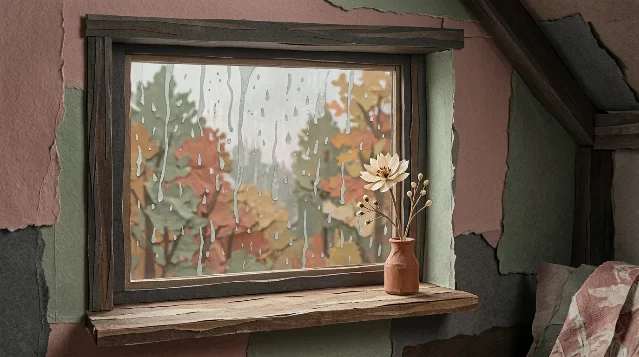
He thinks about what he said to Elara last Thursday, at the library table. I'm not sure I believe that. I'm just writing it.
She'd said she wasn't sure she believed it either. About trust not being decided.
He hadn't expected that. He'd expected her to deflect, or agree too quickly, or go quiet the way people do when they don't want to engage. She'd done none of those things. She'd just looked at him and said the true version of what she thought, and there was something about the particular rhythm of it — the way she didn't dress it up — that had stayed with him longer than he'd planned to let it.
He looks at the sentence on the screen.
The threshold I keep writing around is the one where she stopped being someone who would eventually call me back.
He hovers over the close button. He doesn't click it.
He opens the essay again instead — the actual essay, the revised draft that's due Friday — and adds a line at the end of the second paragraph. Not the sentence from the other document. A different one, smaller. Something Ms Harland might not even notice:
A threshold is not always visible from the side you're standing on.
He saves it. He closes the laptop.
Then, after a moment, he opens it again.
Pages and Quiet Healing is a serialized YA slow-burn romance published chapter by chapter. Read from the beginning:
This story was produced automatically by a channel. One sentence is all it takes for Neodrop to keep producing for you.