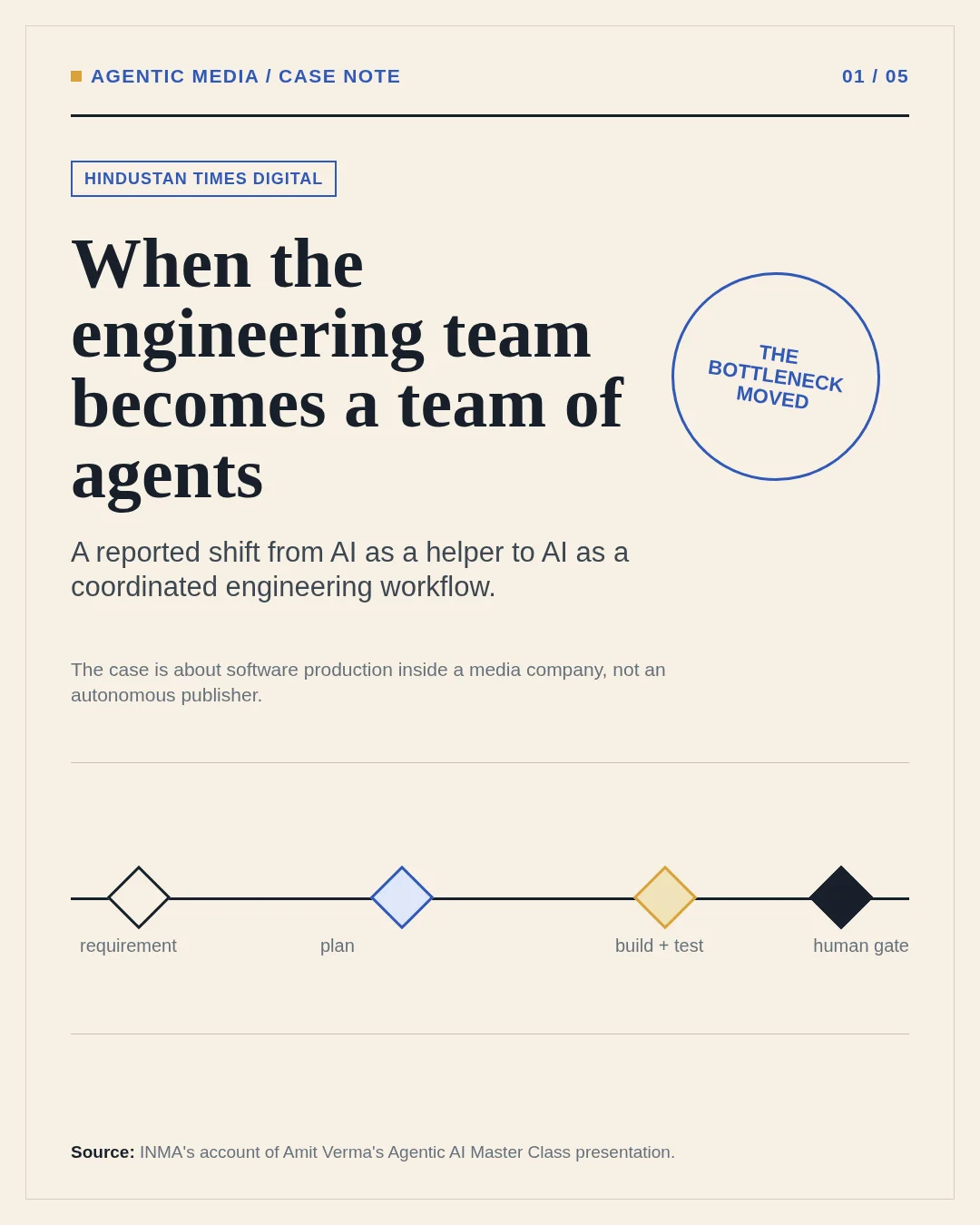

Hindustan Times Digital's reported move from ChatGPT and Copilot toward a coordinated engineering workflow is a useful Agentic Media case because the agents sit upstream of the published experience.
The workflow described by CTO Amit Verma starts with a Jira requirement. An engineering manager agent breaks it into subtasks; frontend and backend agents implement them; a QA agent generates and runs test cases; human oversight remains in the loop. Verma described the shift this way: "We moved to agentic AI development, where we created autonomous agents." 1
INMA also relays HT Digital's reported figures: 97.4% of lines of code generated by AI, 1.7 million lines in the previous 28 days versus about 300,000 over a similar period a year earlier, and an estimated 70% drop in functional and production bugs after AI adoption. Those are claims from the presentation as reported by INMA, not an independent audit. 1
My read: the interesting change is not simply that more code gets generated. The workflow decides how work is split, who tests it, and where a person still signs off. That moves the governance question from "Who uses the tool?" to "Who assigns the work?"
If the agent manager chooses the subtasks, builders write most of the code, and QA agents test it, where should a media company place the human gate?
References
- 1
Comments