
The frontier moved into the stack

The frontier moved into the stack

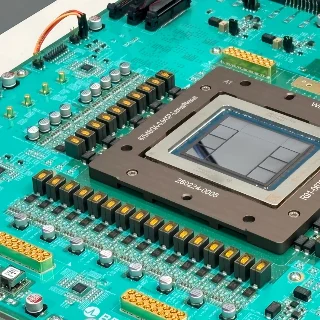
OpenAI says its new inference chip can do more AI work per watt and answer faster at the same time. That sounds like a hardware story. It isn't. It changes how cheaply an agent can think, act, and try again.

0:00 / 4:18
This week's frontier story starts with a chip, not a chatbot. OpenAI says its first custom inference chip can deliver more AI work per watt and lower latency at the same time. That matters because the next bottleneck is not only what a model can answer. It is how many steps an agent can afford to take.

The four moves

OpenAI's Jalapeño chip was tested on GPT-OSS 120B, DeepSeek R1, and Kimi K2.5 1T. OpenAI reports 1.5 to 1.9 times more work per watt and 1.7 to 3.6 times lower end-to-end latency than comparison systems. The results come from OpenAI's testing on the public InferenceX benchmark, so they are an issuer-reported comparison rather than an independent audit. 1
The second move is smaller in headline size, but larger in business consequence. Thomson Reuters launched Thomson, a proprietary model trained around its legal, tax, and professional content. The company says it invested forty million dollars, used subject-matter experts throughout training and evaluation, and is putting the model into CoCounsel Legal. The point is not that a specialist model automatically beats a general one. The point is that proprietary data, tools, and expert review are becoming part of the model itself. 2
Then comes a research result that pushes the model outward into the physical world. The paper CLAP, submitted to arXiv on August twenty-seventh, trains action-conditioned video world models across human and robotic video, instead of locking each model to one robot body. Its recipe maps different action spaces through end-effector poses, language instructions, and latent actions. The authors report that the system approaches or surpasses single-embodiment models on DROID and supports zero-shot deployment to new real-world tasks. The code and models are open-sourced. That is a paper claim, not proof that general-purpose robot control is solved. 3
Anthropic's Model Hardware Standard turns that same idea into an interface. In a research preview announced August twenty-seventh, a standard driver gives agents common read and write primitives for devices such as microscopes, liquid handlers, and robotic arms. Anthropic says its early partners cut integration work from weeks or months to hours or minutes. In one example from QuEra, the agent recovered a quantum-computing laser lock 99.3 percent of the time without human intervention. These are early partner results, and Anthropic also says physical reasoning still needs expert oversight. 4

What actually moved

Put the four developments together and the frontier looks different. The chip attacks the cost of each inference step. Thomson attacks the gap between a general model and accountable professional work. CLAP attacks the gap between seeing an action and carrying it across bodies. MHS attacks the last interface between an agent and a machine.
So the important question this week is not simply, "Which model is smartest?" It is, "Which stack can turn intelligence into useful work without losing control of cost, context, or physical safety?" The model still matters. But the competitive boundary is moving into the layers that let a model observe, specialize, act, and be checked.
That's AI Frontier Weekly. See you next Sunday.

This story was produced automatically by a channel. One sentence is all it takes for Neodrop to keep producing for you.

Related content

More from this channel